 Historical Figure MBTI
#662 · 5-14-26 · The Five Good Emperors
Antoninus Pius
The Steward Who Kept the Peace
86 — 161 CE
6 min read
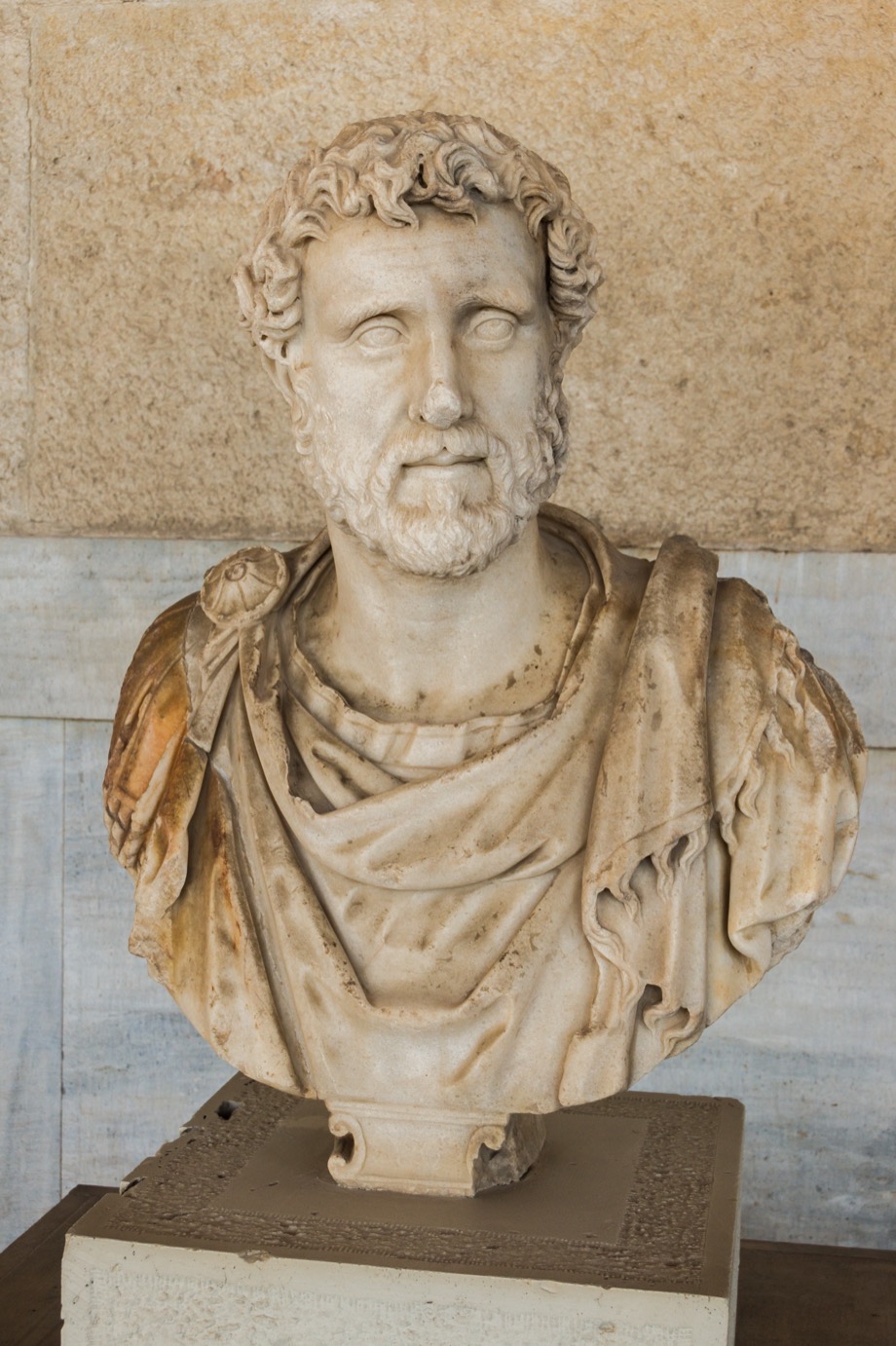
Portrait of Antoninus Pius
Twenty-Three Years, No War, No Ego
Antoninus Pius ruled the Roman Empire for twenty-three years and never once left Italy. He fought no personal campaigns, laid no triumphal arches to his own name, and left behind no monument on the scale of Hadrian's Wall or Hadrian's Pantheon. What he left instead was a treasury fuller than the one he inherited, frontiers that held without a single major war, and a reputation — earned in his own lifetime, from the Senate that gave him his name — for absolute, unglamorous reliability. He is, by a wide margin, the least dramatic of Rome's emperors, and that is exactly the point.
Born in 86 CE to an established senatorial family near Rome, he spent decades doing the patient, procedural work of Roman administration — consul, then proconsul of Asia — before Hadrian, dying childless and unloved by the Senate, adopted him in 138 CE on one condition: that Antoninus adopt in turn both Marcus Aurelius and Lucius Verus, securing two future successions in a single stroke. Antoninus accepted the arrangement as he accepted most things, without visible ambition and without complaint, and then governed the empire for over two decades from his desk — by letter, by legal ruling, by delegation to governors he trusted and rarely needed to correct. He is ISTJ, and the case is almost embarrassingly clean: a man who mistook duty for destiny, and made it work.
Antoninus Pius governed an empire the way a good steward manages an estate he did not build and does not intend to squander — by precedent, by patience, and by refusing every temptation to make the job about himself. That is ISTJ Si, dominant and unbothered, running the whole machine.
The Name He Earned by Defending the Dead
The honorific “Pius” was not flattery — it was a description of a specific act. When Hadrian died in 138 CE, the Senate, which had grown to loathe him in his final, paranoid years, moved to refuse him the customary deification and strike his memory from honor. Antoninus fought them on it, publicly and at some personal cost, until the Senate relented. This was not sentiment for its own sake. It was Si: a bone-deep conviction that continuity, precedent, and the honoring of what came before are not optional decorations on power but the thing that makes power legitimate at all. Hadrian had made him emperor; the office demanded that Hadrian be honored, however inconvenient that was to the men now around him.
That same instinct shaped every frontier decision of his reign. Antoninus did not reinvent Hadrian's defensive architecture — he maintained it, extended it cautiously in Britain with the Antonine Wall, and otherwise left the empire's edges alone, run by governors executing policies already in place. Ancient sources record him settling provincial disputes almost entirely by correspondence, never inspecting a frontier he could instead read a report about. This is not laziness; it is a dominant function that finds its authority in what is established and tested, and treats the untried with suspicion rather than appetite.
An Empire Run From a Desk in Rome
No emperor of the high empire governed more territory with less personal movement. Antoninus never commanded an army in the field, never toured a legionary camp, never set foot outside Italy after his accession — and the empire, remarkably, did not need him to. Taxation, provincial appeals, disputed successions in client kingdoms, legal questions referred up from governors across three continents: all of it came to him as correspondence, and all of it went back out the same way, decided with the same unhurried, procedural care. This is auxiliary Te doing exactly what it does best in service of a Si-led personality — not innovating, not seizing initiative, but building and running a system reliable enough that the man at the center of it barely needs to leave his chair.
The clearest proof is the one that outlives every anecdote: the treasury. Where most long reigns drain a fiscus through war, building, or largesse, Antoninus left his successors a substantial surplus, the product of two decades of careful, boring fiscal management rather than any single dramatic reform. He raised no ambitious new taxes and started no wars to pay for; he simply spent less than the empire earned, year after year — a discipline so unremarkable that ancient historians struggle to narrate it as anything but a list of things that did not happen.
Why ISTJ Over ISFJ
Why not ISFJ?
ISFJ would frame the same behavior as warmth — a caretaker's devotion driving the loyalty to Hadrian's memory and the patient handling of petitioners. But the best evidence we have for Antoninus's inner life is not warm at all: Marcus Aurelius, writing privately in the Meditations with no audience and no reason to flatter, praises his adoptive father's steadiness, his refusal to be rushed, his imperviousness to flattery, and his procedural fairness to petitions — competence and consistency, not emotional attunement. Marcus does not describe a man who felt his way through decisions; he describes a man who worked through them, methodically, by the book. That is Te-flavored duty to system and precedent, not Fe-flavored personal care.
Marcus's testimony is doing the deciding here, and it is unusually good evidence — a son writing for himself alone about the man who shaped him. What survives is not a portrait of tenderness but of discipline: patience with tedious business, indifference to superficial glory, and an equanimity that reads less like feeling and more like a settled operating principle. That is ISTJ, not ISFJ — Si holding the line, Te running the machine, and nothing about the record asking us to read warmth into what was, by every account, competence.
Connected Figures
Further Reading
- Meditations, Book 1 — Marcus Aurelius (trans. Gregory Hays, 2002)The primary source for Antoninus's character — a private tribute from the son who knew him best.
- Life of Antoninus Pius — Historia Augusta (trans. David Magie)The chief ancient biographical source, patchy but essential for the reign's chronology.
- Marcus Aurelius: A Biography — Anthony Birley (1966, rev. 1987)Covers the Hadrianic succession and Antoninus's role in it in careful detail.
- The Antonines: The Roman Empire in Transition — Michael Grant (1994)Places Antoninus's stewardship within the broader arc of Antonine-era Rome.
