 Historical Figure MBTI
#658 · 5-13-26 · The Five Good Emperors
Trajan
Optimus Princeps · Builder of the Widest Rome
53 — 117 CE
7 min read
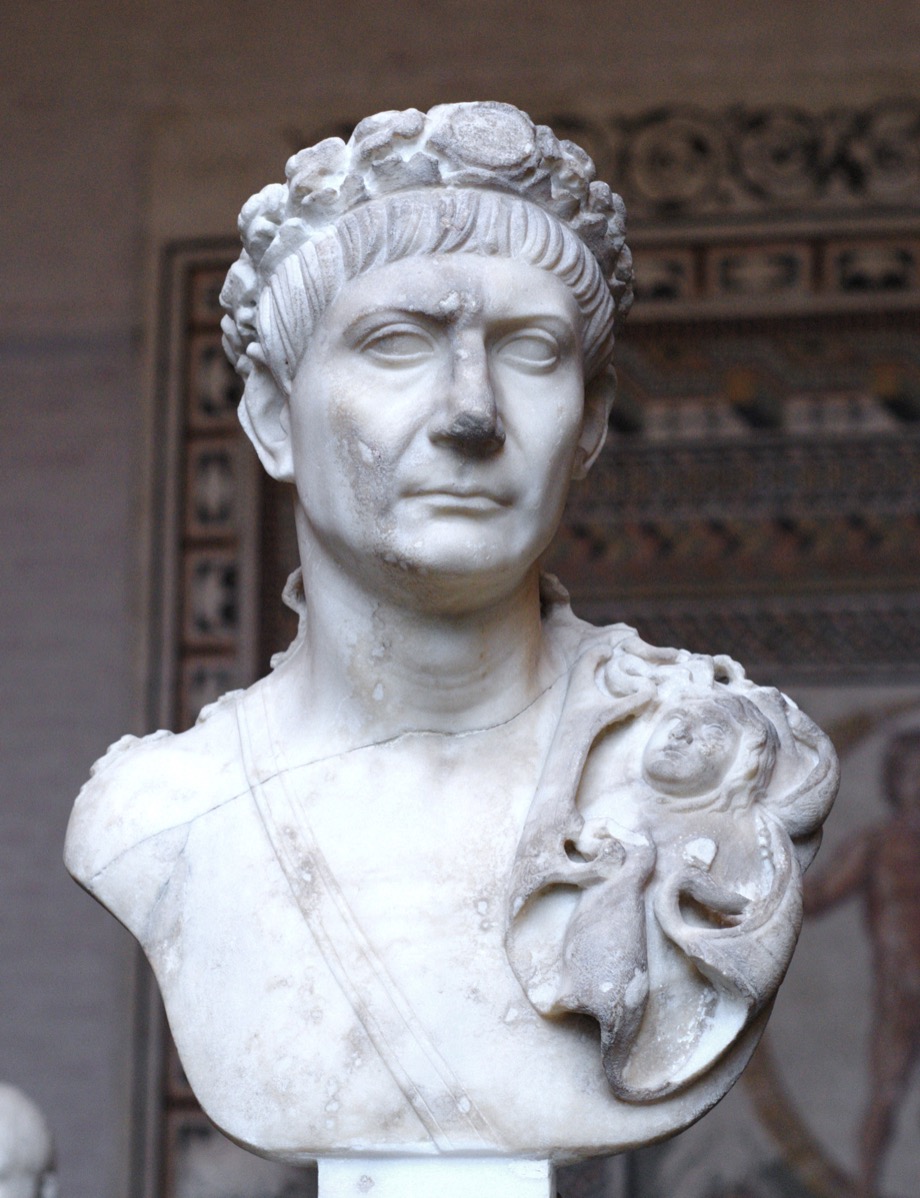
Portrait of Trajan
The Emperor Who Answered His Mail
The Roman Senate invented a title for him: optimus princeps, the best ruler. For three centuries afterward, new emperors were saluted with the wish that they might be luckier than Augustus and better than Trajan. It is a strange superlative for this particular man, because nothing about him was visionary. He wrote no philosophy, as Marcus Aurelius would; he did not restyle the empire's frontiers into a theory of limits, as Hadrian did. What Trajan had was competence — sustained, unglamorous, immense — applied for nineteen years without a visible lapse of attention.
He came from Italica in Hispania, near modern Seville: the first emperor born outside Italy, and a career soldier long before he was anything else. He commanded legions under Domitian and survived that reign with his reputation intact. When the elderly Nerva was cornered by a mutinous Praetorian Guard in 97, he reached for the man the army would accept and adopted him. Trajan inherited a throne that had nearly collapsed twice in three years, and rescued it not with charm or a program but by administering it properly. That instinct — to meet crisis with procedure, and to treat the state as a machine whose parts can be inspected and made to work — is the whole of the man.
Trajan is the archive's cleanest case of dominant ESTJ Te — a ruler who was called the best not for what he imagined, but for what he organized.
Government by Correspondence
Around 111 CE, Trajan sent Pliny the Younger to Bithynia-Pontus as a special governor, and the file of their letters survives — the only extended two-way exchange between a Roman emperor and a working official that we have. It is the most revealing document about Trajan's mind, and it is almost entirely about paperwork: an aqueduct at Nicomedia that has swallowed money without producing water, a theatre with cracking foundations, a proposed fire brigade of 150 men, and a group of Christians Pliny does not know how to prosecute.
Trajan's replies are short, dry, procedural. On the fire brigade he says no: associations of any kind become political clubs; buy equipment instead and let property owners use it. On the Christians he refuses a general rule — they are not to be hunted out, anonymous denunciations are to be ignored as setting a bad precedent, and only the formally accused who refuse to recant are punished. He is not solving a theological question. He is defining a procedure narrow enough that a hundred governors can apply it without writing to him again. That is extraverted Thinking at its natural altitude: not the truth of the matter, but the rule that produces consistent outcomes down a chain of command.
The same reflex shows everywhere. He audited Greek cities that had bankrupted themselves on public building. He organized the alimenta, a system of state loans to Italian landowners whose interest funded child support in their districts — a scheme that survives because it was carved onto a bronze tablet at Veleia, itemized farm by farm. A man ruling by vision leaves manifestos; a man ruling by Te leaves ledgers, procedures, and infrastructure, and Trajan left all three in quantity.
The Machine He Was Handed
Trajan invented almost nothing. Nearly every instrument of his reign was already in the toolbox: the alimenta had been begun under Nerva; the frontier army, the roads, and the fiscal machinery were Domitian's, inherited whole from a man whose memory the Senate had officially damned. Trajan took the apparatus of a hated regime, kept the parts that worked, and changed only the manner of their use — refusing Domitian's dominus et deus, deferring publicly to the Senate, ending the treason trials, while running the same empire on the same rails.
Introverted Sensing here is not nostalgia; it is the conviction that the tested thing is the safe thing and that novelty is a cost to be justified. His constitutional posture was consciously Augustan — first citizen, not master — and he made the archaism visible, entering Rome in 99 on foot and greeting senators by hand. Even his answers to Pliny reach for precedent first: what was done before, what the city's founding charter says, what the previous governor authorized. He was not building a new Rome; he was maintaining the existing one to a standard nobody had held it to in decades.
The Map Kept Getting Wider
The Dacian Wars — 101–102 and again 105–106 — were not defensive. Decebalus's kingdom north of the Danube was a humiliation dating to Domitian's reign, but Trajan did not merely punish it; he annexed it, colonized it, and emptied its gold mines into the treasury. That bullion paid for the Forum of Trajan, the Markets, and the Column, whose spiral relief narrates the campaign in near-documentary detail. Conquest and construction are one act: a system extended outward, then converted into stone at home.
Tertiary Ne shows in what he did with success — he kept enlarging the frame. In 113 he went east against Parthia, annexed Armenia, took Ctesiphon, organized Mesopotamia as a province, and reached the Persian Gulf, where Cassius Dio has him watching a ship set out for India and regretting he was too old to follow Alexander. Rome has never been larger, before or since.
And that is where a tertiary function shows its limits. The eastern conquest was wide but shallow; revolt broke out behind him almost immediately, and Hadrian abandoned the new provinces within months of inheriting them. Trajan's expansiveness was real, but it ran ahead of what his administration could consolidate — the one place where the great organizer let ambition outpace the machine.
Known by Name
The affection Trajan attracted is the hardest thing about him to explain from the letters alone. He was, by every ancient account, personally accessible: he ate with his officers, marched on foot with the column, was said to know the names and service records of common soldiers, and tore up his own clothing for bandages when the dressings ran out in Dacia. Handing the Praetorian prefect his sword, he is supposed to have said: use it for me if I rule well, and against me if I do not.
None of this is warmth in the extraverted-Feeling sense — he was no manager of mood, and the letters are free of flattery in either direction. It reads instead like inferior Fi: a private, unelaborated code about how a man in his position ought to conduct himself, expressed through conduct rather than sentiment. He refused divine honors in life. He walked. He answered his governor's questions himself, in his own dry voice, for years.
It is also the thinnest register in him — his grief and his loyalties are largely invisible to us. What the Romans loved was not a personality but a bearing.
Why ESTJ Over ESTP
Why not ESTP?
The soldier-emperor is an ESTP silhouette: a career officer, popular with the legions, hands-on in the field, crossing the Danube at the head of his own army. But ESTP is a tactical type — read the situation, seize the opening, improvise, and lose interest once the moment passes. Trajan's defining work is the opposite: nineteen years of methodical follow-through, a decade-long building program executed to plan, and a correspondence in which the emperor patiently builds durable procedure out of one small administrative mess after another. The Dacian gold is the ESTP part of the story; what he did with it for ten years afterward is not.
The distinction is exactly what separated Trajan from the emperors before him. Rome had seen decisive men — men who could win a battle, seize a moment, hold a crowd. What it had not seen in a long time was a ruler who would sit down with a provincial audit. The title optimus princeps was not awarded for a victory; it was awarded for reliability, and reliability is a Te virtue.
Connected Figures
Further Reading
- Letters, Book 10 — Pliny the Younger (trans. Betty Radice)The governor-and-emperor correspondence from Bithynia-Pontus — the closest thing antiquity left us to Trajan's own administrative voice.
- Trajan: Optimus Princeps — Julian BennettThe standard modern biography (1997, rev. 2001), strongest on the army career, the Dacian campaigns, and the building program's finances.
- Roman History, Book 68 — Cassius Dio (trans. Earnest Cary)The principal ancient narrative of the reign, including the Parthian campaign and the disputed deathbed adoption of Hadrian.
- The Markets of Trajan — Roberto Meneghini & Lucrezia UngaroArchaeological guide to the forum and market complex, useful for seeing the Dacian gold converted into brick, concrete and administration.
- Kaiser Traian: Eine Epoche der Weltgeschichte — Karl StrobelGerman-language revisionist study (2010) that presses hardest on the strategic logic — and the overreach — of the eastern war.
