 Historical Figure MBTI
#667 · 5-16-26 · The Five Good Emperors
Epictetus
The Slave Who Taught Emperors
c. 50 — 135 CE
7 min read
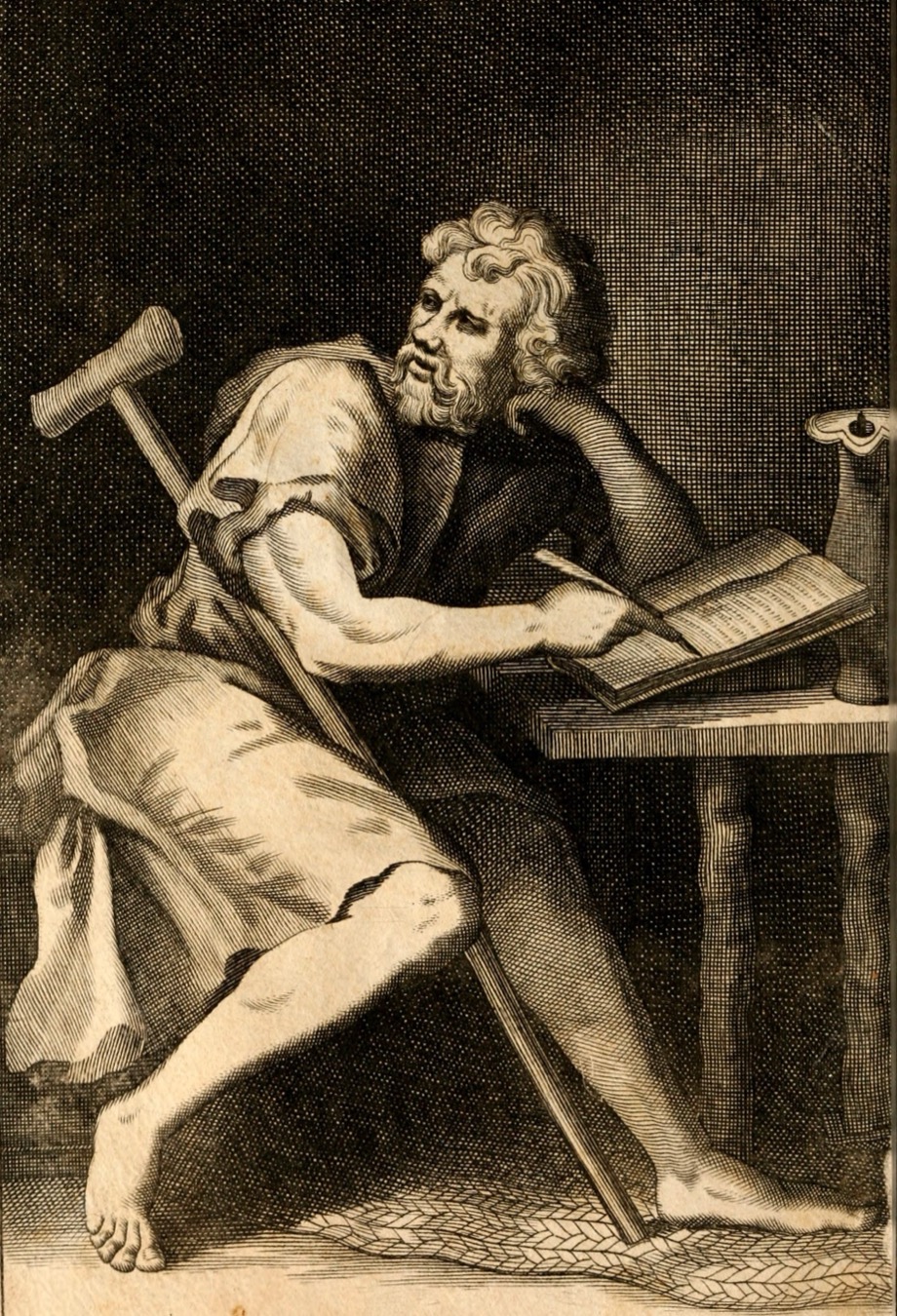
Portrait of Epictetus
A Man Who Owned Nothing and Gave Away Everything
He was property before he was a person. Born around 50 CE in Hierapolis in Phrygia, the boy who became Epictetus was carried to Rome as a slave and ended up owned by Epaphroditus — himself a freedman, and secretary to Nero — so the future teacher of emperors spent his youth inside the most theatrical court in Roman history, watching from the position of a thing that could be sold. Tradition holds that his master broke his leg and left it to heal crooked; some ancient sources prefer a childhood illness. Either way the lameness was permanent, and — this is the important part — he talked about it constantly, in front of audiences, as a joke and a teaching instrument.
That habit is the key to him. He studied under the Stoic Musonius Rufus, was freed, then expelled from Italy with every other philosopher by Domitian's edict around 93 CE. He crossed to Nicopolis in Epirus and opened a school — an actual institution, with a reputation that pulled young Romans of senatorial rank across the Adriatic to sit on a bench and be shouted at. He never wrote a book. Every word we have survives because one of those students, a sharp young aristocrat named Arrian — later a senator, a general, and Alexander's best historian — took down what the old man said as he said it.
The Stoic shelf is crowded with introverts building private cosmologies. Epictetus does not belong there. His philosophy was not composed but performed, at people, with names and faces in the room.
Epictetus is an ENFJ — dominant Fe turned into a classroom. His Stoicism is not a notebook. It is a fire lit in front of other people, and aimed at them.
The Room Is the Argument
Open the Discourses anywhere and the first thing you notice is that somebody else is in the room. Epictetus does not write sentences; he addresses people. Whole lectures are built around a single student who said something foolish at the door: the young man perfumed and preening about his hair, the aspiring orator who came for applause. Epictetus names the failing, mimics the voice, and drives the correction home while the person is still standing there. This is Fe in its most exposed form — moral energy discharged at a specific human being, in real time, calibrated to what that person can be made to feel.
Note the tone. Dominant Fe is often caricatured as warmth; Epictetus's is the teacher's version, warmth as pressure. He shames, mocks, needles, swings from ridicule to sudden tenderness within a paragraph — because the object was never to record a truth but to move somebody. He tells students their progress is measurable in how they treat their households, whether they can stop blaming other people, how they conduct themselves at dinner. The test of a philosopher is what he is like to be around.
And he institutionalized it. He did not retreat to a villa and compose; he built a school and ran it for forty years. When Domitian scattered the philosophers, the answer was not silence but relocation — find another room, fill it, start again. A man whose deepest function is extraverted feeling cannot philosophize alone. He needs the faces.
One Cut Through the Whole World
For all its improvisation, the teaching runs on a single idea that does not waver across four surviving books. Some things are up to us — judgment, impulse, desire, aversion, the movements of our own will — and everything else is not: body, property, reputation, office, the behavior of other people. The dichotomy of control opens the Enchiridion and is the hidden spine of every lecture after it: not a list of maxims but one perception, held so tightly that any case can be dropped into it and sorted.
That is auxiliary Ni doing structural work: not prophecy, but a compressed insight that makes the disorder of experience resolve into one pattern. Epictetus never seems to be searching for his position. He arrives at each new problem — grief, exile, illness, a tyrant's summons — already knowing where it falls, and the lecture is the pleasure of watching him place it. The cosmos is providentially ordered; each of us is handed a role by a playwright not of our choosing; the only question is whether the part is played well. The picture never bends to the case in front of him. The case bends to it.
The Leg, the Bath, the Wrestling Ground
A worldview that abstract could easily have floated off. It never does, because Epictetus taught in things you can see and touch. Life is a festival you were invited to and will be asked to leave. Circumstance is a game of ball — the catching is what gets judged, not the ball. Hardship is the trainer who pairs you with a rough opponent because a soft one would make you nothing.
Above all, the body. He used his own limp as a lecture aid: my leg is lame, and my leg is not me; the fetter binds the leg and not the will. He made the indignities of a broken frame the proving ground for indifference to pain. Tertiary Se here is not appetite for pleasure but a sure feel for the physical particular as the most persuasive thing in the room. An audience remembers a broken leg and forgets a proposition.
Logic as a Tool He Distrusted in His Own Hands
Epictetus was a competent logician and drilled his students in the Stoic syllogisms and the analysis of arguments, and he defended the drilling: you cannot test an impression if you cannot follow an inference. But watch what he does with it. He runs the exercises, then turns on the students who love them — the ones who resolve equivocal premises beautifully and still fly into a rage when dinner is late. The syllogism is scaffolding; the building is conduct.
That ranking — rigor real but subordinated, mistrusted the moment it becomes an end — is what inferior Ti looks like in a mind organized around Fe. A Ti-dominant Stoic would have systematized: written the treatise, closed the definitions, defended the school against the Academy. Epictetus left that to dead Chrysippus and spent his own hours on people, insisting that being able to expound Chrysippus is precisely the accomplishment that proves nothing at all.
Why ENFJ Over INFJ
Why not INFJ?
Because the confusion is about content, and the evidence is in delivery. Epictetus and Marcus Aurelius hold nearly identical doctrine — the dichotomy of control, indifference to externals, the cosmic assignment of one's role — which is why Epictetus keeps getting filed beside him as another Ni-dominant introvert. But Marcus wrote to himself, in a tent, and taught no one: a private audit by a man who found other people exhausting. Epictetus taught for four decades and wrote nothing, because for him the philosophy existed only while it was being said to somebody. The teacher's fire, not the private notebook.
There is a further tell in the texture. INFJ moral writing tends composed and inward — Marcus reasoning himself back to patience, Seneca polishing a letter into permanence. Epictetus's voice is unpolished on purpose: impersonations, rhetorical questions fired at people who cannot answer fast enough, sudden reversals from savagery to affection. It reads like a transcript because it is one. Same Stoicism, opposite attitude — the vision faces outward, and it is pointed at you.
Connected Figures
Further Reading
- Discourses, Fragments, Handbook (trans. Robin Hard, Oxford World's Classics, 2014) — EpictetusThe whole surviving voice in one volume — read the Discourses before the Handbook, because only the lectures preserve the room.
- Epictetus: A Stoic and Socratic Guide to Life (2002) — A. A. LongThe standard scholarly study; strongest on why Epictetus taught as a Socratic interrogator rather than a systematiser.
- Stoicism (2006) — John SellarsClear short introduction placing the dichotomy of control inside the wider Stoic system he inherited.
- Marcus Aurelius: A Guide for the Perplexed (2012) — William O. StephensTraces the Epictetus-to-Marcus lineage in detail, including what the emperor took and what he quietly changed.
- Meditations (Book I and passim) — Marcus AureliusThe clearest evidence of the transmission: an emperor arguing with a dead freedman's framework in his own private notebook.
