 Historical Figure MBTI
#344 · 3-31-26 · The Habsburg Court
Charles VI
Holy Roman Emperor · The Last Habsburg Male · Author of the Pragmatic Sanction
1685 — 1740
7 min read
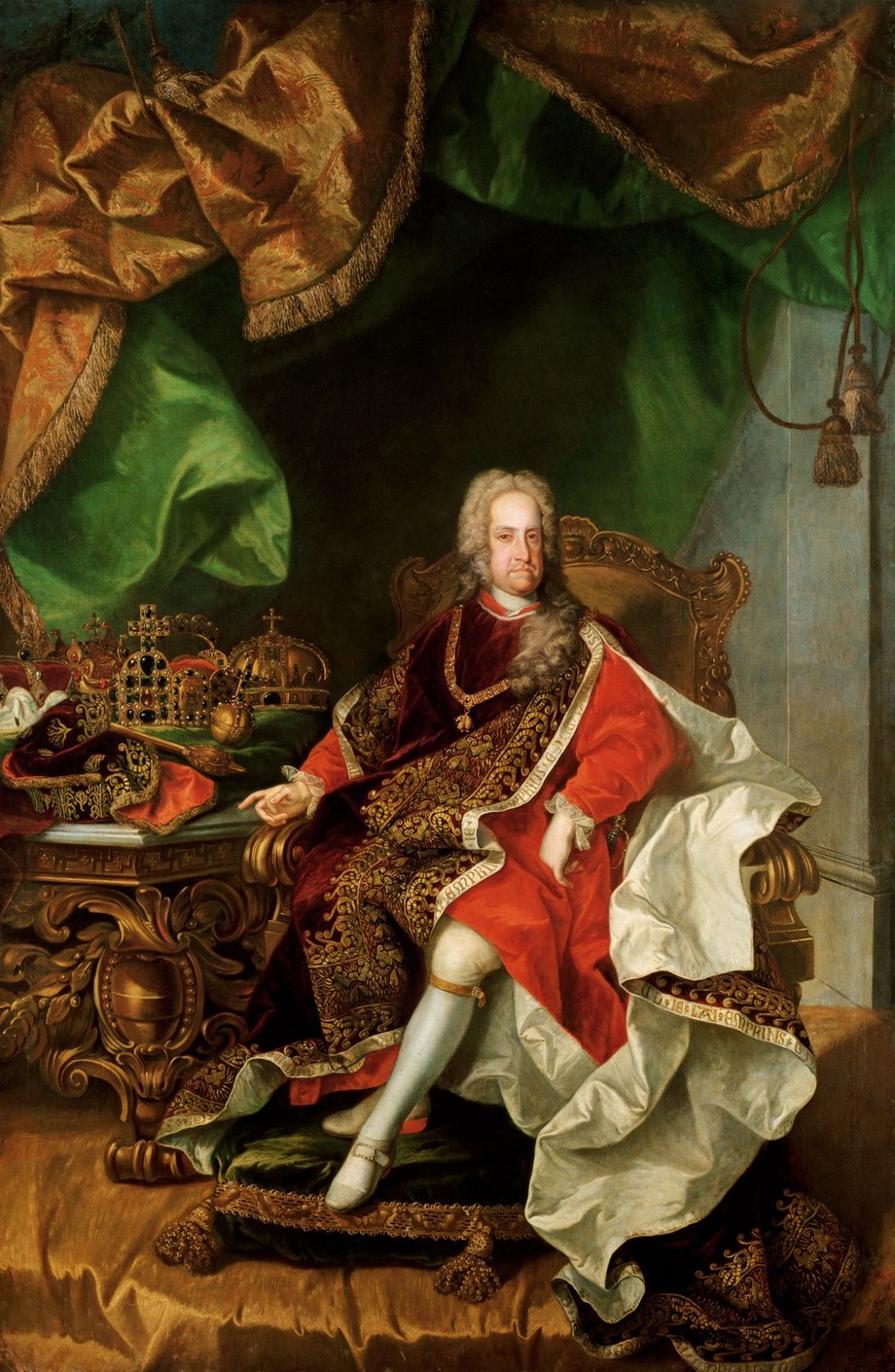
Portrait of Charles VI
The Emperor Who Secured a Throne on Parchment
For nearly thirty years one document consumed the energy of an empire. Charles VI, Holy Roman Emperor, the last Habsburg of the senior male line, had no surviving son, and from the moment that fact hardened into certainty he bent his reign toward a single end: the Pragmatic Sanction, by which his daughter Maria Theresa might inherit the undivided Habsburg lands. He spent decades purchasing the assent of every European power—trading territory, revenue, and strategic advantage for signatures on paper—neglecting his army and emptying his treasury in the process. When he died in October 1740 the guarantees dissolved like mist. Within weeks Frederick the Great marched into Silesia, and the daughter he had spent his life protecting on parchment was left to win her inheritance with her life.
A younger son who became emperor by accident of mortality, Charles had spent the War of the Spanish Succession as the Habsburg claimant to Madrid; when he returned to Vienna as emperor he imported the rigid Spanish ceremonial and wore it the rest of his life. He was formal, devout, melancholic—a man who clung to dynasty, precedent, and form as though they were the only solid ground beneath him. His reign was not a failure of intelligence or effort. It was a failure of imagination: he could not conceive that the legal edifice he had built would simply be ignored.
The psychology that explains him is that of the ISFJ: dominant introverted sensing that revered tradition and dynastic ceremony; auxiliary extraverted feeling that made duty to the house of Habsburg a moral absolute; tertiary introverted thinking that mastered law and precedent but never rose to cold strategy; inferior extraverted intuition that left him unable to foresee what the powers of Europe would do once the man who had paid for their promises was dead.
Charles VI was the ISFJ on the imperial throne—a dominant introverted sensing that worshipped tradition, ceremony, and dynastic precedent, braced by an auxiliary extraverted feeling that made duty to the house of Habsburg the moral law of his life.
The Sanction, the Ceremony, and the Weight of Precedent
Si — dominant
Dominant Si organizes the world through continuity—the trusted weight of precedent, the conviction that order is inherited and conserved rather than invented. No act of Charles's reign expresses this more completely than the Pragmatic Sanction. Faced with dynastic extinction in the male line, his instinct was not to build armies but to draft a document. For more than two decades the Sanction was the obsession of his statecraft: he bought one ratification after another, treating parchment as the load-bearing structure of the monarchy—the belief that if the proper forms were observed and the proper precedents recorded, the order of things would hold.
The same function governed his court. He clung to the title of Spain long after it was lost, maintained the household of a Spanish king-in-exile within his Viennese court, and imposed the rigid, hieratic Spanish ceremonial on his own—an etiquette that struck contemporaries as antique. This was the dominant-Si reflex: to anchor himself in remembered, inherited order, to reproduce the familiar weight of ceremony as a defense against a world that kept refusing to stay fixed. He was a conservator by temperament, and the tragedy is that conservation, however faithful, was no defense against a continent that had decided to break its word.
Duty to the House, and Love of Its Music
Fe — auxiliary
Auxiliary Fe gives the ISFJ its moral compass—loyalty expressed through duty and service rather than self-assertion. In Charles it became a consuming devotion to the house of Habsburg as a sacred trust. The Pragmatic Sanction was not a calculation of power; it was an act of dynastic piety. That same feeling found expression in his genuine love of Baroque music: he played the harpsichord, presided over one of the most musically brilliant courts in Europe, and tended its ceremonial life with real warmth. The pursuit of guarantees for Maria Theresa was the labor of a father determined the patrimony not be left exposed. The ISFJ tragedy is that his Fe knew exactly what was owed and his Si knew how to record it in proper form, but neither could supply the cold strategic foresight the situation required. He guarded his daughter with love and law, and left her surrounded by armies.
The Legalist Who Mistook Law for Power
Ti — tertiary
Tertiary Ti supplies a real but limited capacity for analysis—a facility with rules that serves the dominant Si but rarely commands the personality. Charles was a meticulous legalist, and the Pragmatic Sanction is the monument to this: a carefully constructed, internally coherent legal instrument ratified through a patient sequence of bilateral treaties. Within the closed system of jurisprudence, his reasoning was sound. But his thinking served his Si reverence for form and never broke free to ask the colder question: whether a signature could actually be enforced against a sovereign who decided to ignore it. He treated a question of raw power as a question of legal correctness—and his tertiary Ti gave him the means to draft the perfect guarantee while leaving him without the means to imagine its worthlessness.
The Future He Could Not See
Ne — inferior
Inferior Ne is the ISFJ's blind side—the weak grasp of how circumstances might suddenly shift. Charles could conceive of the future only as a continuation of the order he knew: solemn guarantees, properly obtained, would be honored, because that was how the legal order was supposed to work. He could not imagine that an ambitious king, presented with a young heiress and a pretext, would simply tear up the paper. To purchase ratifications he made concession after costly concession while allowing his army to decay, so fixed on securing the form of the succession that he neglected the substance that would have had to defend it. The verdict came within weeks of his death: Frederick the Great invaded Silesia, and it fell to Maria Theresa—whose temperament reached outward and forward in ways his never could—to make real with armies what her father had left her only in writing.
Why ISFJ Over ESFJ
Why not ESFJ?
The shared SiFe values invite an ESFJ reading, and his own daughter Maria Theresa was precisely that—leading with the outward, mobilizing extraverted feeling that Charles lacked. The ESFJ drives the world through people, commanding rooms, binding allegiance by personal presence. Charles did nothing of the kind. His dutifulness was inward, private, and ceremonious—a clinging to precedent and form rather than an active marshaling of human loyalty. He secured his succession not by rallying men to his daughter, as she would later rally Hungary to herself, but by drafting documents and buying signatures. That is the Si-dominant, not the Fe-dominant—and the difference between Si-first and Fe-first is the difference between an emperor who secured a throne on paper and a queen who secured it with her life.
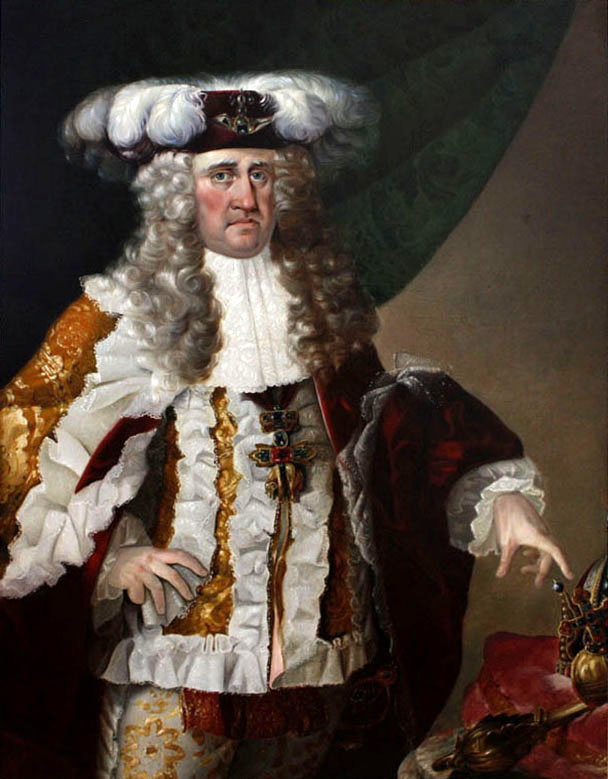
Connected Figures
Further Reading
- Maria Theresa — Edward CrankshawThe best English-language biography of Charles's daughter and heir; opens with a vivid account of the crisis Charles's death provoked.
- The Habsburg Monarchy, 1618–1815 — Charles W. IngraoAuthoritative survey covering Charles VI's reign, the Pragmatic Sanction, and the structural weaknesses of the late Baroque monarchy.
- The War of the Austrian Succession — Reed BrowningDetailed military and diplomatic history of the crisis that erupted the moment Charles's paper guarantees were tested.
- The Habsburg Empire: A New History — Pieter M. JudsonA broad revisionist account of the dynasty; useful for situating Charles VI within the long arc of Habsburg state-building.
