 Historical Figure MBTI
#345 · 3-31-26 · The Habsburg Court
Elisabeth Christine of Brunswick-Wolfenbüttel
Holy Roman Empress · Wife of Charles VI · Mother of Maria Theresa
1691 — 1750
7 min read
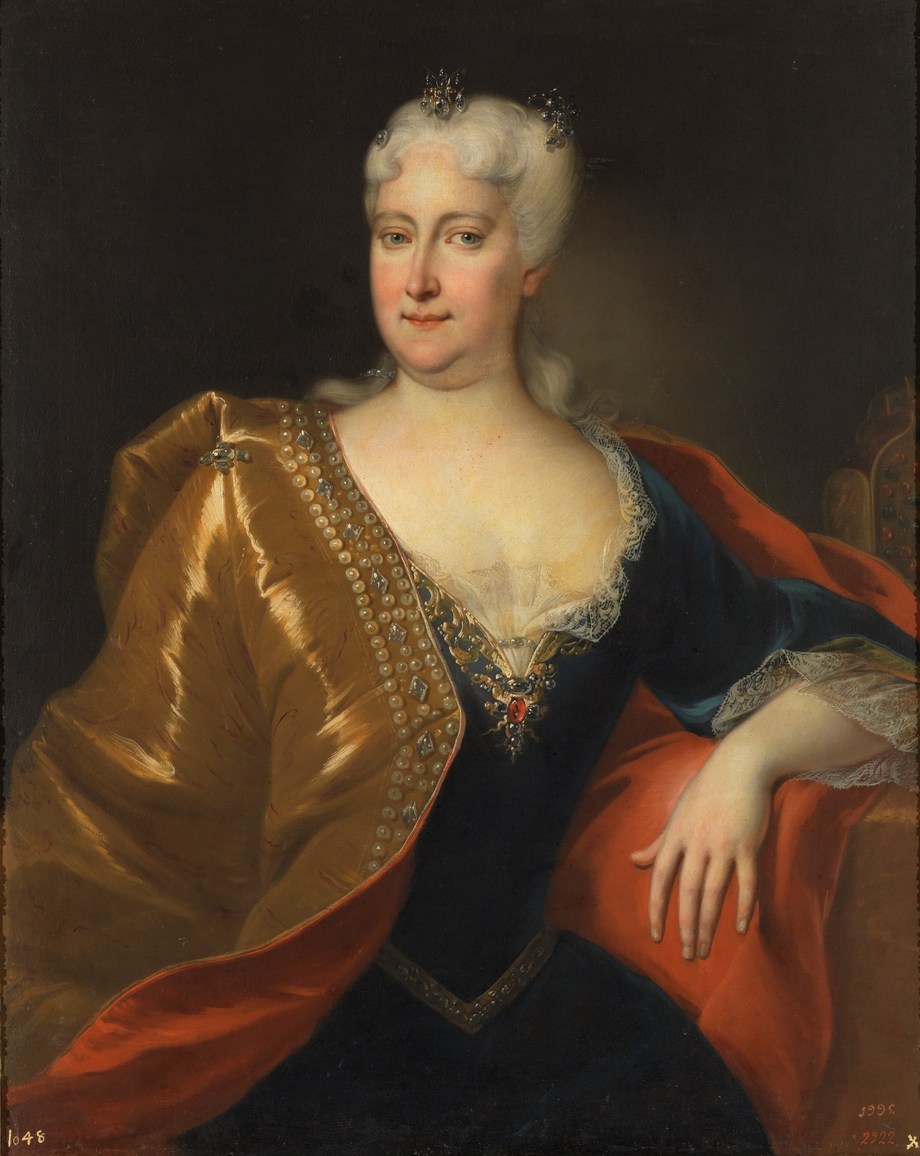
Portrait of Elisabeth Christine of Brunswick-Wolfenbüttel
The Empress Reduced to a Body
When Elisabeth Christine of Brunswick-Wolfenbüttel was chosen in 1707 to marry the Archduke Charles of Austria—the Habsburg claimant to the Spanish throne—she had to abandon the Lutheran faith in which she had been raised and convert to Catholicism, a demand her devout family debated for months. She married Charles by proxy in 1708 and crossed into Spain to join a husband fighting a war for a crown he would never wear. When Charles's elder brother died without sons in 1711, Charles became Holy Roman Emperor, and Elisabeth Christine became his empress. The title carried a single, crushing assignment: produce a son.
She failed, in the only sense the court recognized. A son, Leopold, came in 1716 and died before his first birthday. Then came daughters—Maria Theresa in 1717, Maria Anna the year after—and after that, nothing. Under relentless pressure to conceive again, she submitted to the brutal fertility regimens of the age: fed heavily, plied with wine, subjected to “cures” that ruined her health and left her unwell and withdrawn for the rest of her life. History remembers her almost entirely as a function of the succession crisis that swallowed her court. The psychological reading that fits her best is the ISFJ: dutiful, devoted, anxious, defined by service rather than by self.
Elisabeth Christine was the ISFJ consort in its most poignant form—a dominant Si constancy of faith and duty, an auxiliary Fe devotion to a husband and a dynasty whose hopes rested, agonizingly, on her own body.
The Ordered, Reverent Life
Si — dominant
Elisabeth Christine's entire adult life was an exercise in Si constancy. Even her conversion, which on its surface looks like rupture, was undertaken in the Si spirit of submission to a higher order: once she had become Catholic, she became Catholic thoroughly and permanently, her piety—daily, ritual, devout—the steadiest fact of her existence. Her loyalty to Charles ran along the same channel. When he was a landless claimant fighting for Spain, she went to Spain and stayed. When the cause collapsed and he withdrew to Vienna as emperor, she withdrew with him into the rigid ceremonial of the Habsburg court and occupied the place assigned to her without complaint.
It is the tragedy of dominant Si that it is least equipped for the one demand placed on her. Si endures; it does not engineer outcomes. Faced with the impossible task of producing a male heir on command, she could only submit—to the doctors, the regimens, the wine, the will of a court that treated her body as a dynastic instrument. She accepted the “cures” with the same dutiful obedience she brought to her devotions, and they wrecked her. The very faculty that made her reliably loyal also made her incapable of resistance.
The Devotion That Asked Nothing Back
Fe — auxiliary
In Elisabeth Christine, Fe took the form of a devotion to her husband and his dynasty so complete that it left almost no room for any project of her own. She loved Charles VI, by the surviving accounts, and he was fond of her in return—but the love was bound up inextricably with duty, and the duty pointed at the same impossible object as her affection. When she submitted to the fattening cures, she was, in the deepest sense, performing an act of Fe—sacrificing her own health because the institution she served needed her to. There is something almost unbearable in that: a woman destroying herself out of love for a cause her self-destruction could not advance.
Her devotion was inward and private—directed at husband, children, confessor, God— rather than projected outward as influence. She did not build alliances or shape the court's emotional weather. As the male line failed, she receded further, overshadowed by the crisis and the men managing it. Her auxiliary feeling kept her gentle and accommodating to the last, but it was a feeling that asked nothing in return and received very little.
The Reasoning That Never Took Command
Ti — tertiary
In Elisabeth Christine, Ti is visible mainly in its weakness. She had her own private thoughts about the treatments inflicted on her—one can imagine quiet doubts about the wisdom of the regimens—but no evidence suggests she ever marshaled that judgment into resistance. This is the characteristic shape of tertiary Ti: a logic that critiques privately but defers publicly. Her court was full of strategists—ministers maneuvering over the succession, her husband drafting and redrafting the Pragmatic Sanction—and she was not among them. Her reasoning, such as it was, served only to help her endure a fate she had no power to alter. Ti in the third slot reflects; it does not rule.
No Door Out of the Assigned Room
Ne — inferior
Elisabeth Christine's life was, in a sense, a long demonstration of inferior Ne. She could not imagine, or could not act upon, any version of herself outside the single role she had been handed. Wife, empress, mother of the heir who would not come—these were the only categories available to her. As sons failed to arrive, she did not pivot to some other identity; she grew more anxious, more withdrawn, more overshadowed. Her piety deepened, her health declined, and she receded into the background of a court that had stopped expecting anything of her but the thing she could not provide.
Her dominant Si bound her to duty and continuity; her inferior Ne left her unable to imagine that she might have been anything other than the instrument of a failing line. The imaginative leap she could not make was made, a generation later, by the daughter she did manage to bear: Maria Theresa, who would seize the inheritance her mother's body had failed to secure with a son and remake the dynasty in her own image.
Why ISFJ Over ESFJ
Why not ESFJ?
The ESFJ shares Elisabeth Christine's warmth and devotion but leads with extraverted feeling—producing a more public, organizing, socially commanding figure who manages the court, builds alliances, and shapes the emotional weather of those around her. Elisabeth Christine did none of this. Her devotion was inward and private; she withdrew rather than presided, endured rather than organized. The dominant Si of the ISFJ—steady, self-effacing, anchored in faith and routine—fits a woman defined by constancy and obedience far better than the assertive outward Fe of the ESFJ.
She is remembered, when she is remembered at all, not for what she did but for what was done to her and through her—which is precisely the fate the dominant-Si temperament, faithful and passive to the end, is least able to escape.
Connected Figures
Further Reading
- Maria Theresa — Barbara Stollberg-RilingerThe definitive modern biography of Elisabeth Christine's daughter — begins with a vivid account of the succession crisis Elisabeth Christine's childlessness made so acute.
- The Habsburg Monarchy, 1618–1815 — Charles W. IngraoCovers Charles VI's reign and the Pragmatic Sanction in depth; essential context for understanding the dynastic pressure placed on Elisabeth Christine.
- Maria Theresa: The Last Conservative — Edward CrankshawAn accessible narrative of the court Elisabeth Christine inhabited and the daughter she left behind.
