 Historical Figure MBTI
#338 · 3-31-26 · The Habsburg Court
Maria Theresa
Archduchess of Austria · Holy Roman Empress · Mother of the Monarchy
1717 — 1780
10 min read
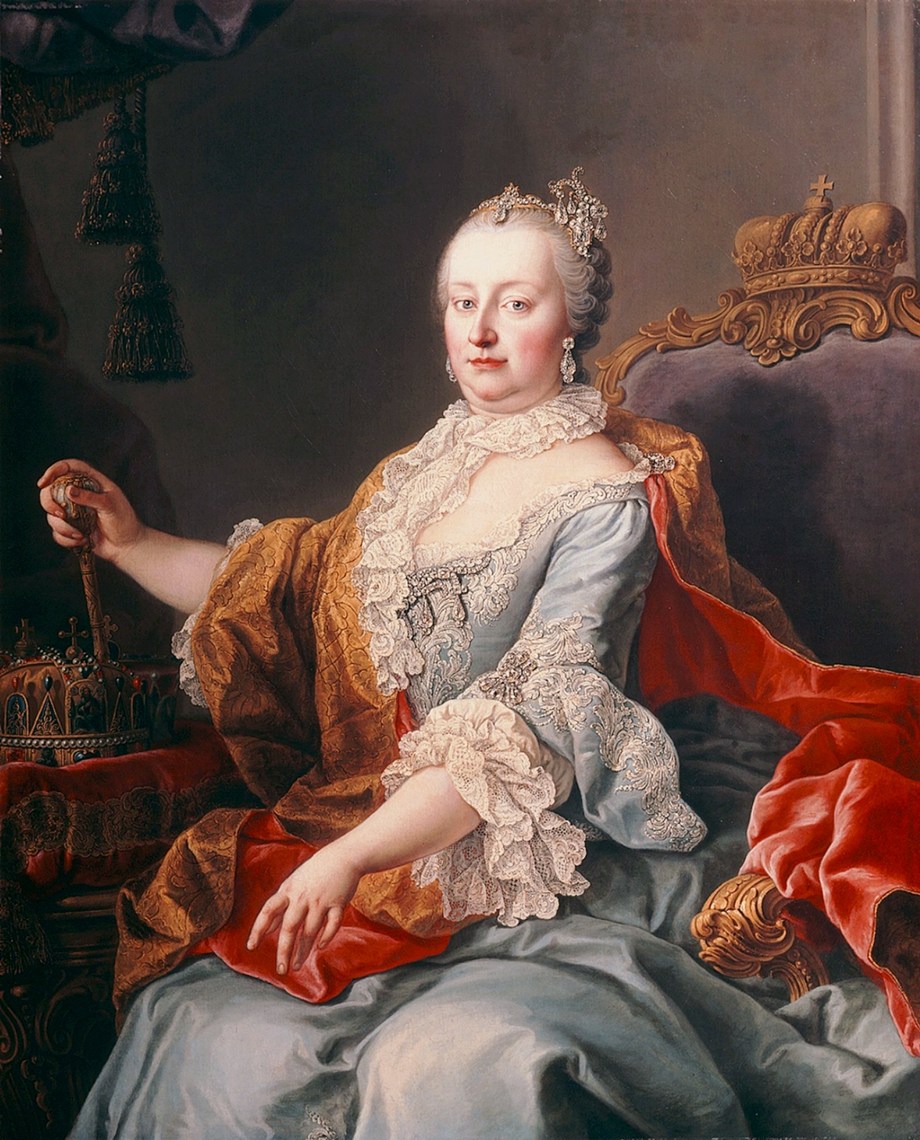
Portrait of Maria Theresa
The Queen Who Ruled an Empire Like a Household
In September 1741 a young queen stood before the assembled magnates of Hungary in the hall at Pressburg and asked them, in Latin, to save her. She was twenty-four, eight months into her reign and visibly pregnant, and the inheritance her father had spent his whole life securing was being torn apart on every frontier. Prussia had seized Silesia; Bavaria, Saxony, and France were closing in. She had almost no army, an empty treasury, and few friends. So she went to the Hungarians—a proud, prickly nobility her ancestors had ruled warily for two centuries—and threw herself on their loyalty, speaking of her cause, her child, and her crown with a directness that cut straight past their grievances to their honor. The legend that they drew their sabers and roared Vitam et sanguinem pro rege nostro! compresses something real: she had reached a roomful of hard men by appealing to what they felt they owed her. It was the first great act of a reign that would last forty years, and it was, to its marrow, an act of social will.
Maria Theresa (1717–1780) was Archduchess of Austria, Queen of Hungary and Bohemia, and—through the husband she crowned and the son who succeeded him—the effective ruler of the Holy Roman Empire: the only female sovereign in the six-hundred-year history of the Habsburg lands. She inherited a fractured, bankrupt, archaic state and left behind a centralized monarchy with a reformed administration, a standing army, a public-health system, and the beginnings of universal schooling. She did this not as a theorist or a soldier but as a manager of people—of ministers, generals, bishops, and above all the sixteen children she bore to her beloved Francis Stephen of Lorraine, whom she married for love and ruled for life. She governed the empire like a household and the household like an empire, and she rarely distinguished between the two.
Maria Theresa was the ESFJ on the throne—dominant extraverted feeling that bound an empire and a dynasty together by duty and personal loyalty, braced by an auxiliary introverted sensing that made faith, tradition, and remembered order the ground she never left.
The Empire as a Family, the Family as a State
Fe — dominant
Dominant extraverted feeling organizes the world through relationship, obligation, and the shared moral atmosphere of a group—it asks what is owed, who belongs, what holds people together. Maria Theresa governed almost entirely in this register. She did not conceive of her realm as a set of institutions to be engineered but as a body of people bound to her and to one another by duty and affection, and she worked those bonds with tireless directness. The appeal to Hungary in 1741 was Fe in its rawest political form: she did not out-maneuver a coalition strategically—she made a roomful of men feel the weight of their loyalty to her person, and converted that feeling into armies. Throughout the War of the Austrian Succession she fought less by generalship than by holding a fractured monarchy together through sheer personal command of its people's allegiance. She lost Silesia, but she kept the monarchy the way an ESFJ keeps anything—by refusing to let the bonds break.
The same function governed her cabinet. Kaunitz, the chancellor who engineered the “Diplomatic Revolution” that allied her with old enemy France—she did not give him an impersonal mandate; she bound him to her, listened, prodded, scolded, and rewarded. Hers was government by relationship, the dominant-Fe mode at the scale of a great power: she converted a web of personal obligation into one of the most effective administrations in Europe.
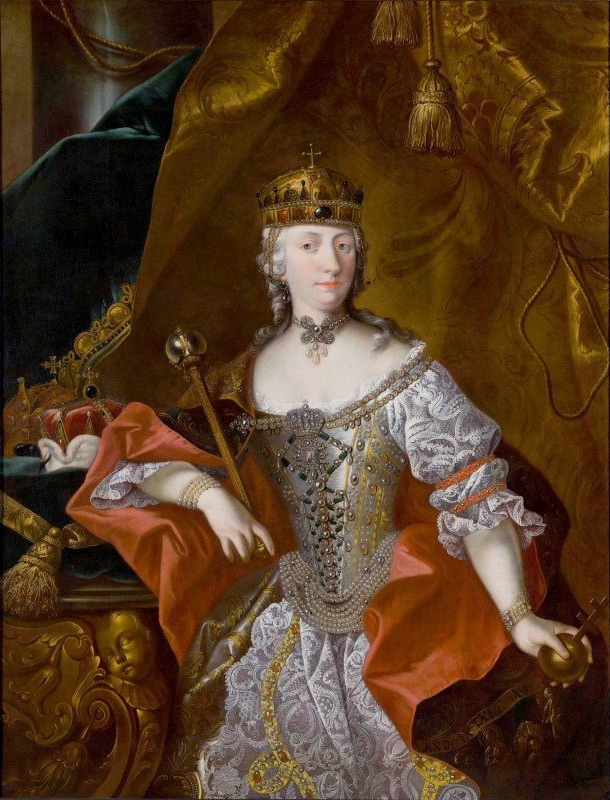
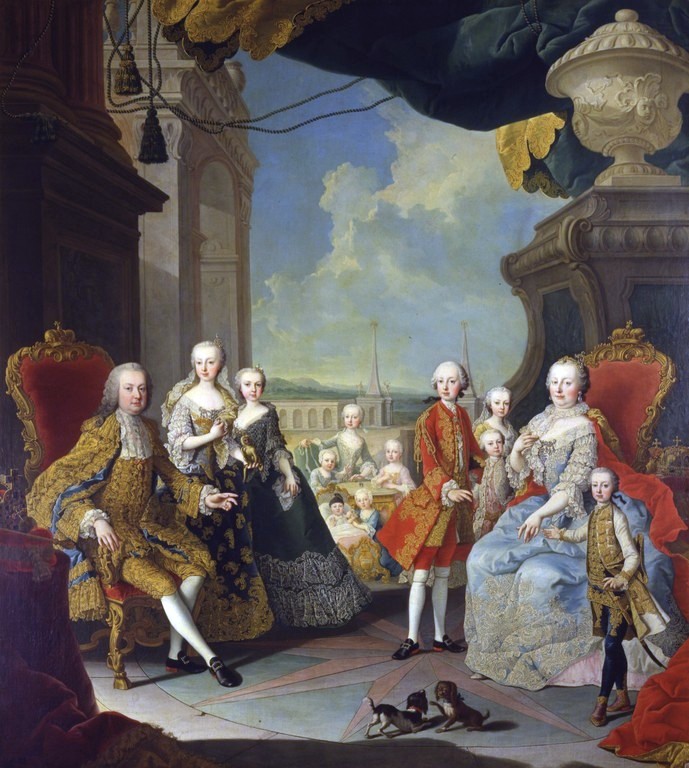
But the supreme theater of her Fe was her family. She bore sixteen children and treated their upbringing, marriages, faith, and conduct as matters of state. She married them across the courts of Europe and then governed them by letter for the rest of their lives, a relentless, loving, controlling correspondence that pursued her daughters into their own foreign palaces. To Marie Antoinette in Versailles she sent instruction on everything from court intrigue to bedroom duty; to Maria Carolina in Naples, the same. She praised, she reproached, she micromanaged from a thousand miles away, never doubting her right to do so, because to dominant Fe the boundary between caring for people and managing them barely exists.
Faith, Order, and the Weight of How Things Were Done
Si — auxiliary
Auxiliary introverted sensing grounds the ESFJ in continuity—in the trusted weight of precedent, custom, and remembered routine. In Maria Theresa it was profound. She was devoutly, immovably Catholic, and her faith was not a private mysticism but a felt inheritance: the religion of her fathers, the moral order of her world, the framework within which duty itself made sense. She heard Mass daily, observed the calendar of the Church as the calendar of her life, and regarded the defense of Catholic orthodoxy as inseparable from the defense of her dynasty. This piety had its harsh face—she could be intolerant of Protestants and Jews, and her religious conservatism set her at odds with the very Enlightenment her reforms drew on—but it was the bedrock Si conviction from which everything else was built.
Her relationship to work and routine bore the same stamp. Maria Theresa was famously, almost punishingly industrious—she rose early, read and annotated the business of the monarchy in steady daily labor, and sustained that discipline across forty years and sixteen pregnancies. Even her reforms, radical in their effects, were undertaken in a spirit of restoration rather than revolution—repairing a monarchy that had been allowed to decay, putting back in working order an inheritance she felt duty-bound to hand on intact. She reformed because the old order had failed in practice, not because she distrusted old order on principle.
The loss of Silesia to Frederick the Great was a wound she carried for life—not an abstract reverse to be written off but a concrete theft of something that was hers, by a man she referred to with lasting bitterness as “that evil man.” Auxiliary Si in a dominant feeler stores injury as a moral debt. The whole reversal of alliances that Kaunitz engineered was in part the machinery built around her refusal to accept that loss as final. Her fidelity to her dead father's wishes, to her faith, to her marriage, to the remembered shape of the monarchy she had been handed—all of it was the same function at work: a temperament rooted in what was, and loyal to it past the point of cold calculation.
The Reformer Who Did Not Trust Reform
Ne — tertiary
Tertiary extraverted intuition in the ESFJ is a real but secondary capacity—a willingness, under the right pressures, to break with custom when custom has plainly failed. In Maria Theresa it shows precisely as that: a pragmatic, reluctant, results-driven openness to change, embraced not because she loved novelty but because the survival of her people and her house demanded it. The near-catastrophe of 1740 taught her, viscerally, that the old monarchy could not defend itself, and from that lesson she authorized a sweeping program of modernization her temperament alone would never have produced.
The vision came from her ministers; the will to enact it came from her. Haugwitz centralized the tangled finances of the Austrian and Bohemian lands and built a standing army on a reliable tax base. Van Swieten dragged Austrian medicine into the modern age, founded clinical teaching, and laid the groundwork for compulsory primary schooling. Kaunitz remade her foreign policy from first principles. Maria Theresa did not originate these ideas, and several cut against her instincts, but she recognized their necessity and backed the men who carried them. That is tertiary Ne at its best: not invention, but a practical receptivity to the inventions of others when the alternative is decline.
Its limits are equally clear. Where her son and co-regent Joseph II pressed sweeping rationalist reform as a matter of principle—abolishing serfdom, dissolving monasteries, decreeing toleration from the top down—Maria Theresa pulled hard on the reins. Their long tension was, in functional terms, the clash between his dominant intuition and her tertiary one: he reformed because he believed the world should be rational; she reformed only so far as duty to her people and her God would allow. Her Ne served her values; it never displaced them.
The One Language She Did Not Speak
Ti — inferior
Inferior introverted thinking is the ESFJ's blind side—the cold, impersonal logic that weighs a question on its internal consistency alone, indifferent to who is affected or what is owed. Maria Theresa was shrewd, decisive, and a superb judge of people, but she did not reason like a philosopher or a system-builder, and she distrusted those who did. Her convictions were moral and felt rather than argued; when challenged on principle, she fell back on duty, faith, and the authority of what was right. The abstract rationalism that defined her age— and that her great rival in Prussia wielded as a weapon—was the one intellectual language in which she was never at ease.
The blind spot had a harsh edge. Her treatment of religious minorities was not a reasoned position she could have defended in cold argument but a visceral piety she never subjected to scrutiny. The most notorious episode of her statecraft, the First Partition of Poland in 1772, caught her in the same bind—she condemned the seizure as immoral, wept over it, and took her share anyway, prompting Frederick's famous gibe that “she weeps, but she takes.” The line lands precisely because it exposes the inferior function: a ruler whose moral feeling and whose hard interest could not be reconciled by any consistent principle, resolved not by logic but by grieving and proceeding.
Where inferior Ti surfaced more constructively, it did so through her ministers. The clean institutional logic of Haugwitz's centralized administration, the systematic rigor of van Swieten's reordered universities, the calculated structure of Kaunitz's diplomacy—these were exercises in exactly the impersonal, consistency-driven thinking that did not come naturally to her. She supplied the will, the loyalty, and the moral purpose; they supplied the cold architecture. It is a characteristic ESFJ solution to an inferior function: not to master the alien mode oneself, but to bind to oneself the people who can.
Why ESFJ Over ISFJ
Why not ISFJ?
The shared SiFe values—deep Catholic piety, devotion to family and tradition, the conscientious industry—tempt an ISFJ reading. But the ISFJ leads with introverted sensing and expresses its care quietly, by steady support rather than command. Maria Theresa was the opposite: she walked into a hall of Hungarian magnates and bent them to her cause, managed a continent's worth of ministers by force of personal allegiance, and governed sixteen children at foreign courts by relentless, active correspondence. That is dominant Fe reaching out to seize and direct people, not auxiliary Fe quietly tending them.
The decisive evidence is the direction of her energy. An ISFJ rules, when it must, by holding its ground and supporting from behind; Maria Theresa ruled by engagement, persuasion, and the sheer projection of social will. She did not wait to be consulted—she summoned, exhorted, scolded, married off, and reorganized, treating every relationship within reach as something to be actively governed. The famous correspondence with her daughters is the perfect tell: a reserved Si-dominant might love her children as deeply, but she would not pursue them across Europe with a lifelong stream of instruction and reproach, unable to leave their conduct alone. Maria Theresa managed an empire and a vast family by the same outward, commanding warmth— that reaching out, sustained across forty years, is the ESFJ and not the quieter, inward ISFJ.
Connected Figures
Further Reading
- Maria Theresa — Edward CrankshawThe classic English biography — readable, warm, and sharp on her character and the Habsburg court.
- Maria Theresa: The Habsburg Empress in Her Time — Barbara Stollberg-RilingerThe definitive modern scholarship — exhaustive on her administration, her faith, and her family politics.
- The Habsburgs: Embodying Empire — Andrew WheatcroftTraces the dynasty's self-image and culture across centuries, with strong coverage of Maria Theresa's era.
- The War of the Austrian Succession — Reed BrowningThe clearest account of the crisis that forged her reign and defined her enmity toward Frederick.
