 Historical Figure MBTI
4 min read
#186 · 3-19-26 · Ancient Athens
Dion of Syracuse
The Idealist Who Took Power Seriously
r. 357 – 354 BCE
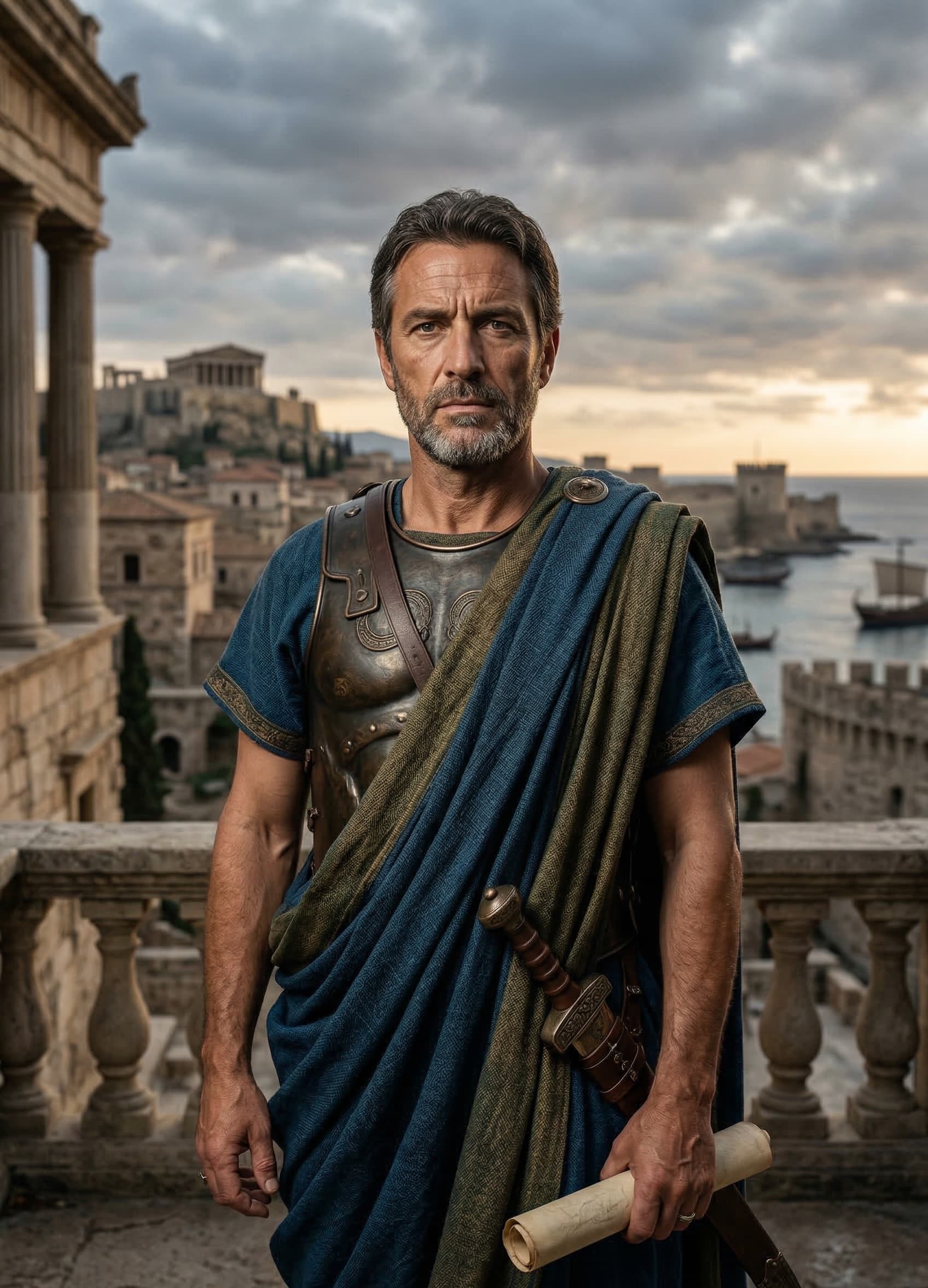
AI-assisted portrait of Dion of Syracuse
The Architecture of Reform
Dion did not begin as a ruler. He began as a student.
Closely associated with Plato, Dion encountered philosophy not as abstraction, but as something that could—and should—shape reality. In the court of Dionysius I and later under Dionysius II, he stood at the intersection of power and thought.
Where others saw governance as control, Dion saw misalignment. And where others adapted, he resolved to change it.
Exiled from Syracuse after falling out with Dionysius II, Dion did not abandon the system. He returned to it—with force.
The Psychological Verdict
Dion is often described as principled, serious, and driven by a vision of what Syracuse should be. His actions are not reactive or opportunistic, but oriented toward correcting what he perceives as a flawed structure.
He reads most clearly as INTJ.
Ni — Dominant
Dion is guided by a singular vision. Influenced by Platonic philosophy, he internalizes an ideal of governance—not as theory, but as a standard. His decisions consistently align with this internal model, even when they require risk, exile, or conflict.
This is Ni: convergence toward a singular, guiding truth. Not exploration. Direction.
Te — Auxiliary
Dion does not remain in contemplation. He acts. His return to Syracuse is not symbolic—it is executed through military action, organization, and strategic planning. He translates vision into structure, seeking to reshape the political system in accordance with his ideals.
This is Te in service of Ni: implementing what must be. Not debating. Doing.
Fi — Tertiary
There is a strong sense of internal conviction. Dion’s commitment to reform is not merely intellectual—it is personal. He does not compromise easily, and his actions reflect a belief in what is right, even when it isolates him.
This reflects tertiary Fi: a quieter, but present, alignment with internal values.
Se — Tertiary
Dion’s relationship with the immediate environment appears secondary. While capable of engaging in action, his orientation is not toward adapting to present conditions, but toward imposing a vision upon them. This can create rigidity—difficulty adjusting when reality does not align with expectation.
This reflects inferior Se: tension with the present in favor of the envisioned.
Analysis
Why not INFJ?
Given his connection to Plato and his philosophical orientation, INFJ may seem plausible—a figure guided by ideals and concerned with moral order. But Dion’s focus is not relational.
He does not primarily seek harmony, nor does he orient his actions around people as ends in themselves. His approach is structural—concerned with systems, governance, and the implementation of a specific vision.
INFJs tend to guide through influence. Dion moves through execution.
This is not Fe-driven alignment. It is Te-driven transformation.
The Vision That Returned
Dion did not simply imagine a better Syracuse. He tried to build it.
His life reflects the tension between philosophy and power—between what is envisioned and what can be sustained. He succeeds in returning, in reshaping the system, but not in stabilizing it.
Still, his trajectory remains clear. He did not adapt to the system he inherited. He moved to replace it.
Not the student who learned philosophy. But the one who tried to enforce it.
Connected Figures
Further Reading
- Dion — PlutarchThe primary ancient biography — part of the Parallel Lives, paired with Brutus. Essential for reconstructing Dion's character and the Syracusan coup.
- The Seventh Letter — PlatoPlato's autobiographical account of his Syracusan visits and his relationship with Dion; the single most important primary source for the philosopher-king experiment.
- Plato: A Life — Robin WaterfieldA modern scholarly biography that places Dion's story within the full arc of Plato's political ambitions and failures.
- The Greek Tyrants — A. AndrewesClassic study of Greek tyranny that contextualizes the Dionysian dynasty and Dion's attempt to end it.
