 Historical Figure MBTI
#459 · 4-13-26 · Capetian France
Enguerrand de Marigny
Chamberlain of France · Hanged on His Own Gallows
c. 1260 — 1315
7 min read
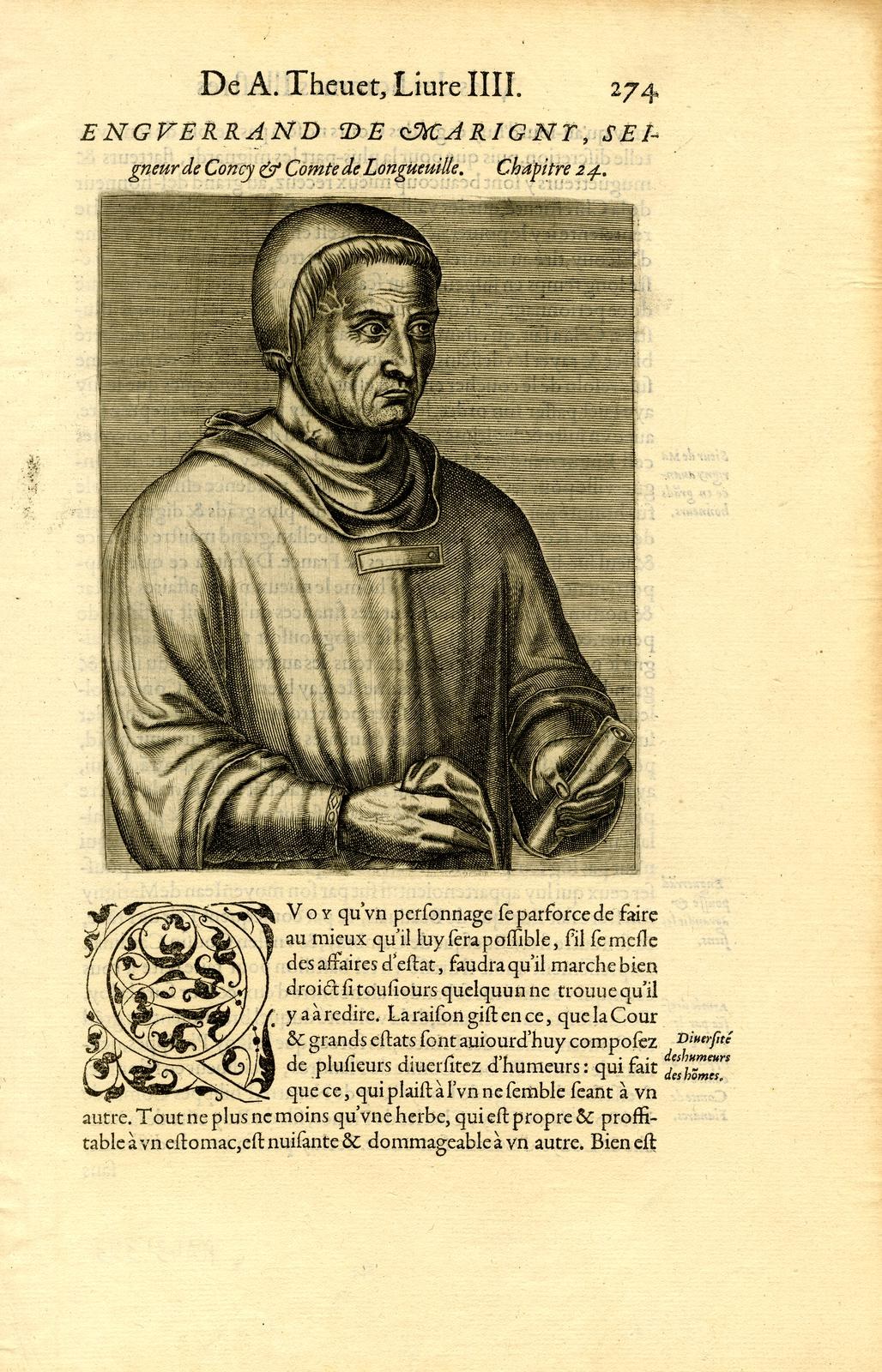
AI-assisted Portrait of Enguerrand de Marigny
The Man Who Ran a Kingdom
For roughly a decade at the close of Philip the Fair's reign, the kingdom of France was effectively administered by a single man who had been born to none of it. Enguerrand de Marigny rose from the modest Norman gentry to become chamberlain, chief financial officer, and de facto first minister of the most powerful crown in Christendom. He controlled the treasury, set policy, dispensed patronage, and grew so grand that he had his own likeness installed among the statues of the kings in the great hall of the royal palace — a commoner standing in stone beside sovereigns.
He was, in the most literal administrative sense, the machinery of the late Capetian state. And when that state needed someone to blame for a generation of hated taxes and currency manipulations, the machinery was turned on the man who had built it. Within months of Philip IV's death in 1314, the resentful nobility — led by the king's own brother, Charles of Valois — had him arrested, tried first for corruption and then, when that faltered, for sorcery, and hanged at the great gibbet of Montfaucon. He had rebuilt that gibbet himself.
Marigny was the ENTJ as state engine: Te bending a kingdom's money and policy to a single will, Ni reading the long arc of his own ascent — the empire-builder finally crushed by the empire he built.
The Administrator-Financier
Te — dominant
Dominant Te organizes the external world into systems that produce results, and it measures a man by what he can make a system do. Marigny's genius was for the least romantic and most consequential instrument of medieval power: money. He took over the royal finances at a moment of chronic crisis — a crown perpetually short of cash, fighting Flanders, quarrelling with the papacy — and made himself indispensable by managing the one thing every faction needed and none could conjure. He oversaw the currency, the revenues, the loans, the negotiations. He did not theorize about the state; he ran it.
The Te operator does not merely occupy an office — he expands it until the office is wherever he happens to stand. Marigny accumulated titles and revenues the way an engineer accumulates leverage: chamberlain, keeper of the funds, coadjutor and rector of the realm in all but name, enriched with lands and pensions until his personal fortune rivalled that of great lords born to it. The currency debasements that made him hated were Te in its coldest register — a problem of royal solvency solved by an instrument that worked, regardless of who absorbed the cost.
What separates Marigny from a mere careerist is the sheer scale of the apparatus he built and held. A clerk executes. Marigny commanded — armies of officials, streams of revenue, the diplomatic correspondence of a kingdom — and answered, in practice, to one man only. That is dominant Te at the height of its reach: the conviction that competence is its own authorization, and that whoever can make the machine run deserves to drive it.
The Architecture of an Ascent
Ni — auxiliary
If Te ran the machine, auxiliary Ni gave Marigny the long view that turned a useful clerk into a strategist. Ni reads the trajectory of things — where a situation is heading, how present moves compound into future position. Marigny did not simply solve the crown's problems as they arrived; he managed his own rise as a deliberate, years-long campaign, converting each administrative victory into more proximity to the king, more revenue, more dependents who owed him their offices.
The same forward sight shaped his statecraft. His handling of the Flemish question — preferring negotiated settlement and financial pressure to ruinous open war — reflected a mind that calculated the eventual cost of a course rather than its immediate satisfaction. He thought in terms of the realm's solvency a year or a decade out, not the glory of a single campaign. That is Ni in harness to Te: strategy disciplined by execution, the long arc translated into ledgers and treaties.
Ni's blind spot, though, is its conviction that it has foreseen everything. The statue in the royal gallery was Ni's monument to its own narrative of inevitable ascent — and the one variable the projection could not control was the king's mortality. Marigny had built his entire architecture on the favor of one man. When that man died, the vision that had carried him to the summit had nothing left to read.
The Appetite for the Tangible
Se — tertiary
Tertiary Se in an ENTJ shows up as a taste for the concrete trophies of success — the lands, the buildings, the visible magnificence that proves the abstract victory was real. Marigny had it in abundance. He amassed estates, built and adorned, endowed a collegiate church at Écouis in Normandy as a monument to his arrival, and surrounded himself with the physical splendor of a great magnate. The statue among the kings was the purest expression of this: not power held quietly, but power made marble and put on display.
That appetite for tangible grandeur was also what made him a target. In a court that still measured rank by blood, the conspicuous wealth of a Norman parvenu read as presumption. The very visibility Se craved — the manors, the monuments, the effigy in the palace — gave his enemies a precise and resented inventory of how far above his birth he had climbed. He had made his success impossible to overlook, and so impossible to forgive.
No Constituency but the King
Fi — inferior
Inferior Fi is the ENTJ's thinnest faculty: the inner compass of personal loyalty, of who one is beyond what one accomplishes. Marigny's tragedy is written in its weakness. He had spent two decades optimizing systems and outcomes, and almost none building the kind of personal bonds — the affection of peers, the gratitude of equals — that might have shielded him when the system turned. He had made himself useful to a king and resented by everyone else, which is exactly the position Te builds and Fi fails to insure against.
When Philip died, Marigny discovered he had no constituency. The nobles he had outranked and out-earned, the rivals he had bested in council, the new king Louis X who owed him nothing — none felt the slightest tie to the man who had run their kingdom. The charges escalated from corruption, which could not be made to stick, to sorcery, which did not need to be true. He was hanged at Montfaucon in 1315, on the gibbet his own administration had rebuilt — the inferior function's revenge on a life that had counted everything except who would stand beside it at the end.
Why ENTJ Over ESTJ
Why not ESTJ?
The ESTJ is the faithful steward of an established structure — the official who administers an inherited office well, within its bounds, by the rules as he found them. Marigny did something categorically different: he built his own power base from almost nothing, improvised new instruments of finance and authority, and expanded his role far past anything his birth or his title formally allowed. That is the visionary empire-building of Te paired with Ni, not the dutiful maintenance of what already exists.
The whole shape of his life is the arc of outsized ambition, not faithful administration. An ESTJ rises through an institution; Marigny rose above his station and made the institution bend around him, accumulating wealth and reach until he overreached into the company of kings. The ESTJ's caution would likely have kept him alive — and minor. It was the ENTJ's refusal to stay within the lines of his birth that carried him to the royal gallery, and to the gibbet.
Connected Figures
Further Reading
- The Reign of Philip the Fair — Joseph R. StrayerThe standard English account of the late Capetian state — essential for understanding the administrative machine Marigny ran and the politics that destroyed him.
- Un conseiller de Philippe le Bel: Enguerran de Marigny — Jean FavierThe definitive scholarly biography (in French); Favier reconstructs Marigny's rise, his fortune, and the trial that ended him.
- Capetian France 987–1328 — Elizabeth Hallam & Judith EverardThe best single-volume survey of the dynasty — situates Marigny within the long arc of Capetian government and its crises.
