 Historical Figure MBTI
#458 · 4-13-26 · Capetian France
Guillaume de Nogaret
Keeper of the Seals · The King's Cold Instrument
c. 1260 — 1313
7 min read
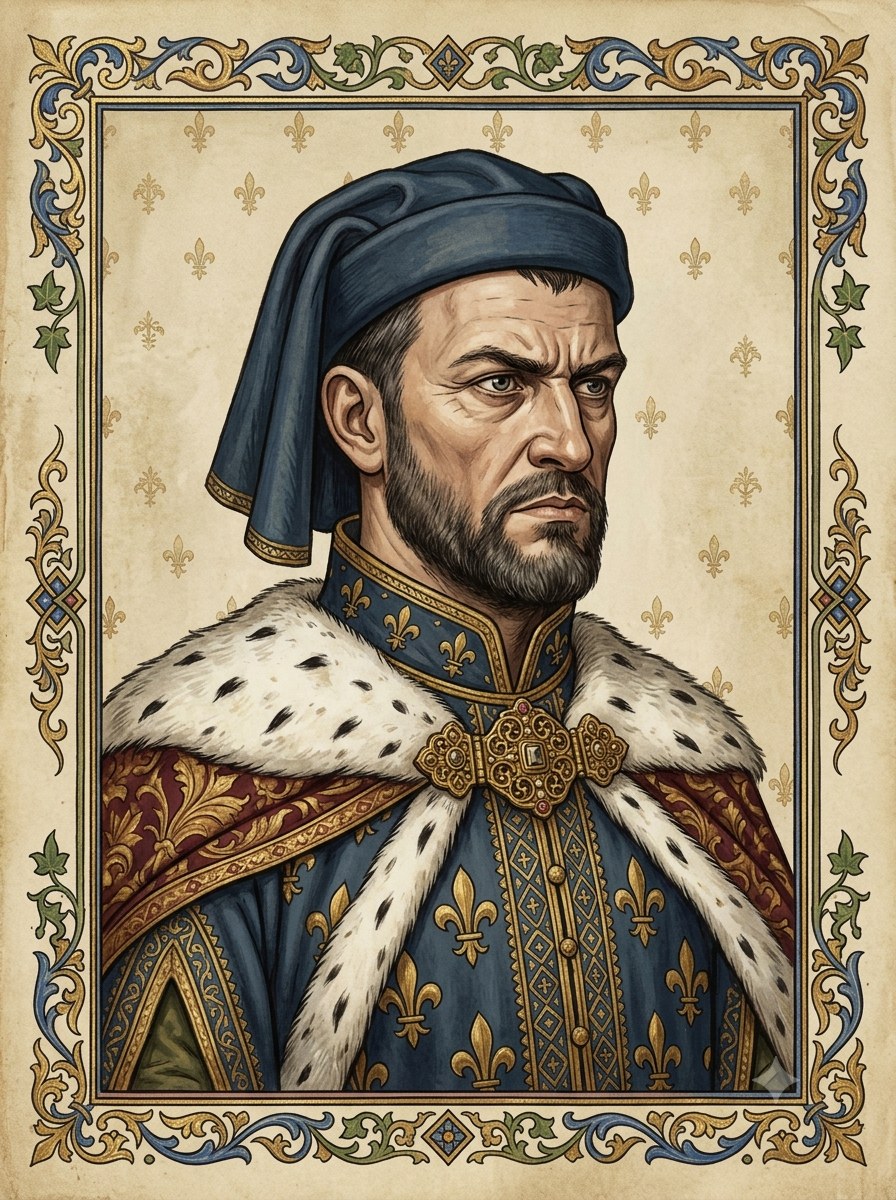
AI-assisted Portrait of Guillaume de Nogaret
The Lawyer Who Made Law a Weapon
Every tyrant needs a mind that can dress force in the language of legitimacy, and Philip IV found his in a pale, relentless jurist from the Languedoc. Guillaume de Nogaret was a legist—a scholar of revived Roman law—and by the first decade of the fourteenth century he had become the keeper of the seals, the instrument through which the king of France did his darkest work. He did not wield armies or hold great estates. He held arguments, and in his hands an argument could break a pope or burn an order of warrior-monks.
He came, it was whispered, from a family the Church had condemned as Cathar heretics and consigned to the flames—a wound, if true, that would help explain the cold, almost personal zeal he brought to humbling the papacy. Whatever its source, the zeal was real, and it was disciplined. Nogaret did not rage; he prepared. He built dossiers, drafted charges, marshaled jurists and notaries, and turned the slow machinery of legal procedure into something that could be aimed and fired. He is the INTJ as ideological enforcer—a strategist who saw, years ahead, exactly which enemies the crown had to destroy, and who reverse-engineered the law until it became the means.
Nogaret was the strategist of the velvet dungeon—a long, cold vision of breaking the king's great rivals, the Church and the Temple, executed through procedure turned into a blade. The mind was Ni; the weapon was Te.
The Architect of the Long Campaign
Ni — dominant
Dominant Ni is a single converging vision held over years, and Nogaret's vision was the supremacy of the French crown over every rival authority that claimed to stand above it. Where lesser royal servants reacted to crises as they came, he saw the war whole: the papacy and the Knights Templar were not nuisances to be managed but obstacles to be eliminated, and he set himself to eliminate them by design. The conflict with Pope Boniface VIII over the king's right to tax the clergy was not, for Nogaret, a dispute to be negotiated. It was a problem with a solution, and the solution was the destruction of the pope's standing itself.
So in 1303 he carried the vision to its logical end. Rather than wait for Boniface to excommunicate the king, Nogaret rode to the papal town of Anagni, forced his way into the pope's residence at the head of an armed party, and held the old man prisoner—an act of such audacity that contemporaries spoke of it in the same breath as the crucifixion. The townspeople freed Boniface days later, but the shock broke him, and he was dead within weeks. Ni does not improvise such things in the moment; it foresees the endgame and accepts, in advance, what reaching it will require. Nogaret had decided long before he arrived that a living, defiant pope was intolerable—and then he made the future match the plan.
The Machinery of Prosecution
Te — auxiliary
If Ni supplied the target, auxiliary Te supplied the apparatus. Nogaret's genius was procedural: he knew how to convert a political intention into a legal record that looked like justice. The destruction of the Knights Templar is his masterwork. On a single coordinated morning in October 1307, royal agents across France arrested the Order's members on charges Nogaret had assembled—heresy, blasphemy, obscene rites—and the interrogations, conducted under torture, produced exactly the confessions the dossier required. The case was manufactured, but it was manufactured with a craftsman's rigor: depositions, formal articles, a paper trail that could be paraded before commissioners and kings.
This is Te as an engine of execution rather than discovery. Nogaret did not ask whether the Templars were guilty; he asked how to make the verdict inevitable and the record airtight. He coordinated arrests across a kingdom, drafted the charges, and managed the years of proceedings that ground the Order down until Jacques de Molay, its last Grand Master, was burned on an island in the Seine in 1314. The same instinct had framed the assault on Boniface: Nogaret had spent months before Anagni building a juridical indictment of the pope as a heretic and usurper, so that even violence could be presented as a lawful arrest. Te wants the outcome organized, documented, and defensible. Nogaret made atrocity look like administration.
His charges were lies and his confessions were extracted under torture—but the files were immaculate. That is the auxiliary Te of a man who understood that power endures longest when it can produce paperwork.
The Private Grievance Beneath the Ice
Fi — tertiary
Nogaret presented himself as nothing but the crown's loyal servant, yet the intensity of his war on the Church suggests a tertiary Fi running hot underneath the procedural calm. The story that his own family had been burned as Cathars—whether literally true or a tale he half-believed—gave the campaign a moral charge that pure royal policy cannot account for. He pursued Boniface not merely as a legal opponent but as a personal one, and he insisted, with what reads like genuine conviction, that he was defending the faith and the kingdom against a corrupt and illegitimate pope.
Tertiary Fi in an INTJ is exactly this: a buried, fiercely held value that the dominant functions rationalize and serve. Nogaret seems to have needed to believe he was right—not just effective—and he built that belief into the very indictments he drafted. The coldness was real, but it was coldness in service of something he felt. A man purely cynical would have negotiated; Nogaret prosecuted, and he prosecuted as if the verdict were owed to him.
The Scholar Forced Into the Street
Se — inferior
Anagni is the moment inferior Se shows itself. Nogaret was a man of documents and chambers, most at home in the deliberate world of statutes and seals—and yet the climax of his career was a sudden, physical seizure of a pope by force of arms. Inferior Se, when a pressured intuitive reaches for it, tends to erupt as a single dramatic act rather than a native fluency with the physical world. The raid was bold to the point of recklessness, and Nogaret seems not to have anticipated how the surrounding townspeople would react—they rose, freed Boniface, and nearly killed him. The strategist had mastered the long game but misjudged the immediate, tangible moment in front of him.
The pattern fits a mind that lived in plans and underweighted the messy present. Nogaret could foresee the destruction of an institution across a decade, but in the room, amid the shouting of a mob, his control slipped. Inferior Se is the blind spot of the INTJ mastermind: the strategy is flawless until it collides with the unscripted physical world.
Why INTJ Over ISTJ
Why not ISTJ?
The ISTJ would have administered the king's law faithfully—applying existing statutes, honoring precedent, executing duty with diligence. Nogaret did something categorically different: he did not apply the law, he weaponized it, inventing novel instruments to destroy a pope and an entire religious order where no precedent existed. Fabricating the legal theory that a sitting pope could be arrested as a heretic, or assembling charges to annihilate the Templars, is not by-the-book administration. It is strategic invention—Ni-Te—in the service of a long ideological vision the dutiful ISTJ would never have conceived.
The distinction is between custody and conquest. An ISTJ keeper of the seals would have guarded the crown's legal order; Nogaret used that order as a siege engine against the two greatest powers his king could not otherwise reach. The cold, far-sighted masterminding —seeing which enemies had to fall and then reverse-engineering the law until it could fell them—is the mark of the INTJ strategist, not the conscientious administrator.
Connected Figures
Further Reading
- The Reign of Philip the Fair — Joseph R. StrayerThe standard English study of Philip IV's reign and the lawyer-administrators, Nogaret foremost among them, who built the machinery of the French state.
- The Trial of the Templars — Malcolm BarberThe definitive account of the Order's destruction — the charges, the torture, and the legal apparatus Nogaret engineered.
- Philippe le Bel — Jean FavierThe major French biography of the king, essential on Nogaret's role at Anagni and in the long war against the papacy.
