 Historical Figure MBTI
#457 · 4-13-26 · Capetian France
Joan I of Navarre
Queen of France · Reigning Queen of Navarre
1273 — 1305
7 min read
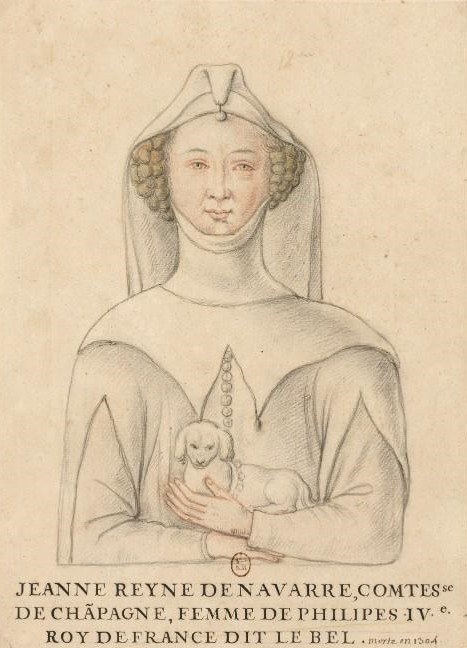
AI-assisted Portrait of Joan I of Navarre
The Queen Who Was No Ornament
History remembers Joan I of Navarre, when it remembers her at all, as the wife of Philip IV of France — the beautiful, ruthless king who broke the Templars and bullied the papacy. It is an unjust shorthand. Joan was not a consort acquired to seal an alliance and then set aside to bear children. She was a reigning queen in her own right: sovereign of Navarre, Countess of Champagne and Brie, an heiress whose hand brought two of the wealthiest and most strategically vital territories in Western Europe into the orbit of the French crown. When she married Philip in 1284, she did not so much join his power as double it.
Born in 1273, orphaned of her father in infancy and spirited to the French court for protection, Joan inherited her kingdom as a child and grew into a ruler who governed rather than reigned. When the Count of Bar invaded Champagne, she organized the military defense of her county herself; she administered her inherited lands with a competence contemporaries thought remarkable; and in 1305, with her own funds, she founded the College of Navarre in Paris, an institution that would educate the elite of France for the better part of five centuries. She was, in short, the rarest thing a medieval queen could be: indispensable in her own person.
Joan was the ESTJ on a throne — Te organizing armies and revenues and institutions, Si steady on the duties of inherited rule. She did not dream of what her realms might become. She made sure they ran.
The Queen Who Made Things Run
Te — dominant
Dominant Te is the drive to organize the external world — to take a situation, impose order on it, and make it produce a result. Joan's public life is a catalogue of it. When the Count of Bar marched into Champagne, the instinctive response of a Te-dominant is not to lament or negotiate from weakness but to assemble the means of defense and use them: she raised and directed forces to expel the invader and protect her county. And she governed Champagne — a commercial powerhouse whose fairs were among the great clearing-houses of European trade — as a going concern, managing its revenues and officials herself rather than collecting the prestige and farming out the work. Te does not merely hold a title; it runs the operation the title names.
Her most enduring act was the most characteristically Te of all. Rather than leave a legacy of sentiment, she built an institution and endowed it to outlast her: the College of Navarre, established in Paris in 1305, funded from her own resources and structured to educate students from her territories and beyond. Te thinks in systems that keep working after their founder is gone. The college did exactly that, training generations of French scholars and statesmen for nearly five hundred years — a machine for producing competence, set running by a queen who valued nothing more.
The Steward of What She Was Given
Si — auxiliary
If Te supplied the will to act, auxiliary Si supplied the frame: a deep respect for inheritance, continuity, and the established order of things. Joan was, before anything else, a steward — the holder of titles passed down to her, and the keeper of the rights and customs that came with them. She did not invent Navarre or Champagne; she received them, and her governing impulse was to preserve them intact and hand them on undiminished. That is Si's loyalty to what already exists.
It shows in her defense of Champagne, which was as much an act of conservation as of war: the county was hers by inheritance, and her duty was to keep it whole. It shows in the seriousness with which she discharged the obligations of rule rather than treating her crowns as decoration. Si builds its life on continuity and constancy — on honoring what one has been given — and Joan governed as if the order she inherited were a trust she had no right to squander.
The Founder's Reach
Ne — tertiary
Tertiary Ne in an ESTJ is the faculty that lets a deeply practical mind occasionally lift its eyes past the ledger and imagine something that does not yet exist. It is not the restless idea-generation of an Ne-dominant; it surfaces in flashes, usually harnessed to a concrete end. In Joan it appears most clearly in the founding of the College of Navarre. To endow a college is to bet on a future you will not see — to picture students, generations off, shaped by an institution that is at the moment only a deed and an intention. That forward projection is Ne, pressed into the service of Te's institution-building.
But it was a supporting player, not the lead. Joan was no visionary who reimagines a realm; her gift was for seeing what a structure could become and then building it solidly enough to get there — just enough imaginative range to found something lasting, and the dominant Te to make sure it stood long after she was gone.
The Private Loyalties
Fi — inferior
Inferior Fi is the quietest part of the ESTJ — the personal, inward sense of value that the type rarely puts on display but holds with surprising depth. In Joan it lived in her private attachments rather than her public conduct. The fidelity of her marriage was not, on the evidence, mere dynastic prudence; the bond between Joan and Philip read as genuine, and the king's refusal to remarry after her death is the kind of constancy that points to real feeling beneath the statecraft. Fi keeps its loyalties close and does not advertise them.
Inferior functions also provoke what they cannot govern, and Joan's did so posthumously and grotesquely: years after her death she became the pretext for a political witchcraft trial, her memory dragged into a courtly intrigue she could no longer answer. It is a bitter coda for an inferior-Fi figure — the woman who had spent her life on duties, revenues, and defenses reduced, once she was gone, to a symbol others could bend to their purposes. The competent steward could secure her lands; she could not secure her own legend.
Why ESTJ Over ISTJ
Why not ISTJ?
The ISTJ shares Joan's diligence, her respect for tradition, and her gift for sound administration — which is exactly why it tempts. But the ISTJ leads with Si and serves with Te: it is the careful, reserved keeper of records who works best behind the scenes and acts when called upon. Joan was the reverse. She led with action — raising a defense, governing a county hands-on, founding a college and willing it into being. She did not wait to be deployed; she initiated, commanded, and built outward into the world. That outward, directive energy is dominant Te, not auxiliary Te in an inward-anchored ISTJ.
The distinction is one of stance. Both types prize order and duty, but the ISTJ's center of gravity is internal — a private custodian of the way things are done. Joan led from the front, not the archive. That is the ESTJ: the steward who does not merely keep the order but runs it, and expands it, in plain view.
Connected Figures
Further Reading
- The Reign of Philip the Fair — Joseph R. StrayerThe standard English study of Philip IV's reign — essential for situating Joan within the machinery of the French crown she helped enlarge.
- The Queens Regnant of Navarre, 1274–1512 — Elena WoodacrePlaces Joan in the line of Navarrese ruling queens, taking her sovereignty in her own right seriously rather than as an appendage to France.
- Capetian France 987–1328 — Elizabeth Hallam & Judith EverardThe authoritative survey of the dynasty — invaluable for understanding Champagne, the succession, and the world Joan's sons would inherit.
