 Historical Figure MBTI
#465 · 4-13-26 · Capetian France
Philip V
King of France · The Tall, the Reformer
1293 — 1322
6 min read
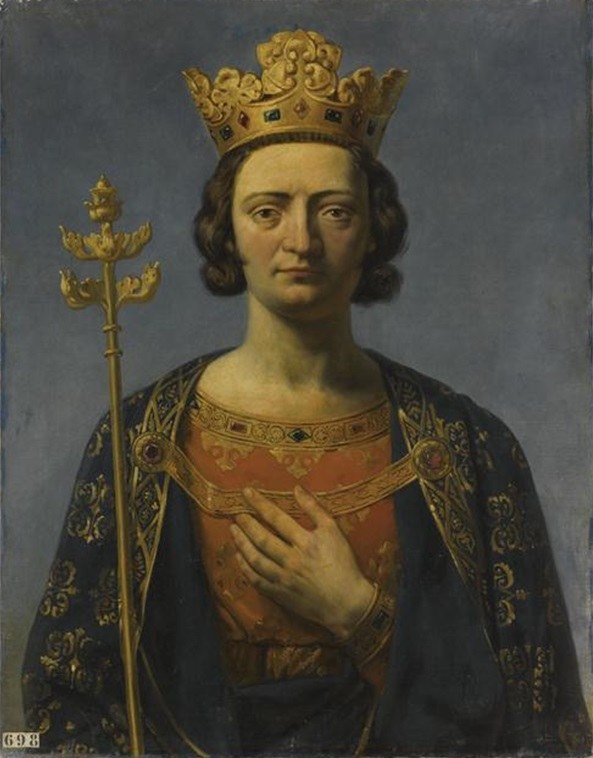
AI-assisted Portrait of Philip V
The King Who Counted
He was the second son, and second sons were not supposed to rule. But of the three brothers who wore the crown of France in the wreckage of their father's reign, Philip V — called “the Tall,” and more lastingly “the Reformer” — was the only one who knew what to do with it. Where his elder brother Louis X reigned briefly and quarrelsomely, and his younger brother Charles IV mostly held the line, Philip governed like a man auditing an estate inherited in disarray: line by line, account by account, fixing what could be standardized.
He came to the throne in 1316 through one of the strangest successions in French history. When Louis X died, his queen was pregnant; Philip stepped in as regent. The child, a boy known to history as John I, lived only five days. Philip then took the crown himself — pushing aside Louis's young daughter by asserting that a woman could not inherit the throne of France. It was an improvised justification for a contested seizure, but it hardened, over the generations that followed, into the principle men would call the “Salic law.” A throne taken by argument, defended by a rule: that is a very particular kind of king.
Philip V was the ISTJ on the throne of France — Si's reverence for precedent and standard wedded to Te's instinct for administration, a king whose power was order rather than command.
The Logic of the Standard
Si — dominant
Dominant Si is a mind organized around what is known, established, and reliable — it trusts the precedent, the record, the fixed measure. Where another temperament might have seen the disorder of early-fourteenth-century France as a chance for bold improvisation, Philip saw a system out of true, to be brought back into alignment with how things ought regularly to work. His reforms read like the agenda of a man who cannot tolerate a unit of measurement that means one thing in Paris and another in Toulouse.
The coinage is the clearest case. Money in the realm had been debased and confused; Philip worked to regularize it, because to an Si mind a coin is a promise of consistency, and an unreliable coin is a small daily betrayal. The same impulse drove his push to standardize weights and measures and to impose order on the accounts of the royal household and treasury. None of this was visionary in the Ne sense of imagining a wholly new order; it was the patient correction of an existing one against a remembered standard. That is Si in power: not invention but maintenance, raised to the level of policy — and it shows even in how he took the throne, reaching instinctively for the rule that would settle the matter rather than seizing it by sheer force of will.
The Machinery of State
Te — auxiliary
If Si told Philip what the standard should be, auxiliary Te gave him the apparatus to impose it. Te is the executive function — it builds structures, assigns responsibility, measures results, and is impatient with anything that wastes effort. Philip's reign was, more than his brothers', a reign of administration: of councils convened, accounts centralized, and officials set to the patient labor of making a sprawling kingdom govern itself by consistent procedure rather than by the whim of local power.
He worked at the machinery of government the way a competent manager works at a failing department — not with grand gestures but with reorganization. He pushed the centralization of royal finance and tried to make the crown's revenue something that could be reliably forecast rather than perpetually scrambled for. The ambition was thoroughly Te: a state that runs predictably because its parts are well-ordered and someone is keeping the books.
Te also explains how he weathered crisis. When the Pastoureaux — the so-called Shepherds' Crusade — erupted into a wandering popular uprising, and when panic over an imagined conspiracy of lepers and Jews swept the realm, Philip met both not as a man of passionate conviction but as an administrator managing a disturbance: containing it, restoring order. He did not author these episodes and was no persecutor by zeal; he was a manager of consequences, which is what an Si-Te king tends to be when the irrational breaks loose.
The Private Conviction
Fi — tertiary
Tertiary Fi gives the ISTJ a quiet inner compass — not the outward, atmosphere-reading warmth of Fe, but a private and somewhat inflexible sense of duty owed and standards kept. In Philip it surfaced less as warmth than as seriousness: a conviction that the king's work was an obligation to be discharged properly, and that good order was, in some moral sense, owed to the realm. There was an undertone of righteousness in his insistence on regularity and fair measure.
Fi at the tertiary position is also guarded and not easily moved by sentiment. Philip pursued the throne with a determination that brushed past the claim of a young girl — his own niece — justifying the act by principle rather than feeling. That is the shape of tertiary Fi yoked to Si and Te: a moral certainty that is real but inward, expressed through the dutiful execution of what he has decided is correct rather than any open display of the heart.
The Unimagined Future
Ne — inferior
Inferior Ne is the ISTJ's blind spot — the realm of open-ended possibility, of the wholly new departure, that an Si-Te mind tends to distrust and underuse. Philip's gifts were consolidating, not generative. He could repair a broken system superbly; he was far less a man for imagining one that had never existed. His reforms refined the Capetian state rather than reinventing it, answering “how do we make this work properly?” far more readily than “what else might this become?”
There is a quiet irony in where this left him. The methodical king who ordered the realm so carefully could not order the one thing that mattered most for a dynasty — the future. The Salic principle he improvised to seize his own throne would, within a generation, be turned outward to bar an English claimant and help touch off the Hundred Years' War — an unforeseen consequence of a rule made for an afternoon. Inferior Ne rarely sees that far ahead; it builds the system and is surprised by what the system later does.
Why ISTJ Over ESTJ
Why not ESTJ?
The ESTJ shares Philip's Te and his love of order, but leads with it — an outward, projecting, commanding presence that organizes people by sheer force of leadership. Philip governed from behind the desk, not the front of the room: a standardizer of coins, weights, and accounts who worked through systems and records rather than personal command. His mother Joan I of Navarre — a reigning queen who defended her territory and asserted herself in the open — reads far more ESTJ than her son. Philip's power was the quiet authority of procedure, which points to Si-dominant ISTJ rather than Te-dominant ESTJ.
The distinction comes down to where the energy points. The ESTJ's order is enforced outward, through visible leadership; the ISTJ's is anchored inward, in a remembered standard of how things should reliably be, and then expressed through patient administration. Philip was a behind-the-scenes reformer of the state's plumbing, not a commander of its public stage. His authority was order, not presence — and that is the ISTJ's signature.
Connected Figures
Further Reading
- The Reign of Philip the Fair — Joseph R. StrayerThe classic study of the administrative monarchy Philip V inherited and refined — essential for understanding the machinery he set out to standardize.
- Capetian France 987–1328 — Elizabeth Hallam & Judith EverardThe standard narrative survey of the dynasty, with clear coverage of the strange succession of 1316 and the brothers who followed Philip IV.
- The Capetians — Jim BradburyAn accessible history of the whole royal line that places Philip V's short, reforming reign within the long arc of Capetian state-building.
