 Historical Figure MBTI
#1298 · 9-26-26 · Heian Japan
Fujiwara no Tokihira
Minister · Rival of Michizane · Figure in a Contested Dismissal
871–909
5 min read
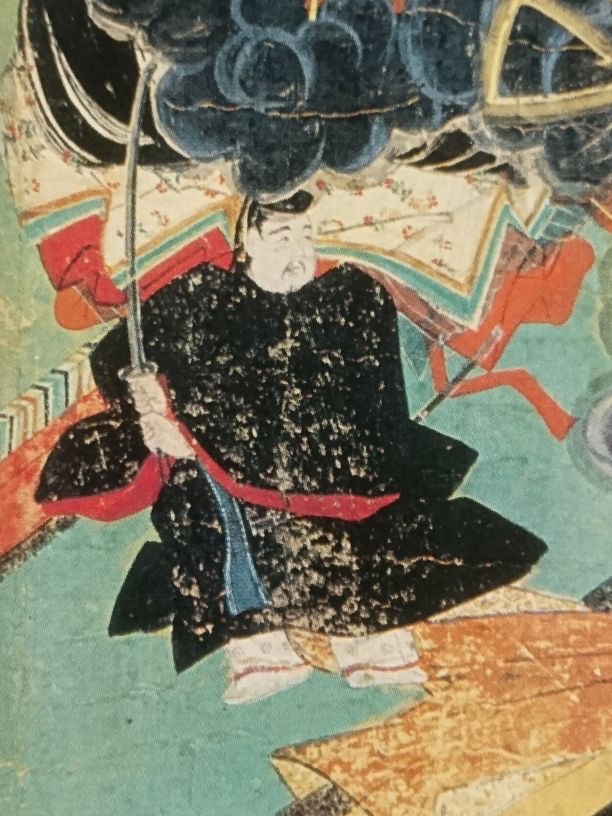
Portrait of Fujiwara no Tokihira — 1219 (later depiction)
A Minister Behind the Villain
Fujiwara no Tokihira is easiest to encounter as the antagonist of a more beloved figure. In Tenjin narratives, his rivalry with Sugawara no Michizane becomes a moral drama ending in supernatural punishment. The historical minister also occupied offices, participated in compilation, and helped direct government. A tentative ESTJ reading concerns that institutional activity, with low confidence. Neither a villain's role nor a minister's title can establish his private personality.
Born in 871, Tokihira was a son of Mototsune. Family standing supplied important opportunities, but his career did not consist merely of assuming an unchanged paternal office. He advanced under Uda and became Minister of the Left under Daigo. The two reigns offered different political settings, while his position linked aristocratic inheritance with ongoing work in imperial government.
ESTJ is a low-confidence hypothesis: dominant Extraverted Thinking fits Tokihira’s recorded participation in directing and clarifying the procedures of government.
Putting Administration into Usable Form
Tokihira participated in the government-sponsored compilation associated with the Engi era. The Engikyaku gathered regulations, while the Engishiki concerned detailed procedures for official activity. Work on the latter began in 905. It drew on earlier collections whose overlapping provisions and differing arrangements made consultation difficult. The task was not to invent every procedure afresh, but to make inherited instructions usable within a functioning administration.
Tokihira died in 909 before the Engishiki was complete. Tadahira and later officials continued the work, which was presented in 927 and brought into effect later. Calling Tokihira the sole author of all fifty books would erase that long collective history. His participation matters as an identifiable phase in a project whose scope extended beyond his lifetime.
Extraverted Thinking is proposed cautiously for the emphasis on organized official practice and the coordination required for compilation. The hypothesis is stronger when tied to a particular undertaking than when inferred from high rank alone. Even so, a commission documents responsibility more securely than temperament. The surviving evidence does not show how he handled every practical problem or interacted outside government.
Authority Through Received Forms
The procedures concerned matters such as offices, ritual responsibilities, supplies, and the resources required for public undertakings. Previous codes and regulations remained authoritative reference points. Clarification and consolidation therefore worked through received institutional forms. Reform did not necessarily mean discarding the order that had made Tokihira's position intelligible.
Introverted Sensing offers a limited comparison for this attention to inherited procedure and precedent. It does not prove that he opposed novelty in every setting. His generation had to respond to changing conditions, and the compilation itself could reorganize material. The proposed ESTJ pattern joins practical direction with the maintenance of recognizable standards, rather than equating tradition with mechanical repetition.
The Accusations of 901
Michizane held the office of Minister of the Right while Tokihira held the senior position on the left. Their advancement brought different family resources and imperial relationships into the same governing circle. In 901 accusations concerning the succession led to Michizane's removal to Dazaifu. Later histories and shrine traditions associate Tokihira with the denunciation. The political result is clear; the details of every private intention are less accessible.
A responsible account should not state the alleged plot as established conduct by Michizane, or reproduce the shrine narratives as a transcript of Tokihira's mind. Political accusation could remove a rival without leaving a neutral explanation of why all participants accepted it. Imperial decisions, court access, kinship, and factional interests all belong in the analysis. Reducing the affair to one jealous man obscures that setting.
Tokihira died at thirty-eight by modern reckoning in 909. Later tradition interpreted his early death through the wrath of Michizane's spirit. That interpretation belongs to the development of Tenjin worship. It cannot establish supernatural causation, a confession of guilt, or a psychological tendency inferred backward from the manner in which a rival was remembered.
Court Culture and the Limits of Attribution
Tokihira's household also appears in the record of poetry and garden contests. An autumn plant contest associated with his residence survives through its poems, although its precise date and circumstances remain uncertain. Such an event places him within the cultural practices of elite patronage. It does not by itself disclose his aesthetic sensitivity or show that the sponsor personally designed every feature of the occasion.
This distinction is useful across his career. A compiled text, a sponsored gathering, and a hostile legend each preserve a different relation to the minister. Public responsibility can be identified while authorship, intention, and personal habit remain uncertain. Keeping those categories separate yields a less dramatic portrait, but one that recognizes both his governmental contribution and the unresolved politics of Michizane's fall.
Testing the ESTJ Reading
Why not ENTJ?
ENTJ is plausible for a senior minister capable of consolidating authority and directing major undertakings. ESTJ is preferred tentatively because the clearest institutional evidence emphasizes the clarification and execution of received procedures. That distinction rests on a narrow public record, and a scholarly commission does not reveal an individual's full cognitive preferences.
The type proposal excludes supernatural vengeance and remains separate from any judgment about the justice of the removal of Michizane.
Connected Figures
Further Reading
- Sugawara no Michizane and the Early Heian Court — Robert BorgenA modern study of the scholar’s political career, literary work, and the court institutions around him.
- The Cambridge History of Japan, Volume 2: Heian Japan — Donald H. Shively and William H. McCullough, editorsScholarly accounts of imperial government, Fujiwara authority, religion, and cultural life.
- A History of Japan to 1334 — George SansomA broad historical account useful for chronology, to be read alongside more recent work on institutions and sources.
- Engishiki: Procedures of the Engi Era — Felicia Gressitt Bock, translatorA partial English translation of the procedural collection whose compilation began during Tokihira’s lifetime.
