 Historical Figure MBTI
#598 · 5-4-26 · The Age of the Borgias
Giulia Farnese
Mistress of the Pope · The Bride of Christ · Founder of Farnese Fortunes
1474 — 1524
6 min read
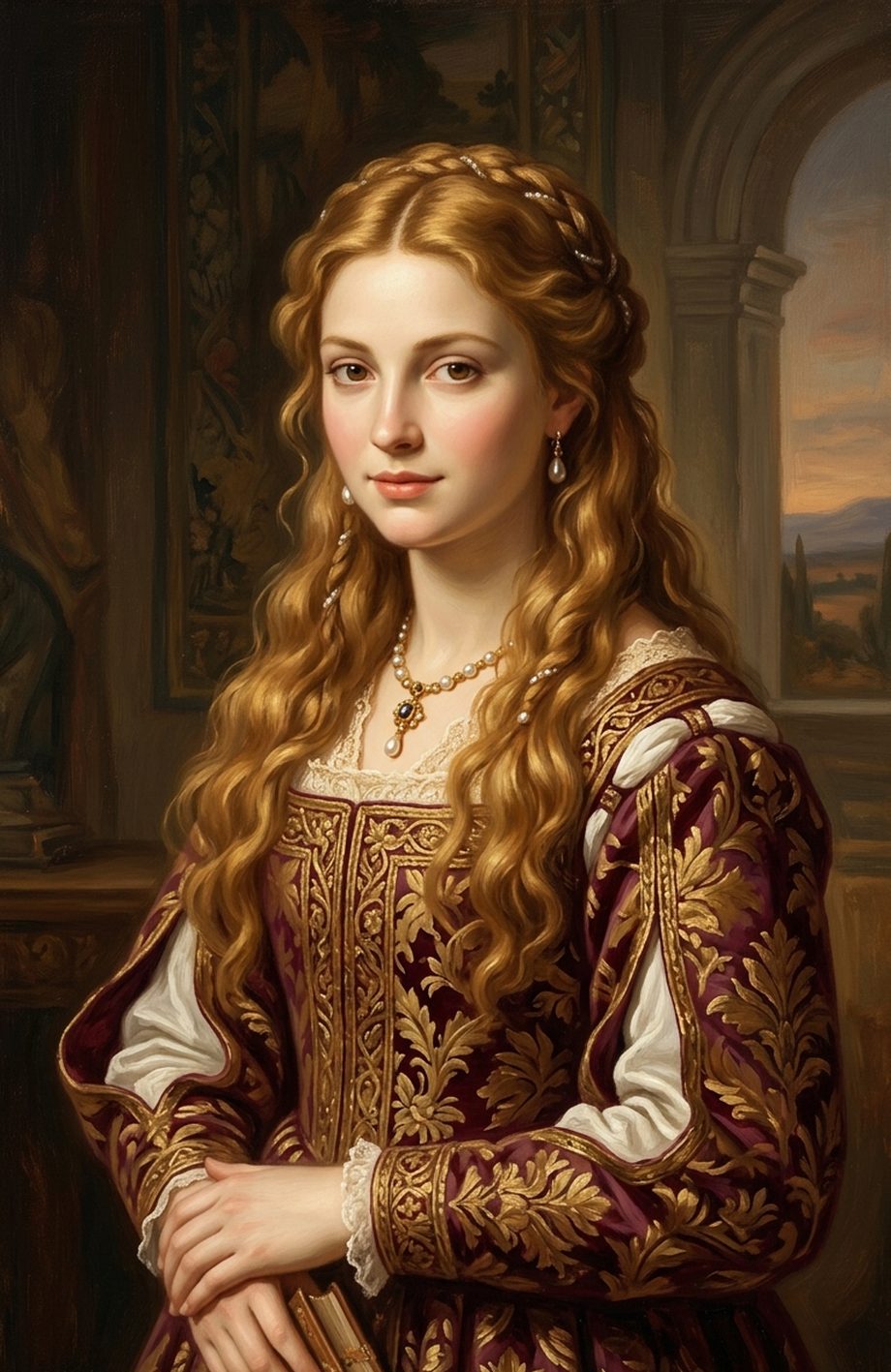
AI-assisted Portrait of Giulia Farnese
The Face That Made a Dynasty
Rome called her Giulia la Bella — Giulia the Beautiful — and for once the gossip and the truth agreed. In an age that treated beauty as a form of currency, she was reckoned among the most dazzling women alive, and she spent that currency with a shrewdness no one expected from a girl barely out of her teens. Married at fifteen to an inoffensive nobleman of the Orsini clan, she became, at about nineteen, the mistress of Pope Alexander VI — the Borgia pope, then near sixty, the most powerful man in Christendom. Rome jeered. They called her “the Bride of Christ” and worse, painted her as the Pope's whore, a pretty ornament on a corrupt old man's arm.
They mistook the ornament for a fool. Giulia (1474–1524) understood exactly what she held, and she used it — not for a mistress's vanity, but for blood. Her family, the Farnese, were minor Roman nobility going nowhere. Through her sway over Alexander she pulled them upward: her brother Alessandro received a cardinal's hat, sneered at across Rome as “the Petticoat Cardinal” because he owed it to his sister's charms. That same brother would rise, decades later, to become Pope Paul III. Giulia's face, in the final accounting, launched a papal house.
Giulia is the ESFP as courtly enchantress: Se's gift for beauty, spectacle, and the sensual pleasures of the Renaissance court, harnessed by an Fi loyalty that pointed always in one direction — the Farnese blood. She lived by allure and spent it, coolly, on the people she loved.
The Currency of Beauty
Se — dominant
Dominant Se lives in the immediate, physical, sensory world — and Giulia's great instrument was her own presence. Contemporaries did not merely note that she was handsome; they wrote as though her beauty were an event, something that happened to a room. Her fabled golden hair reached, it was said, to her feet. The Farnese later hung her likeness in their palace and, by tradition, the sculptor and painters of the age used her as a model for their Madonnas and their allegories of beauty itself. This is Se's signature: not the idea of loveliness but its overwhelming fact, wielded in person, in the flesh, in the charged air of a papal court.
And she was at home in that court's pleasures. The Borgia Rome of the 1490s was a world of banquets, spectacle, and appetite, and Giulia moved through it with ease. She was not a schemer working the shadows; she was a charmer working the light — present, warm, physically magnetic, the sort of woman who won a room by walking into it. Where a strategist plots, the Se enchantress simply arrives, and the arrival is the argument. Alexander, for all his cunning, was captivated for years.
Blood Before Rome
Fi — auxiliary
Auxiliary Fi is a private compass — a loyalty felt rather than argued, oriented to a handful of people who matter above the whole clamoring world. Giulia's compass pointed, unwaveringly, at the Farnese. She endured the ugliest slander in Rome, the leering nickname, the caricature of the fallen woman, and there is no sign it moved her at all. What she cared about was her own — and by her own she meant her brother, her family, her name. She spent her position not on herself but on them, and she did it without apology.
This is the distinction that saves her from being merely a courtesan of history. A woman who wanted only luxury and status would have hoarded the Pope's favor for her own comfort. Giulia converted it into a cardinal's hat for Alessandro — a durable, inheritable form of power that would outlast her looks and her hold on Alexander alike. It was Fi's quiet arithmetic: the beauty is temporary, but the blood is forever, so pour the temporary thing into the permanent one while you still can. Her warmth was real and it was narrow, and that narrowness was precisely its strength.
When the Mirror Turns
Ni — inferior
Inferior Ni is the ESFP's blind spot — the long, dark foresight of time and consequence that the present-tense charmer would rather not look at. Giulia's gift was bound to the moment, and the moment does not last. As she aged, her hold on Alexander loosened; a younger face caught his wandering eye, and the woman who had ruled the Pope's attention found it drifting elsewhere. She had weathered worse in the flesh — captured by French troops on the road in 1494 and held for ransom until Alexander scrambled to buy her back — but no ransom could purchase back a fading beauty. The single asset on which her whole rise had been built was the one asset that could not be renewed.
But if Ni was her weakness, she had, through Fi and Te, quietly hedged against it. The cardinal's hat she won for Alessandro did not fade with her hair. When Alexander died in 1503 she was not yet thirty; she remarried after her first husband's death, and lived on two more decades, dying in 1524 — long enough to watch the seed she had planted grow toward a papacy she would not survive to see. The enchantress who could not hold a moment had, almost in spite of her type, secured a future.
Why ESFP Over ESFJ
Why not ESFJ?
The warm, sociable, family-serving surface can read as ESFJ — the dutiful caretaker organizing everyone's expectations. But the ESFJ works through communal duty and shared roles, filling the place a family or society hands her. Giulia did the opposite: she operated through personal magnetism and her own desire, an individualist who charmed a pope into breaking every rule of decorum. She served her family, yes — but as an Fi loyalist choosing her own, not an Fe caretaker tending the group's harmony. That is Se–Fi allure, not ESFJ social duty.
The tell is her relationship to scandal. An ESFJ lives inside the web of social approval; to be branded the Pope's whore across Christendom would be a wound to the core. Giulia simply did not seem to care. She took what she wanted, gave what she chose to give, and let Rome talk. That indifference to communal judgment, paired with a fierce private loyalty to a handful of her own blood, is pure Fi — and the whole enterprise rode on a beauty and a presence that were unmistakably Se. She was not filling a role. She was an appetite with a purpose.
Connected Figures
Further Reading
- The Borgias and Their Enemies — Christopher HibbertA vivid narrative history of the Borgia court — strong on the texture of Alexander VI's Rome and Giulia's place within it.
- The Borgias: The Hidden History — G. J. MeyerA revisionist account that weighs the propaganda against the record, reassessing the family and the women around them.
- Lucrezia Borgia: Life, Love and Death in Renaissance Italy — Sarah BradfordThe definitive life of Giulia's friend — the fullest portrait of the female world of the Borgia circle in which Giulia moved.
