 Historical Figure MBTI
#597 · 5-4-26 · The Age of the Borgias
Juan Borgia
Duke of Gandia · The Favored Son · The Body in the Tiber
c. 1474 — 1497
6 min read
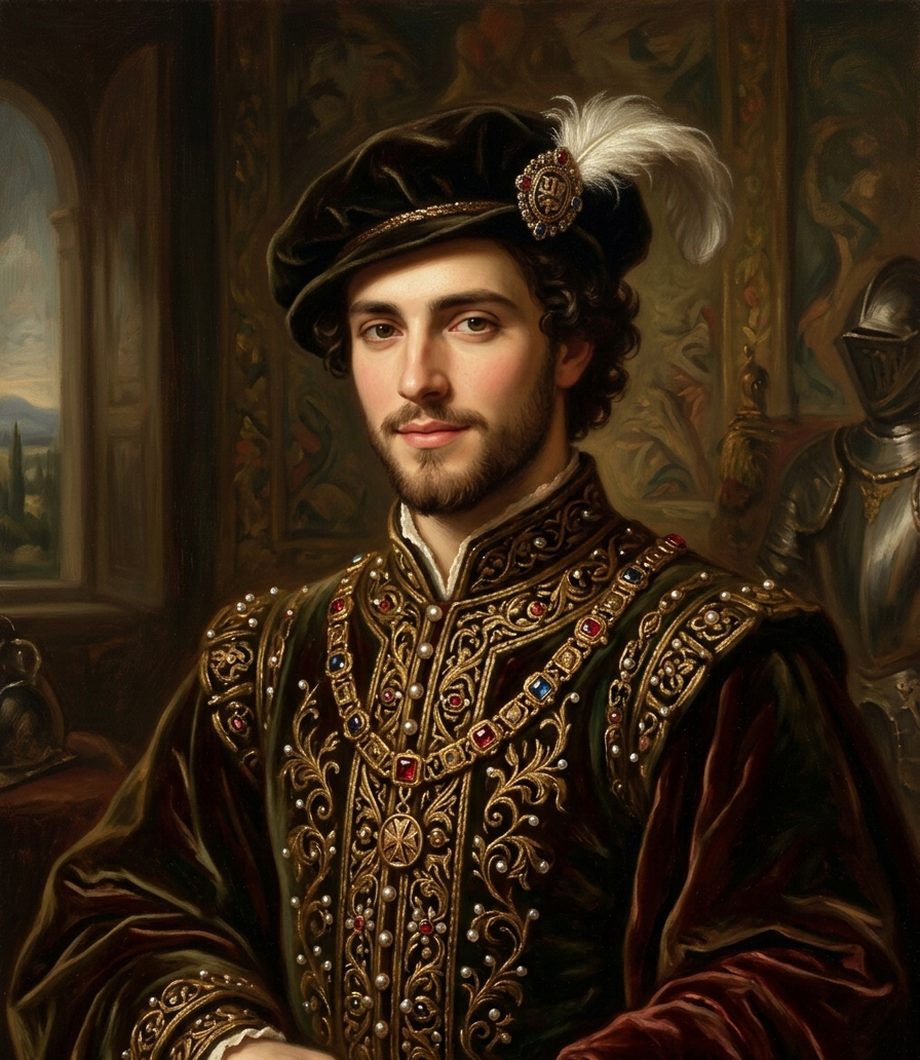
AI-assisted Portrait of Juan Borgia
The Son Who Was Given Everything
Every family has a favorite, and the Borgias had Juan. Handsome, charming, and indulged past all reason, he was the son his father loved best and the world could least justify. Where his brother Cesare was all cold ambition and his sister Lucrezia all pliant grace, Juan was pure appetite — a young man who wanted the pleasures of the good life and expected them to arrive without effort, because for him they always had. He is the golden boy of the most notorious family of the Renaissance, and the tragedy of his brief life is that being loved is not the same as being capable.
Giovanni — “Juan” in the Spanish style the family favored — Borgia, second Duke of Gandia (c. 1474–1497), was the son of Pope Alexander VI by his mistress Vannozza dei Cattanei. Alexander poured upon him everything a doting father with a papacy at his disposal could give: the rich Spanish duchy of Gandia, a cascade of titles, and finally the command of the papal armies, for Juan was meant to be the dynasty's warrior — the Borgia sword. It was a role for which nothing in him fit. He was a ESFP handed a soldier's life, a pleasure-seeker dressed as a general, and the one test that mattered would expose him completely.
Juan is the ESFP as indulged golden boy: Se's hunger for luxury, spectacle, and the good life, coupled to an Fi charm that won his father's love in place of any achievement — a man loaded with honors he was never equal to carrying.
An Appetite for the Good Life
Se — dominant
Dominant Se is a hunger for the vivid present — for luxury, spectacle, sensation, and the immediate rewards of being alive — and Juan wanted all of it. He dressed magnificently, kept lavish company, and moved through Rome as a young man to whom the city's pleasures were simply his due. Contemporaries and later chroniclers describe a life given over to display and diversion: fine clothes, women, gambling, the glittering surface of Renaissance Rome enjoyed to the hilt. He had the taste and the means, and no inclination to earn either.
That appetite would have been harmless in a private nobleman. In the son commissioned to lead armies it was ruinous, because Se's pull toward pleasure kept crowding out the grinding, unglamorous work of command. Juan preferred the feast to the field, the revel to the drill. When his father sent him against the Orsini strongholds in 1496–97, the campaign went badly — poorly managed, a costly reverse at Bracciano — and it was hard not to see a general who had rather enjoyed his station than done its labor. The good life was the point; the duty was the interruption.
Loved, Not Earned
Fi — auxiliary
Auxiliary Fi gave Juan the personal charm that was, in the end, his only real asset. He had the gift of being liked — a warmth and an easy attractiveness that made a doting father dote all the harder. Alexander VI did not favor Juan for anything he had accomplished, because he had accomplished almost nothing; he favored him because Juan was his darling, the child on whom his affection had fixed. It is the pathos of the type's lesser form: the charm secures the love, and the love substitutes for merit.
This is what separates Juan from the ruthless engine of his family. His brother Cesare rose by cold calculation and terror; Juan rose by being adored. Every honor heaped on him — the duchy, the titles, the command — flowed from his father's feeling rather than his own achievement, and everyone at the papal court understood as much. It bred a corrosive jealousy, above all in Cesare, who watched the family's prizes go to the brother who had earned none of them. Juan's charm bought him a father's heart, and it may, in the end, have cost him his life.
The Sword That Would Not Cut
Te — tertiary
Command is Te's province — the organization of men, resources, and logistics toward a hard objective — and for the ESFP it sits low in the stack, weak and unpracticed. This was the exact faculty Juan's life demanded and the exact one he lacked. Made Captain-General of the Church, he was expected to plan campaigns, discipline troops, and win. Instead he proved a poor and unsuccessful commander, out of his depth the moment the fighting grew serious. The 1496–97 war against the Orsini, which was to make his name, instead unmade it: the papal forces were checked and bloodied, and the Duke of Gandia came home with little to show but the appointment itself.
It is the cruelty of a mismatch between a man and his role. Juan had been given the one job that draws entirely on a strong Te — strategy, command, the cold administration of force — and he had none to draw on. His gifts were for the banquet and the bedchamber, not the battlefield. Loaded with an authority he could not exercise, honored as a warrior he had never been, he coasted on his father's favor until, for once, results were required — and there were none. His single real test exposed exactly how little was underneath the honors.
Why ESFP Over ESTP
Why not ESTP?
The temptation is to read the swaggering, pleasure-loving soldier as an ESTP — the bold, shrewd operator who reads a situation and seizes advantage. But that is precisely what Juan was not. The ESTP is tactically capable, alive to opportunity, effective under fire; Juan was militarily inept and out of his depth, a general who lost. He rose on charm and paternal favor rather than competence, coasting where an ESTP would have gripped and maneuvered. His is Se–Fi indulgence, not ESTP tactical command.
The distinction is the difference between an operator and an ornament. An ESTP given the papal armies would have found the angle, worked the terrain, and turned the war to his advantage; Juan simply enjoyed the title and fumbled the task. What defined him was not a cool reading of the present for gain but an appetite for its pleasures — the good life pursued for its own sake, backed by a charm that won love in place of achievement. That is the ESFP: the favored son who was equal to every honor except the one that asked him to actually do something.
Connected Figures
Further Reading
- The Borgias and Their Enemies — Christopher HibbertA vivid narrative history of the family — strong on Juan's favored status, his dissolute Rome, and the unsolved murder.
- The Borgias: The Hidden History — G. J. MeyerA revisionist account that scrutinizes the legends around the family, including the case against Cesare for Juan's death.
- The Borgias: The Rise and Fall of a Renaissance Dynasty — Michael MallettThe measured scholarly study of the dynasty — places Juan's brief career and killing within the family's political rise.
