 Historical Figure MBTI
#596 · 5-4-26 · The Age of the Borgias
Lucrezia Borgia
Duchess of Ferrara · Daughter of a Pope · Pawn and Survivor
1480 — 1519
8 min read
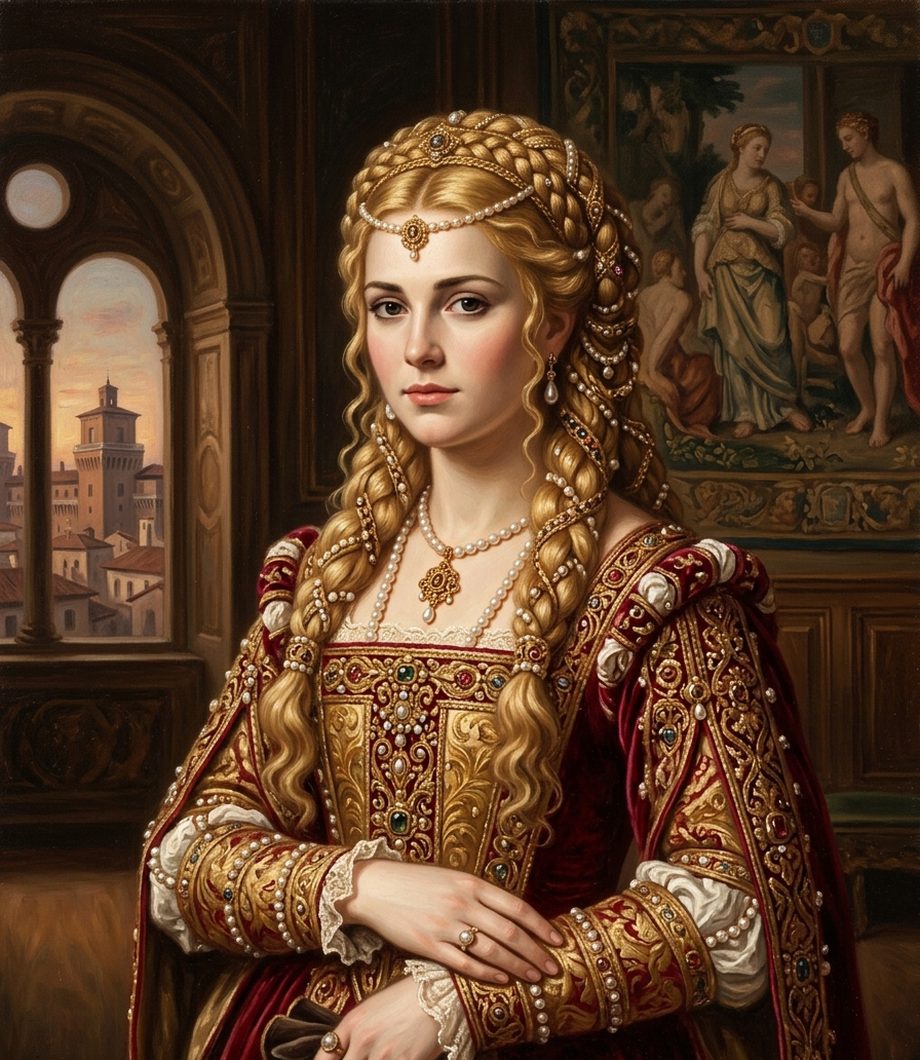
AI-assisted Portrait of Lucrezia Borgia
The Poisoner Who Never Poisoned Anyone
She is the most slandered woman of the Renaissance, and almost none of it is true. For five centuries Lucrezia Borgia has been the golden-haired sorceress with a hollow ring of poison, the incestuous daughter of a corrupt pope, the femme fatale trailing dead husbands and lovers. It is a magnificent legend, and it was almost entirely manufactured — assembled by the enemies of her family, who could not strike at the terrifying pope and his terrifying son, and so struck at the one Borgia who could not strike back. The real Lucrezia poisoned no one. She was not the schemer of the story. She was its instrument.
Born in 1480 to Rodrigo Borgia — the future Pope Alexander VI — and his mistress Vannozza dei Cattanei, she was a currency before she was a person. Her father and her brother Cesare spent her three times on the marriage market: first to Giovanni Sforza, discarded when the alliance soured and publicly humiliated by an annulment on grounds of impotence; then to Alfonso of Aragon, the one husband she truly loved, murdered almost certainly at Cesare's command; and finally to Alfonso d'Este, heir to Ferrara, where at last she was sent to live. And there the black legend quietly collapsed. Given a domain of her own, far from Rome, she became something no one had let her be: herself — a capable duchess, a beloved regent, a patron of poets, a woman of real feeling and quiet grace. The monster of the story turned out to be an ISFP who had simply never been allowed a life.
Lucrezia is the ISFP defined by everything that was done to her rather than by anything she did: dominant Fi kept an untouched inner self — her true loves, her private integrity — alive through years of being used as a Borgia bargaining chip, and Se turned that survival, once she was finally free, into a life of beauty, art, and grace.
The Self They Could Not Sell
Fi — dominant
Dominant Fi is a private compass — an inner sense of what is true, what is loved, held so deeply that no external pressure can rewrite it. Lucrezia's whole life was a test of that compass, because for two decades others controlled everything about her circumstances and nothing about her interior. Betrothed at eleven, married at thirteen, divorced, widowed, and remarried, each move dictated by Borgia strategy, she kept intact the one thing they could not negotiate: her own feeling. She loved Alfonso of Aragon for himself, not for the alliance he represented, and when he was murdered she grieved with a private ferocity that embarrassed a family that expected her to move on to the next arrangement.
The clearest window into that interior is her correspondence with the poet and future cardinal Pietro Bembo — a tender, probably chaste exchange from the years of her Ferrara marriage. The letters are not the letters of a schemer; they are careful, warm, alive to a feeling she could name to a poet but act on with no one — the record of a woman keeping a chamber of her own heart lit while she performed the role a dynasty had assigned her. Fi does exactly this: it protects an authentic self behind the necessary public face, and grants that self to almost no one.
This is why the poison legend is not merely false but psychologically backwards. The Borgia who killed did so from cold calculation of advantage; Lucrezia's defining trait was the opposite — a stubborn personal integrity that outlasted being used. She never became the ruthless thing her family needed. The inner life they could never reach turned out to be the most durable thing about her.
The Aesthete of Ferrara
Se — auxiliary
Auxiliary Se is the ISFP's outward channel — a sensuous appetite for beauty and a gift for living gracefully in the physical present. Lucrezia had it in abundance, and contemporaries who met her expecting a demon were repeatedly disarmed by it: when she made her grand progress north to Ferrara in 1502, the party escorting her reported not a scheming poisoner but a charming, elegant young woman who danced, dressed superbly, kept her spirits up on a hard winter journey, and put an initially suspicious Este court at ease. Charm, here, is not a weapon but a temperament — the natural warmth of a person genuinely present with whoever stands before her.
At Ferrara that sensibility found its setting. Her court became one of the most cultivated in Italy: she gathered poets and musicians, patronized Pietro Bembo, and moved in the same brilliant orbit as Ludovico Ariosto, who would praise her in the Orlando Furioso. She loved fine clothes, jewels, dancing, and the whole aesthetic surface of Renaissance court life — not out of vanity but out of the ISFP's deep pleasure in the beautiful and the immediate. Where Cesare made himself the most feared man in Italy, Lucrezia made herself the center of a small, graceful world and filled it with art.
Learning to Read the Long Game
Ni — tertiary
Tertiary Ni develops slowly, and in Lucrezia it grew where it had to: in survival. A girl raised inside the most dangerous family in Italy, and used as its instrument, learns eventually to see a few moves ahead. The young Lucrezia was a pure pawn; the older Duchess of Ferrara had absorbed the lesson of her own history and could read the currents around her with a foresight her earlier self never had — and the proof is that she outlasted her own family. When Alexander VI died in 1503 the Borgia empire collapsed with terrifying speed; Cesare, so recently the master of central Italy, was ruined within a year and dead within four. Lucrezia, safely established in Ferrara, survived them all, because she had built for herself a life on other foundations — a marriage, a duchy, a reputation for piety and grace — that would stand when the family that made her had fallen.
The Ruthlessness She Was Born To and Never Had
Te — inferior
Inferior Te is the ISFP's weakest register — the cold, impersonal machinery of power, leverage, and calculated ends. The irony of Lucrezia's life is that she was born into the family that wielded that machinery more nakedly than anyone in Italy, and was the one Borgia who could not operate it. Her father and brother thought in terms of alliances, threats, and disposable people; Lucrezia thought in terms of loves and loyalties. The legend that made her a poisoner is, at bottom, a slander that assigns her brother's faculty to her.
Where inferior Te did surface was in administration — late, and learned rather than native. As regent she governed competently, but never in her family's way: she ruled through care, presence, and personal loyalty rather than system and command. When she died in 1519, worn out by repeated pregnancies and grief, Ferrara mourned her not as a strategist it had feared but as a duchess it had loved — the perfect epitaph for the type, the Borgia who conquered no one and was mourned by everyone.
Why ISFP Over ISFJ
Why not ISFJ?
The ISFJ case is tempting: Lucrezia was dutiful, pious, married where she was told, and spent her final years in devoted service to Ferrara. But the ISFJ fills an expected role out of duty, submerging the self into what the family and community require. Lucrezia did the opposite. Once free of Rome she did not merely serve the part of duchess — she built her own identity, her own tastes, her own court, her own loves and friendships and patronage, quietly becoming a distinct person rather than a well-behaved role-filler. That is Fi individuality asserting a private self, not Si-Fe conformity to an inherited script.
The distinction is the whole story of her life. For twenty years Lucrezia was made to play the ISFJ's part — obedient daughter, useful wife, piece moved around the board — because she had no choice. What both the black legend and the dutiful-daughter reading miss is the person underneath: a woman with an inner life entirely her own, who loved where she chose and, given at last a small domain to fill, filled it not with someone else's expectations but with poetry, beauty, and her own grace. She was never the monster and never merely the pawn — she was an individual all along, waiting to be let out.
Connected Figures
Further Reading
- Lucrezia Borgia: Life, Love and Death in Renaissance Italy — Sarah BradfordThe definitive modern biography — a meticulous, sympathetic reconstruction that dismantles the black legend and recovers the real woman behind it.
- The Life and Times of Lucrezia Borgia — Maria BellonciThe classic Italian portrait, richly documented from the Ferrara archives; long the standard life and still deeply evocative of her world.
- The Borgias and Their Enemies — Christopher HibbertA vivid, accessible narrative of the whole family — useful for placing Lucrezia within the ambitions of her father and brother that shaped her fate.
