 Historical Figure MBTI
#444 · 4-11-26 · The Age of Travelers
Guillaume Boucher
Parisian Goldsmith · Builder of the Silver Tree of Karakorum
fl. 1250s
8 min read
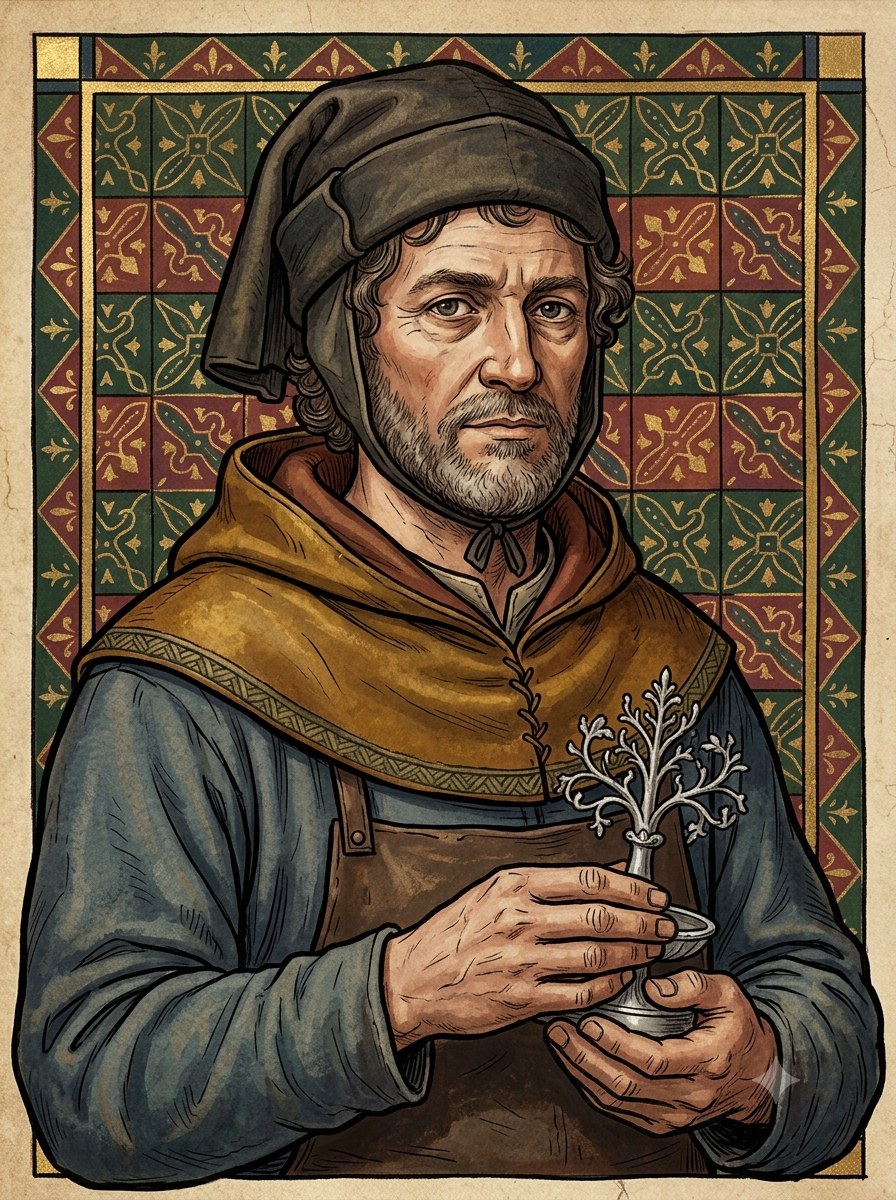
AI-assisted Portrait of Guillaume Boucher
The Goldsmith Who Built Wonders for His Captors
He was a goldsmith from Paris, and then he was a slave. Sometime in the 1240s, as the Mongol armies tore across eastern Europe, Guillaume Boucher was seized at Belgrade, in Hungary, and carried thousands of miles east to Karakorum—the capital that Möngke Khan's family had raised on the Mongolian steppe. Most captives of that scale vanish from the record entirely. Boucher did not, because Boucher could do something the Mongols valued more than ransom: he could make metal do impossible things.
At the Great Khan's court he built his masterpiece—the Silver Tree of Karakorum, a mechanical drinking-fountain shaped like a great tree of silver. Four silver lions and four serpent-pipes poured wine, fermented mare's milk, mead, and rice-wine on command, and a silver angel perched at the summit lifted a trumpet to signal the cup-bearers when the reservoirs ran dry. It was a marvel of European engineering installed at the dead center of the largest empire the world had yet seen, built by a man who had been dragged there in chains. We know all of this because a Flemish friar, William of Rubruck, met him at Karakorum around 1254 and wrote it down: the fountain, the hidden machinery, the wife, the exile.
Boucher is the ISTP reduced to its purest expression—a problem-solving intelligence that lives in the hands and the mechanism, indifferent to whose banquet it serves, fixed on the only question that has ever really interested it: how does the thing work?
The Logic Inside the Silver
Ti — dominant
The genius of the silver tree was never the silver. Any wealthy court could commission a handsome ornament; what Boucher delivered was a working machine disguised as one. Hidden inside the trunk a man crouched out of sight, and at the angel's summit a system of pipes and bellows was rigged so that, on a signal, air was forced through the trumpet to produce its blast. Below, four separate conduits had to be routed, sealed, and balanced so that wine, kumis, mead, and rice-wine each emerged from its own serpent without leaking or mixing. This is dominant Ti at work: the world treated as a system of internal relations to be reasoned out, where every component must be logically consistent with every other or the whole thing fails.
What distinguishes Ti from mere skill is its indifference to the surface. Boucher did not ask whether the tree was beautiful enough to honor a Khan; he asked whether the mechanism would actually function—whether the hidden operator could see his cue, whether the pressure would carry the liquid the full height of the serpents, whether the angel would lift its arm on command. The pleasing form was a constraint the machinery had to satisfy, not the point of the exercise. It is telling that the detail Rubruck records most carefully is the engineering, not the ornament: to the court the tree was a wonder; to its maker it was a solved problem.
Mastery in the Hands
Se — auxiliary
Ti supplies the logic; auxiliary Se supplies the hands that make it real. A goldsmith's trade is the most tactile imaginable—the heft of the ingot, the exact heat at which silver yields, the resistance of the metal under the graver, the moment a solder takes. This is sensory intelligence of the highest order, knowledge that cannot be read in a book but only learned through years of contact with the material itself. The ISTP's Se makes him the natural craftsman: present to the physical world, attuned to how things behave under the tool, capable of improvising when the metal does something the plan did not predict.
That hands-on responsiveness is also what made Boucher portable. A scholar torn from Paris and set down on the steppe would have been useless; his value lived in a context that no longer existed. Boucher's value lived in his fingers—give him a forge, silver, and tools and he could reconstitute his entire worth anywhere on earth, which is precisely what he did. The Ti–Se pairing is the engine of the whole figure: auxiliary Se gives dominant Ti a material to think through, and the abstract logic of pressure and flow becomes a real tree of hammered silver. Strip out the hands and Boucher is a clever man with a diagram; strip out the logic and he is a fine metalworker with nothing remarkable to build.
The Single Vision Behind the Whole
Ni — tertiary
Tertiary Ni in an ISTP shows up as the capacity to hold a finished design in the mind's eye before a single piece of it exists. The silver tree was not assembled by trial and error; it was conceived whole—tree, lions, serpents, angel, hidden operator, all coordinated toward one effect—and then executed toward that image. Someone had to foresee how the concealed man, the air bellows, the four conduits, and the timing of the pour would converge into a single unified spectacle. That convergent, end-state foresight is Ni, lending the hands-on Thinker a sense of where a long build is ultimately heading.
Held in the tertiary position, this insight serves the dominant function rather than ruling it. Boucher was no mystic; his Ni was harnessed entirely to the machine, supplying the master plan that his Ti made consistent and his Se made real—the quiet faculty that lets a craftsman commit months of irreversible labor to an object that exists, for most of that time, only as a picture in his head, and trust that the picture will hold.
The Stranger at the Banquet
Fe — inferior
Inferior Fe is the ISTP's blind spot—the realm of group feeling, loyalty, and belonging that the type navigates least naturally. Boucher's circumstances threw it into sharp relief. He built the centerpiece of the Khan's feasts, the very fountain around which the court's collective revelry turned, yet he stood outside that warmth entirely: a Christian captive among Mongols, a Parisian on the steppe, a man whose creation served a fellowship he could never join. He supplied the social occasion without sharing in it.
And yet inferior Fe is not absent—it surfaces, late and quietly, in the one place such a man tends to find it. Boucher had a wife at Karakorum, the daughter of a captured woman from Lorraine, two exiles who built a private bond at the edge of the world. Rubruck's account preserves this domestic life alongside the marvels, and it reads as the human counterweight to the machine: the goldsmith whose genius answered to logic and silver found his belonging not in the glittering court he furnished but in a small household of fellow strangers. The inferior function, here, is the part of the story that has nothing to do with how anything works—and everything to do with how a captured man kept hold of a life.
Why ISTP Over ISFP or ESTP
Why not ISFP?
The ISFP shares the goldsmith's love of the material but leads with feeling and aesthetics—an artist whose hands serve a sense of beauty. The marvel of Boucher's tree, though, is not how it looks but how it works: the hidden operator, the air-driven trumpet, the four balanced conduits. His genius is mechanical, not decorative—a logic problem solved in silver. That is Ti leading Se, the engineer, not Fi leading Se, the craftsman-aesthete.
Why not ESTP?
The ESTP flips the stack—Se dominant, Ti auxiliary—and lives outward, reading rooms, working people, hungry for the social arena. Boucher is the inward variant: a man who stood apart from the very court he dazzled, absorbed in the mechanism rather than the crowd around it. His talent was for the closed system of the device, not the open game of people. The introverted, problem-first orientation is the ISTP's, not the performer's.
The decisive question is what Boucher was actually solving for. Not beauty, and not an audience—but function. He built a machine that happened to be made of silver and happened to delight a Khan, and he understood it, to the end, as a piece of engineering. The ISTP's motivation is exactly that: to make the thing work, cleanly and completely, whoever ends up drinking from it.
Connected Figures
Further Reading
- Guillaume Boucher: A French Artist at the Court of the Khans — Leonardo OlschkiThe single dedicated study of Boucher — reconstructs the goldsmith, the silver tree, and his place in the cultural traffic between Europe and Mongol Asia.
- The Mission of Friar William of Rubruck — ed. Peter Jackson & David MorganThe annotated translation of Rubruck's report, the eyewitness source for the silver tree and the only record of Boucher's life at Karakorum.
- Voyager from Xanadu — Morris RossabiOn the long-distance travelers who crossed the Mongol world; rich context for the captives and craftsmen swept into Karakorum.
