 Historical Figure MBTI
#445 · 4-11-26 · The Age of Travelers
Töregene Khatun
Regent of the Mongol Empire · Who Made Her Son Khan
d. 1246
9 min read
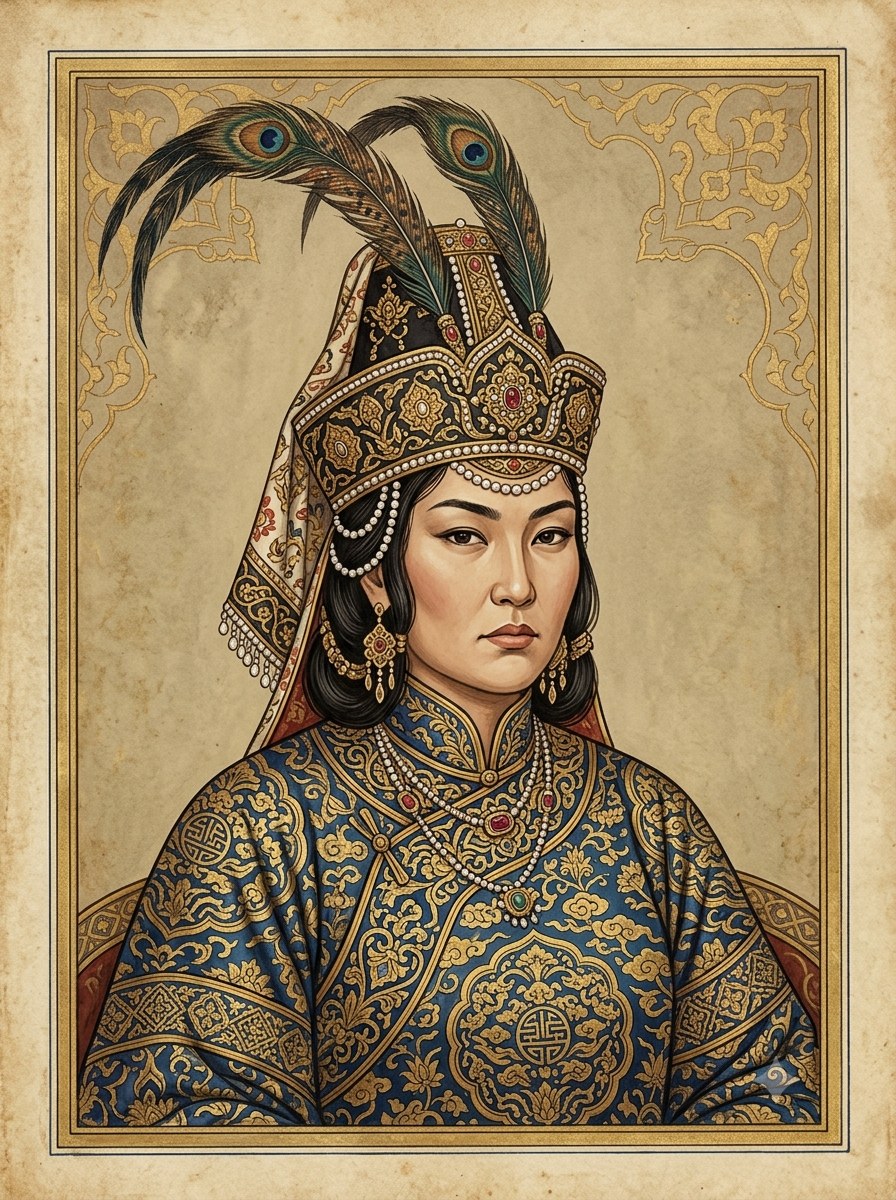
AI-assisted Portrait of Töregene Khatun
The Woman Who Rewrote the Succession
When Great Khan Ögedei drank himself to death in December 1241, the largest contiguous land empire the world had ever seen—stretching from the Pacific to the gates of Hungary—was left without a master. The horde's armies were halfway across Europe; the princes of the House of Genghis were scattered across a continent; and the dead Khan had named as his heir not a son but a grandson, the young prince Shiremün. Into that vacuum stepped Ögedei's senior widow, and for the next five years she did not merely hold the empire together. She bent it, deliberately and against her late husband's explicit wishes, toward a single end of her own choosing.
Töregene Khatun was not born to the Mongol elite—she came to Ögedei as a captive wife, taken from a defeated rival people—and she had none of the hereditary claim that smoothed the path for the empire's great men. What she had instead was an appetite for command and a politician's grasp of leverage. She seized the regency of the entire empire, sidelined the boy her husband had chosen, purged the experienced ministers who might have opposed her, and ruled through a tight circle of her own loyalists while she campaigned, year after year, to put the crown on the head of her own son Güyük. In 1246, at the great kurultai on the steppe, she won. It is one of the most audacious political operations in the history of the medieval world, and it was executed by a woman who, for half a decade, was the most powerful person alive.
Töregene was the ENTJ regent in its rawest form—commanding Te fused to a patient, long-range Ni vision, a will that treated an inherited succession not as sacred order to be administered but as raw material to be remade around her own bloodline.
The Iron Hand on the Empire
Te — dominant
Dominant Te is the drive to organize the external world—to take a situation, impose a structure on it, and make people and institutions obey. Töregene's first act as widow was a pure expression of it. Mongol custom gave the senior wife a strong claim to administer the realm during an interregnum, but custom is not the same as control. Töregene moved fast to convert a customary claim into real, operational power: she took the seals, she controlled the flow of orders, and within months she had made herself the undisputed regent of an empire that ran from Korea to the Caucasus.
What followed was a methodical consolidation. The capable ministers Ögedei had relied on —men like the chief secretary Chinqai, the administrator Mahmud Yalavach, and the great Khitan statesman Yelü Chucai, who had taught the Mongols how to tax a settled empire rather than simply loot it—were exactly the figures who could check a regent. So she broke them. Some fled, some were stripped of office, some were marked for death; Yelü Chucai, sidelined and powerless, died in 1244 watching the financial system he had built handed over to her favorites. In their place she installed her own people, most strikingly a captured Persian woman named Fatima, who became her closest confidante and effectively ran the regime's patronage. The administration was no longer the empire's; it was hers.
This is Te governance without the softening of any other priority. It was partisan, often heavy-handed, and her enemies accused her of misrule—of selling offices, of issuing contradictory decrees, of letting Fatima settle scores. But measured against the only goal Töregene actually held, the machine worked perfectly. The empire did not fracture, the armies were paid, the orders went out and were obeyed, and the entire apparatus of state was pointed, for five years, at a single objective. Te does not ask whether the structure is loved; it asks whether it functions and whether it answers to the right hand. Hers did.
The Five-Year Game
Ni — auxiliary
If Te gave Töregene her grip, auxiliary Ni gave her a target far enough away that lesser players never saw it coming. The regency was not the prize. It was a means. From the moment Ögedei died, Töregene was working toward a fixed future that did not yet exist and that the dead Khan had specifically forbidden: her son Güyük on the throne of the Great Khan. Ögedei had named Shiremün, a grandson, as his successor precisely to pass over Güyük, whom he distrusted. Töregene set out to overturn that judgment, and she gave herself years to do it.
Auxiliary Ni shows up as strategic patience—the willingness to hold a single outcome in mind and bend every short-term move toward it. She did not try to crown Güyük by decree, which would have invited civil war. Instead she used the time. A kurultai, the great assembly that elected a Khan, required the princes of the blood to gather and consent, and Töregene simply declined to convene one until she had arranged the board. She spent five years distributing patronage, buying loyalty, neutralizing the supporters of Shiremün and of the senior prince Batu (who loathed Güyük and pointedly stayed away), and building the coalition that would, when the moment finally came, deliver the vote she wanted.
That is the Te–Ni signature: not the improviser seizing the nearest advantage, but the strategist who can see the destination years out and grind toward it through a long campaign of preparation. When the kurultai at last met in 1246 and Güyük was raised on the felt and proclaimed Great Khan, it looked like the assembly's free choice. It was the harvest of a plan she had been executing since the day her husband died.
The Tactician of the Moment
Se — tertiary
Tertiary Se gave the long game its short-range teeth. Where Ni held the distant goal, Se supplied the quick reading of an immediate situation—who had just gained ground, where the leverage lay this week, when to strike and when to wait. Töregene was a creature of the concrete maneuver: the well-timed gift, the office handed to a useful man, the rival isolated before he could organize. She read the present field of power the way a hunter reads terrain, and she acted on what was actually in front of her.
The reliance on Fatima is the clearest tertiary Se tell. Faced with a court of suspect grandees, Töregene did not build a slow institutional base of support; she reached for the immediate, available instrument—a clever, loyal operator she could deploy at once to manage patronage and intelligence—and used her hard. It worked beautifully in the moment and made her enemies in the long run, because Se prizes present effectiveness over durable legitimacy. The same instinct let her move with a speed that kept opponents permanently a step behind: by the time Shiremün's partisans understood what was happening, the offices and alliances had already changed hands.
The One Loyalty
Fi — inferior
Inferior Fi in an ENTJ rarely surfaces as warmth. It surfaces as a small, fiercely held set of personal attachments that the otherwise instrumental will refuses to negotiate. For Töregene that core was her son. Every cold calculation, every purge and bribe and deferral, served an attachment that was not strategic at all: she wanted Güyük to rule, and she wanted it badly enough to override her own husband's deathbed wishes and to spend five years of her life and the empire's resources securing it. The whole ruthless apparatus of her regency was scaffolding around that single, intensely personal loyalty.
Inferior Fi is also clumsy and slow to read others' values, and Töregene paid for that. Her devotion to Fatima blinded her to how the bond looked from outside—a foreign slave-woman wielding real power read, to the Mongol aristocracy, as scandal and misrule. She underestimated how deeply the princes resented being managed. And the cruelest turn came after her victory: once Güyük was enthroned, the son she had spent everything to crown turned on her circle, moved against Fatima, and brought her favorite to a brutal end. Töregene died in 1246, very soon after seeing him take the throne—her one great attachment fulfilled, and then, almost immediately, repudiated by its object. The inferior function gives the ENTJ its one human anchor; it does not promise that the anchor holds.
Why ENTJ Over ESTJ
Why not ESTJ?
The ESTJ is the supreme administrator of an established order—the figure who takes an inherited system of rules and succession and enforces it faithfully and well. An ESTJ regent would have done her duty: convened the kurultai promptly and seen Ögedei's chosen heir, Shiremün, lawfully enthroned. Töregene did the opposite. She refused to administer the order she was handed and instead spent five years dismantling and re-engineering it to crown a different heir against her husband's explicit command. That is not a custodian of precedent (Si); it is a strategist subverting the given arrangement to realize a future of her own design (Ni).
The distinction is auxiliary Ni versus auxiliary Si, and it is decisive. Both types share dominant Te—both command, organize, and make the world obey—which is why the ESTJ reading is tempting for so forceful an operator. But the ESTJ's Te is anchored to Si: it conserves, it upholds the inherited structure, it treats the established line of succession as the thing to be defended. Töregene treated that line as the thing to be overturned. Her power-grab was visionary, not custodial—a patient campaign to reshape the empire's future around her bloodline rather than a dutiful stewardship of its past. The schemer who rewrites the succession is an ENTJ; the administrator who guards it is an ESTJ. Töregene rewrote it.
Connected Figures
Further Reading
- The Secret History of the Mongol Queens — Jack WeatherfordThe most accessible account of the Mongol regent-queens; devotes its central chapters to Töregene's seizure of the regency and the campaign to crown Güyük.
- The Secret History of the Mongols — Anonymous (trans. Igor de Rachewiltz)The foundational thirteenth-century Mongol chronicle — the indispensable primary source for the house of Ögedei and the politics of the interregnum.
- Women in Mongol Iran: The Khātūns, 1206–1335 — Bruno De NicolaA scholarly study of Mongol royal women's political and economic power that situates Töregene's regency within the broader pattern of khatun authority.
