 Historical Figure MBTI
#446 · 4-11-26 · The Age of Travelers
Oghul Qaimish
Regent of the Mongol Empire · Güyük's Widow
d. 1251
9 min read
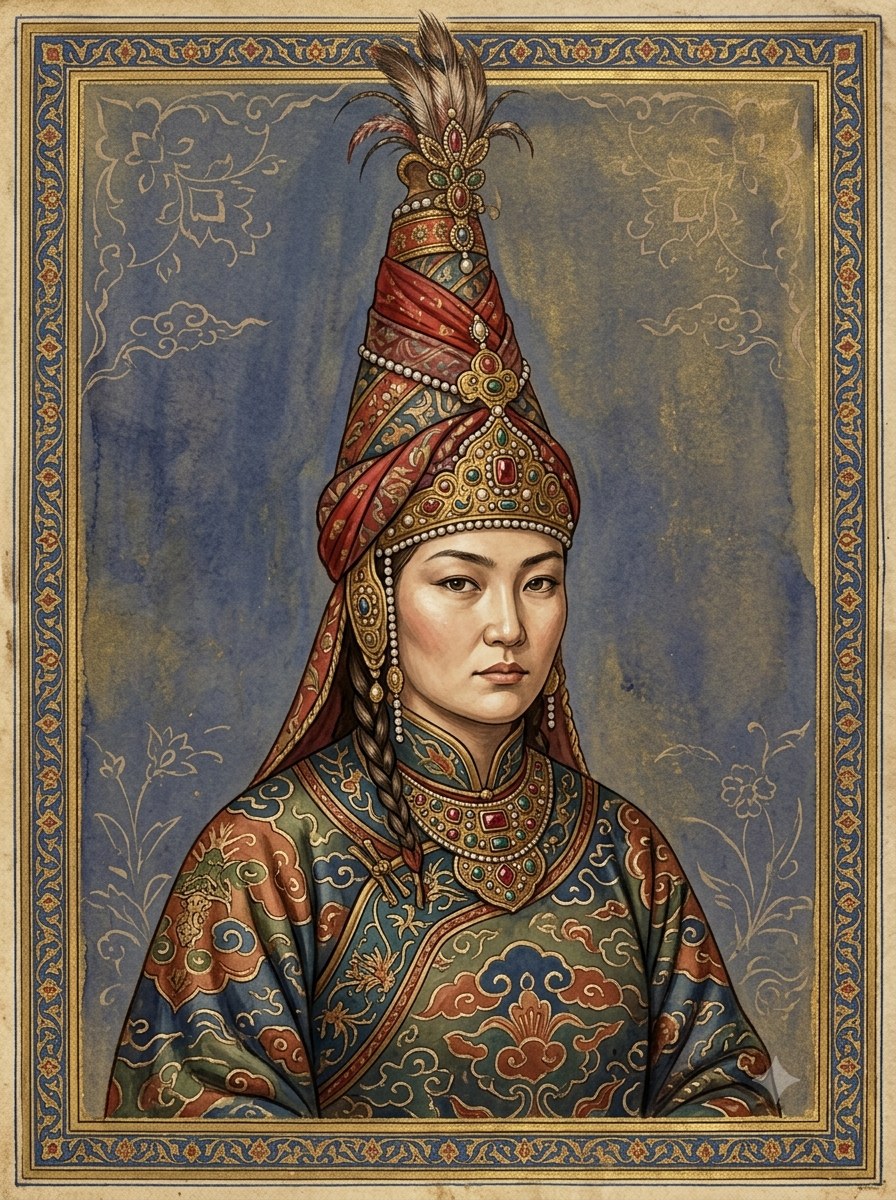
AI-assisted Portrait of Oghul Qaimish
The Regent Who Held the Forms and Lost the Empire
When the Great Khan Güyük died on the road in 1248, barely two years into his reign, the regency of the Mongol Empire passed to his widow, Oghul Qaimish. On paper it was the most powerful position on earth: the realm Genghis had built now stretched from the Pacific to the gates of Europe, and the woman who held the seal between khans held the world’s largest dominion in trust. Her mother-in-law, Töregene Khatun, had occupied that same office and used it ruthlessly — purging ministers, packing the next election, and installing her own son Güyük on the throne by sheer force of will. Oghul Qaimish inherited the office. She did not inherit the grip.
Contemporaries were blunt about her. She was said to care more for shamans and divination than for the business of ruling, to spend her days among soothsayers while the empire’s affairs drifted, and to be unable to control even her own sons, who ran their own affairs in defiance of her. Yet she was no fool about authority itself. She understood exactly what the regent’s office was, and she meant to use its prerogatives to hold the throne for the Ougedeid line — her husband’s house, and her sons’ inheritance. When an envoy arrived from Louis IX of France — the friar Andrew of Longjumeau, bearing gifts and a letter — she received him from a position of assumed supremacy and treated the gifts as a tribute of submission, dispatching him home with a demand for annual obeisance. She was playing the part of the sovereign of the world.
Oghul Qaimish was an ESTJ who had been handed command and reached to exercise it — asserting the regent’s formal authority (Te) and clinging to the inherited claim of her husband’s line (Si), without the strategic vision to see that the office was already being taken out from under her.
That was the fatal gap. The forms of power she commanded; the long game she never saw. While she presided over the prerogatives of the regency, the rival Toluid branch — the formidable Sorghaghtani Beki and her sons, backed by the weight of Batu and the Golden Horde — was building the coalition that would simply elect a different dynasty into being. Oghul Qaimish was the losing regent of a collapsing house, and the manner of her end would be as brutal as the politics that produced it.
The Command That Could Not Command
Te — dominant
Dominant Te reaches instinctively for the levers of formal authority — the office, the title, the right to issue orders and expect compliance. Oghul Qaimish’s whole conduct in the regency reads as a by-the-book assertion of the powers her position conferred. She did not retreat into private mourning or quiet administration; she took up the regent’s prerogatives and tried to rule by them. She convened and corresponded as the empire’s head, issued decrees in the Great Khan’s stead, and treated the regency as what it formally was — supreme command of the largest state on earth, hers to wield until the next khan was chosen.
Her handling of the French embassy shows the Te reflex precisely. Andrew of Longjumeau arrived from a Christian king who imagined he might be addressing a possible ally, perhaps even a fellow believer. Oghul Qaimish read the encounter through the grammar of rank: gifts meant tribute, an embassy meant submission, and a sovereign of the Mongol world acknowledged no equal. She sent the friar back with a letter instructing Louis to deliver annual tribute in person if he wished to keep his lands. It was the move of someone who genuinely held authority and meant to exercise it to the letter — an insistence on the prerogatives of the office, pressed without regard to whether the empire behind her would actually back the demand.
That last clause is the whole tragedy of her Te. The function asserts authority; it does not, by itself, secure the power to enforce it. Oghul Qaimish commanded as though the chain of obedience ran from her seal to the farthest tumen, when in fact the princes, generals, and her own sons increasingly looked elsewhere. She mistook the formal right to command for the actual ability to command — the characteristic exposure of a Te that has the office but has lost the field beneath it.
The Keeper of an Inherited Claim
Si — auxiliary
If Te supplied the will to command, auxiliary Si supplied the thing she was commanding for: the established order of succession and the legitimacy of what she had inherited. Oghul Qaimish’s defining political conviction was that the throne belonged to the Ougedeid house — the line of Güyük and Ougedei before him — and that her task was to keep it there. This is Si in its conserving mode: the past confers the right, the precedent settles the question, and the duty of the present is to hold what was handed down rather than to imagine it otherwise.
She clung to that inherited claim with real tenacity. Through the long interregnum she stalled, delayed, and maneuvered to keep the regency in Ougedeid hands and forestall a council that might choose against her house. Her loyalty ran to the established forms — the family’s precedence, the traditional prerogatives of the senior widow, the customary expectation that the dead khan’s line would furnish the next one. Even her reported absorption in shamans and omens fits the pattern: a reliance on familiar, traditional sources of guidance rather than on cold political calculation about a shifting board.
But Si conserves; it does not strategize. It can defend an inheritance against an ordinary challenge, yet it has no instinct for the kind of opponent who does not contest your claim so much as render it obsolete. Oghul Qaimish was guarding the Ougedeid title as a fixed possession at the very moment the Toluids were assembling the votes, the marriages, and the muscle to make a wholly different house the legitimate one. She kept faith with the past. The future was being negotiated without her.
No Map of the Possible
Ne — tertiary
Tertiary Ne in an ESTJ is a thin and unreliable faculty — the capacity to read where events might be heading, to imagine the alternative moves an adversary could make, to see the board as a field of possibilities rather than a set of fixed positions. It is precisely what Oghul Qaimish lacked when she needed it most. She could assert the office and defend the claim, but she could not anticipate the shape of the game being played against her.
The Toluid strategy was not a frontal assault she could meet with the regent’s authority. It was a slow, lateral construction: Sorghaghtani Beki cultivating allies, securing the decisive backing of Batu and the Golden Horde, and arranging for a council to be called on ground favorable to her sons. Reading that required imagining how a rival might win without ever directly challenging your title — the kind of projective, what-if perception that tertiary Ne supplies only weakly. Oghul Qaimish kept treating the situation as a matter of holding her formal position, when the real contest had moved to terrain she could not see.
Where a strategic mind would have moved first — built her own coalition, courted the swing princes, denied the Toluids the legitimacy of a broad-based election — she reacted, stalled, and clung. By the time the council she had tried to prevent convened, the outcome was already arranged. Her tertiary Ne never gave her the foresight to disrupt the plot while it was still forming; it left her perpetually one move behind a faction that was thinking several ahead.
The Defiance That Sealed Her Fate
Fi — inferior
Inferior Fi surfaces in an ESTJ as a stubborn, half-buried sense of personal conviction that erupts under pressure — usually as rigidity rather than reflection. When the council finally elected Möngke Great Khan in 1251 and the Ougedeid cause was lost, Oghul Qaimish did not bend. She refused to recognize the outcome, withheld her submission, and was implicated — whether truly or conveniently — in the plots and conspiracies the new regime moved to crush. The brittle, immovable refusal is the signature of inferior Fi under siege: conviction with no flexibility, dignity with no calculation.
The victors answered with a cruelty reserved for those judged dangerous. Oghul Qaimish was seized, interrogated, and condemned on a charge of witchcraft — a fitting accusation against a regent already mocked for her devotion to shamans. Stripped and examined, her hands were sewn up, her body wrapped in felt, and she was drowned: the Mongol execution for those whose blood was not to be spilled. The woman who had styled herself sovereign of the world was put to death as a sorceress, erased so the Toluid ascendancy would carry no rival claimant into the future.
There is something almost coherent in how badly it ended. A more supple temperament might have read the room, submitted, and lived — trading the lost claim for survival. Oghul Qaimish’s inferior Fi gave her no such off-ramp. She held to the Ougedeid right past every signal that it was finished, and her refusal to yield turned a political defeat into a death sentence. The forms she would not abandon became the rope she could not escape.
Why ESTJ Over ISTJ
Why not ISTJ?
The ISTJ and the ESTJ share the same conserving traditionalism — the loyalty to precedent, the duty to the inherited order, the Si that guards what was handed down. The difference is the lead function, and it is decisive here. An ISTJ regent would have led with that Si: a dutiful, low-profile stewardship, administering the interregnum quietly and keeping the seat warm without grasping for more than the role required. Oghul Qaimish did the opposite. She led with outward Te — asserting command, issuing demands to a foreign king, pressing the regent’s prerogatives as supreme authority. She reached for control rather than merely keeping the books, which is an extraverted-judging move, not an introverted one.
The distinction matters because her failure was specifically a failure of overreach, not of passivity. She did not lose the empire by neglecting it from some quiet corner; she lost it by claiming and commanding more authority than she could actually enforce, and by doing so loudly enough to mark herself as the obstacle the Toluids had to remove. That is the ESTJ’s characteristic exposure — the dominant Te that seizes the formal levers of power and presses them hard, only to discover that the office was never the same thing as the strength to hold it. An ISTJ keeps to the stewardship and survives the transition. The ESTJ reaches for the throne’s command, overreaches, and is swept aside.
Connected Figures
Further Reading
- The Secret History of the Mongol Queens — Jack WeatherfordThe fullest popular account of the Mongol women who ruled as regents — places Oghul Qaimish against Töregene and Sorghaghtani.
- The Secret History of the Mongols — Anonymous (trans. Igor de Rachewiltz)The foundational thirteenth-century chronicle of the dynasty, essential context for the succession struggle she lost.
- Women in Mongol Iran: The Khātūns, 1206–1335 — Bruno De NicolaA scholarly study of the political and economic power of Mongol noblewomen — the institutional world the regency operated in.
