 Historical Figure MBTI
#1201 · 9-2-26 · The Mughal Empire
Hemu
Commander · Claimant to the Delhi Throne
c. 1501–1556
7 min read
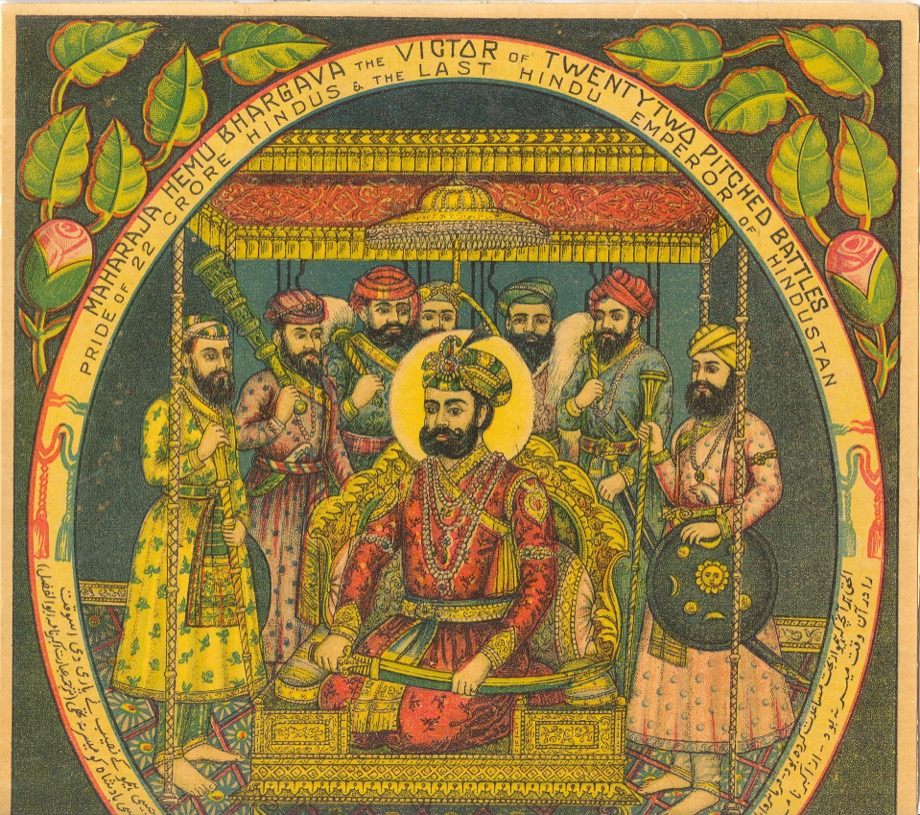
Portrait of Hemu — retrospective bazaar depiction, 1910s
From Markets to the Centre of Battle
Hemu’s career crossed a boundary that dynastic histories preferred to keep visible. A man associated with commerce and market supervision became the general whose capture of Delhi threatened the newly restored Mughal monarchy. He had no Timurid pedigree and did not inherit the Sur throne. His power came through work performed within another ruler’s government, then through the ability to bring an army to the place where sovereignty could be claimed.
Born around 1501, he rose in the service of Islam Shah and became a leading minister and commander under Muhammad Adil Shah after the Sur succession fragmented. The details of his early occupation vary in later accounts, and descriptions of humble origins often carry contempt for social ascent. The secure outline matters more than a picturesque beginning: administrative employment preceded major military responsibility, and victories over Adil Shah’s rivals preceded his advance on Delhi in 1556.
This archive’s ESTJ interpretation has low confidence. It follows the conjunction of logistical responsibility, organized service, and field command. It neither makes his religion a psychological explanation nor turns his defeat into a personality trait. The richest narrative, Abu’l-Fazl’s Akbarnama, was written for the dynasty Hemu nearly displaced and must be read against its hostility.
The low-confidence ESTJ reading places dominant Extraverted Thinking in Hemu’s conversion of administrative responsibility into coordinated military power.
Authority Earned Through Deployment
Market supervision was a consequential office in an early modern state. Supplies, prices, and the conduct of traders touched both urban order and the needs of armies. A career beginning in that sphere is relevant to Hemu’s later command, but it should not be inflated into proof that he personally invented a superior supply system. The record establishes a progression of responsibilities; the psychological inference concerns the repeated assignment and execution of practical tasks.
Under Adil Shah, whose authority faced rival Sur claimants, Hemu became a principal instrument of military survival. Campaigning required men, pay, transport, elephants, intelligence, and a choice of objectives. His success against several opponents shows more than a single lucky intervention. Yet the familiar claim of twenty-two victories should be attributed to the chronicles and treated as contested in its exact total and comparability. It is unnecessary to the case for administrative ability.
Abu’l-Fazl’s account reluctantly supplies evidence of organized power while surrounding it with denunciation. Hemu brought substantial preparations westward, defeated the Mughal force outside Delhi, and took the capital. The achievement is explicable through command exercised across a functioning army. Extraverted Thinking is one possible name for that concern with assembled means and observable results, though public achievement cannot by itself settle the type.
Experience Carried Across Offices
The thread linking Hemu’s offices is experience made useful in a new setting. He advanced within the Sur political system rather than appearing suddenly as an independent warrior. Islam Shah’s government provided an environment of regulated responsibilities and central supervision; service under Adil Shah required applying skills amid the collapse of that earlier stability. Knowledge of the apparatus mattered even when the identity of its master changed.
The war elephant makes the practical dimension of his command particularly visible. It was transport, a fighting platform, and a conspicuous centre around which followers could recognize their commander. Maintaining such animals and coordinating their use belonged to an army’s organized resources. At Panipat the position also exposed the dependence of command on a visible person. The same arrangement that advertised authority made the consequences of his incapacitation immediate.
Auxiliary Introverted Sensing is a tentative interpretation of continuity between service, accumulated competence, and repeated military execution. We cannot reconstruct Hemu’s private memories from lists of offices. The stronger claim is that his record contains an occupational and operational progression that a portrait based entirely on audacity would miss. He knew a political machine from within before briefly attempting to occupy its summit.
Delhi as a New Possibility
Humayun’s death in January 1556 altered the opportunity. The restored Mughal regime was young, Akbar was still a boy, and Bairam Khan had to secure a vulnerable inheritance. Hemu’s advance toward Agra and Delhi turned instability into a strategic opening. At Delhi he defeated Tardi Beg’s force in October, forcing the Mughal leadership to confront the loss of its capital rather than simply continue the consolidation begun by Humayun.
The adoption of the title Vikramaditya is associated with Hemu’s elevation after this victory. The precise constitutional relationship between his new claims and Adil Shah’s sovereignty is less transparent than later celebrations suggest. Abu’l-Fazl stresses ambition and usurpation; modern narratives can turn the episode into a straightforward national restoration. Neither framing should remove the Afghan officers and Sur political connections through which Hemu had acquired his power.
Tertiary Extraverted Intuition offers a cautious description of recognizing that service could open into a different political future. It is weaker evidence than his administrative career. Seizing a capital naturally changes a commander’s opportunities, whatever his cognitive preferences. What matters is the transition from defeating a patron’s enemies to holding a position from which he could present a larger claim of his own.
A Person Beneath Competing Verdicts
The surviving record gives little secure access to Hemu’s own account of loyalty, ambition, or belief. His Hindu identity within a state ruled by Afghan Muslims demonstrates the inadequacy of a simple religious division of the combatants. It does not establish modern secular ideals, just as his assumption of an ancient royal title does not establish a fully documented programme of religious restoration. Political service and personal sovereignty could coexist uneasily.
Inferior Introverted Feeling is the least recoverable element of the suggested type. It would be easy to invent an inward commitment from the title he took or from the cause later admirers assigned him. The evidence does not warrant that invention. The meaningful restraint is to let Hemu remain a consequential actor whose public decisions can be described, while acknowledging that the values by which he explained those decisions largely escape us.
Testing the ESTJ Reading
Why not ENTJ?
The advance on Delhi and assumption of royal standing support an ENTJ alternative. Those acts show strategy and ambition, but they occupy a short, exceptionally unstable phase. ESTJ is weakly preferred because the longer visible career joins administrative service to repeated military execution. The evidence for a sustained personal vision reorganizing the state is thinner than the evidence for effective direction of its existing resources.
Why not ESTP?
Personal battlefield leadership and rapid exploitation of opportunity make ESTP plausible. Hemu was clearly capable of decisive action. Yet an account centred on the elephant charge leaves out the appointments, preparations, and coordination that brought him to the battlefield. The low-confidence ESTJ reading gives that longer pattern greater weight without treating logistical work as automatic proof of type.
The alternatives remain live because hostile narratives rarely preserve how Hemu deliberated. The proposed distinction concerns which pattern deserves emphasis: sustained responsibility and organization, with tactical boldness as part of that career. It cannot be decided by counting victories or by making one dramatic wound stand for an entire life.
Connected Figures
Further Reading
- The Akbarnama, Volume II — Abu’l-Fazl; translated by Henry BeveridgeThe Mughal court account of the Sur rivals and restoration; read its political hostility critically.
- Medieval India: From Sultanat to the Mughals, Part II — Satish ChandraPlaces the Sur succession and early Mughal consolidation within their wider political setting.
- The Mughal Empire — John F. RichardsA scholarly account of the restored dynasty and the institutions of imperial rule.
