 Historical Figure MBTI
#633 · 5-10-26 · Sengoku Japan
Hosokawa Gracia
Daughter of the Betrayer · The Christian Convert · The Martyr of Sekigahara
1563 — 1600
8 min read
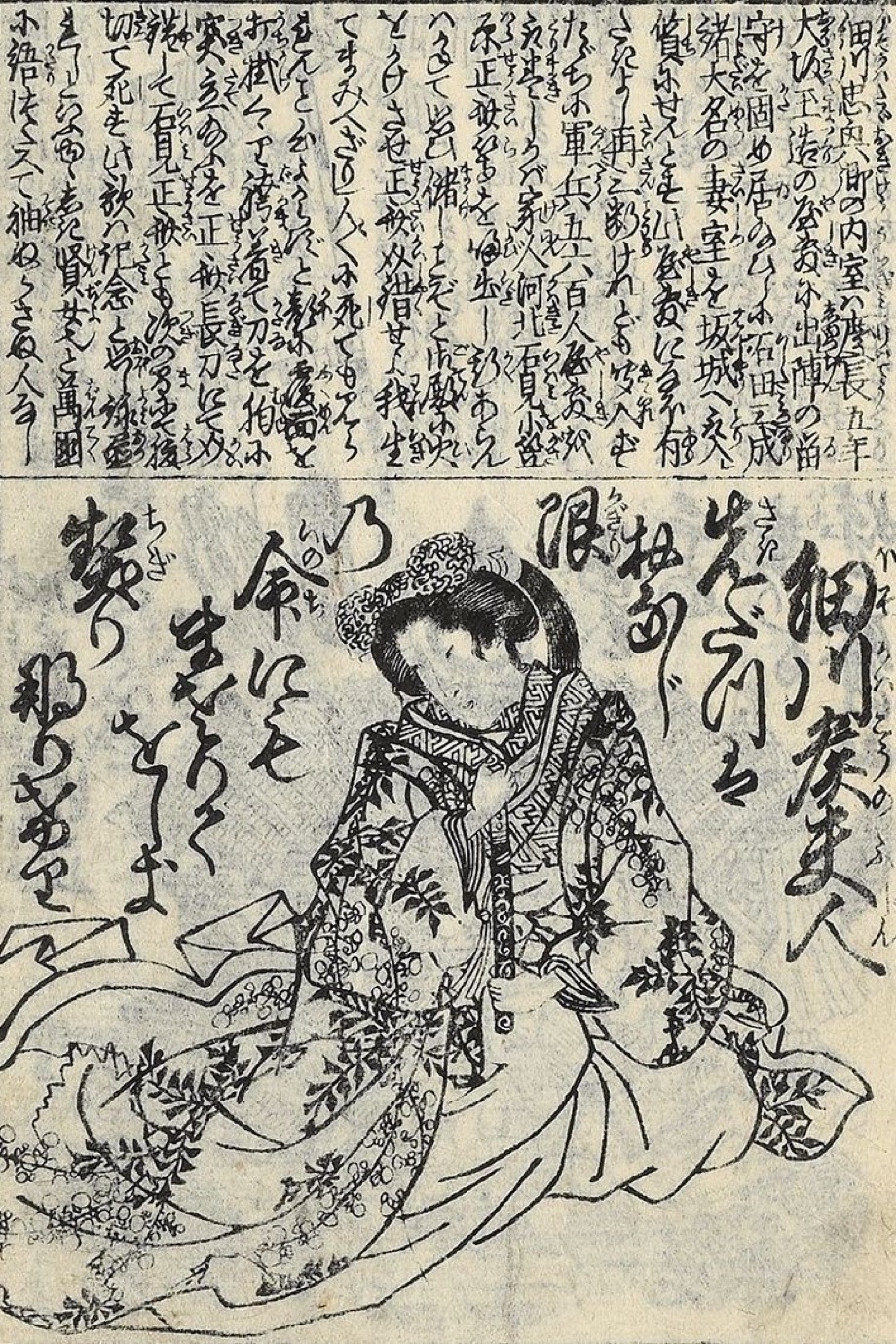
Portrait of Hosokawa Gracia
The Prisoner Who Chose Her Own Ending
She was the most famous beauty of her age and the daughter of its most infamous traitor, and she spent the middle years of her life shut away in a mountain village because the second fact had made the first unbearable. What Hosokawa Gracia did with that confinement is the whole of her character. Forbidden even to leave her own gate, she turned inward and found there a certainty so complete it reorganized her entire life around a single conviction — and in the end she died for it, on her own terms, at thirty-seven, in a burning mansion in Osaka.
Born Akechi Tama in 1563, she was married young to the daimyō Hosokawa Tadaoki, a match of politics and of unusual intellectual equality. Then, in 1582, her father Akechi Mitsuhide turned on his lord Oda Nobunaga at the temple of Honnō-ji and destroyed him — and was himself destroyed within days. Overnight Tama became the daughter of a regicide, her very blood a liability to the husband she loved. To protect her, Tadaoki confined her in the hills of Tango. It was in that isolation that she was drawn toward the foreign faith the Jesuits had carried into Japan — and where a lesser spirit would have been crushed, she converted catastrophe into an axis, seizing Christianity not as a consolation but as a system and the fixed center of an identity she would surrender to no one.
Gracia is the INFJ convert: a woman whose Ni fastened onto one unifying conviction and held it, in secret, against every pressure — a faith studied and chosen rather than merely felt, married to an Fe that made of her honor and her bonds a matter of life and death.
The Conviction Seized in the Dark
Ni — dominant
Dominant Ni is the mind that collapses a chaos of possibility into one certainty and lives from it. Gracia's conversion is Ni in its purest and most improbable form. A prisoner in her own house, forbidden to travel, she could not go to a church or sit before a priest — so she conducted her theology at a distance, sending her lady-in-waiting out to the Jesuits with questions and pressing further. The fathers recorded her not as a docile inquirer but as a sharp interlocutor who argued doctrine and would not be satisfied by soft assurances. This was not a woman feeling her way toward comfort. It was a mind hunting for the one true thing and testing every claim against it.
What she arrived at, she held with the totality that marks the type. Around 1587 she was secretly baptized as "Gracia," in the teeth of everything: Hideyoshi had just issued his edict expelling the missionaries, and her husband disapproved and would later pressure her to renounce the faith. None of it moved her. Once the inner picture had formed, the external cost simply did not register as a reason — the Ni signature, a conviction that arrives whole and becomes the immovable ground on which everything else must stand. It reordered her whole life: she had taken the worst fact of her existence, that she was a regicide's daughter, and answered it not with despair but with a new and unshakable identity. The prison had made the visionary.
The Weight of Honor and the Bond
Fe — auxiliary
If Ni gave Gracia her conviction, auxiliary Fe gave it its moral shape — a deep seriousness about her bonds, her name, and the honor she owed those she was tied to. She was no mystic withdrawn from the human world but intensely alive to her obligations within it. Her marriage to Tadaoki was famously volatile and famously close, two proud and gifted people in a bond that mattered enormously to her — and that history kept trying to poison.
The Fe reading explains the shape of her final act more precisely than any account of mere piety. In 1600, as Ishida Mitsunari prepared for the Sekigahara campaign, he moved to seize the wives of the lords allied with Tokugawa — to hold them hostage and bend their husbands to his side. Gracia was a prime target: take her, and Tadaoki could be leashed. Her refusal was not only personal terror; it was a matter of her husband's honor and her own, and she would not become the instrument by which he was coerced. To be used as a hostage was, to her, a dishonor worse than death. Ni supplied the absolute limit; Fe supplied the reason it mattered so much, and her death was, in the most literal sense, an act of fidelity.
The Theologian in the Locked Room
Ti — tertiary
Tertiary Ti gave the visionary a scalpel. Gracia's faith was never a warm, wordless sentiment; it was a body of doctrine she wanted to understand precisely. The missionaries found her formidable — a convert who probed their arguments, raised objections, and demanded that the logic hold. She reportedly wrestled with hard questions of Buddhist and Christian thought and would not accept a doctrine she could not reason her way into. The conviction was Ni's; the dissection of it was Ti's.
This is exactly what distinguishes her faith from private feeling: she did not merely believe, she wanted the structure to be sound. The clearest instance is her handling of the Church's teaching on suicide. A samurai woman of her station was expected, in extremity, to take her own life — and Gracia had accepted a faith that forbade it absolutely. She did not fudge the contradiction or ignore the doctrine when it became inconvenient; she held to the rule with rigorous consistency, and it shaped the very manner of her death. Because she could not kill herself, she arranged to be killed by another — the logic followed to its literal, lethal conclusion. That is tertiary Ti serving an INFJ's conviction: a fierce insistence that the belief be coherent and that she live, and die, by its terms without exception.
The Fire She Could Not Escape
Se — inferior
Inferior Se is the outer, physical, present-tense world — the domain the INFJ inhabits least easily and confronts most dramatically at the crises of a life. For most of hers, Gracia lived at a remove from it: sequestered, veiled from public life, conducting even her spiritual battles by proxy. The concrete, sensory sphere was precisely what her confinement had walled off.
And then the physical world arrived at her gate with soldiers, and she met it with a decision so absolute it has never been forgotten. When Mitsunari's men came to seize her in the summer of 1600, Gracia did not flee and did not bargain. Barred by her faith from killing herself, she gave the order to a household retainer, who ran her through; the mansion was then set ablaze so that no enemy could take even her body. It is the inferior function seized and mastered in a single stroke. When the sensory sphere she had lived apart from finally forced itself on her, she took hold of the one fact that could not be undone — the manner and moment of her own ending — and made it the loudest statement of her will.
Why INFJ Over INFP
Why not INFP?
A woman of deep private feeling who converts to a faith in seclusion looks, at first, like Fi finding a personal truth. But Gracia's faith was no soft, exploratory sentiment held for its own sake. It was a systematic conviction she studied, argued sharply with the Jesuits, and made the single organizing principle of her identity and her death. The INFP's Fi–Ne searches and resists final systems; Gracia did the opposite — she seized one certainty, closed the question, and reasoned through its hardest implications without flinching. That is the decisive, world-ordering Ni–Fe of the INFJ.
The distinction lives in how she died. An INFP's conviction is inward and inviolable, but it rarely hardens into a fixed architecture that dictates a course of action to the letter. Gracia's did. She did not find her truth and cherish it privately; she made it the law of her life — and obeyed it to the flame.
Connected Figures
Further Reading
- Women Religious Leaders in Japan's Christian Century, 1549–1650 — Haruko Nawata WardThe essential scholarly study of the Christian women of the era — the best treatment of Gracia's faith, her theological engagement, and her place among Japan's female converts.
- The Christian Century in Japan, 1549–1650 — Charles R. BoxerThe classic history of the Jesuit mission and its rise and violent suppression — indispensable context for the world Gracia converted into and died within.
- Samurai Women 1184–1877 — Stephen TurnbullA concise, accessible survey of the martial and political roles of women in samurai society — useful for placing Gracia's death in the tradition of honor she both drew on and refused.
