 Historical Figure MBTI
#834 · 6-16-26 · The American Civil War
James Longstreet
Lee's Old War Horse
1821–1904
6 min read
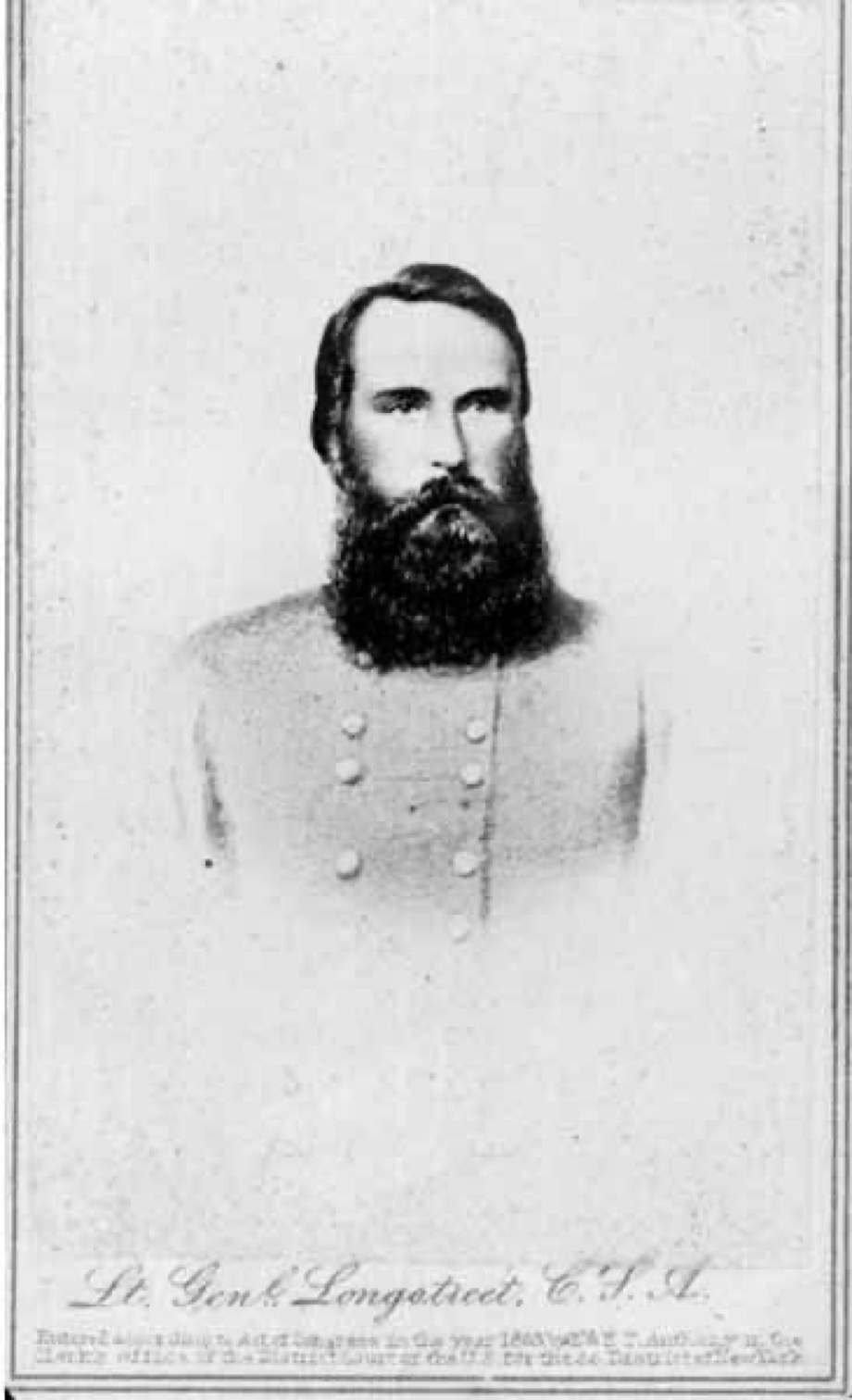
Portrait of James Longstreet
The Old War Horse
Every army needs someone who tells the commander the truth he does not want to hear, and then carries out the order anyway. In the Army of Northern Virginia, that man was James Longstreet. Where Stonewall Jackson brought audacity and Robert E. Lee brought a gambler's instinct for the decisive blow, Longstreet brought something rarer in Confederate command: patience. He wanted ground he could hold, numbers he could count, and a plan built on what had actually worked before — not on what might, gloriously, work this once.
Born in 1821 and raised between South Carolina and Georgia, Longstreet came up through West Point into the peacetime army the same methodical way he did everything else, and it was there, in the years before secession, that he formed a friendship with a fellow officer named Ulysses S. Grant — close enough that Grant stood at his wedding. War would put them on opposite sides of a line neither had drawn, but it never fully erased the regard between them. By 1862 Longstreet had become Lee's senior corps commander, the general Lee called his "old war horse" for the sheer dependability of his defensive work at Second Bull Run, Antietam, and Fredericksburg, where a Confederate line dug in on high ground shredded wave after wave of Union assaults — a lesson in position and patience that Longstreet never stopped drawing on.
That lesson is exactly what an ISTJ temperament is built to absorb and apply. Longstreet's mind ran on remembered, verified experience, translated into blunt, executable orders — a soldier who trusted what the ground and the record had already proven over what a bold new stroke merely promised.
Longstreet was not a man who dreamed up victories. He was a man who remembered how they were actually won — and argued, respectfully but immovably, for doing it that way again.
The Ground That Had Already Proven Itself
Longstreet's dominant Si showed up as a near-physical trust in terrain and precedent. At Fredericksburg in December 1862, his corps held the stone wall along the sunken road below Marye's Heights, and he had walked that ground beforehand, positioned his artillery to sweep every approach, and told a subordinate that a chicken could not survive crossing that field alive. He was right almost to the letter — wave after wave of Union infantry broke against a position he had already, in his mind, finished fighting before the first shot was fired.
This was not caution for its own sake. It was a settled conviction, built from Second Bull Run and Antietam alike, that the defender on prepared ground with interlocking fire held an advantage no amount of enemy courage could overcome. Longstreet did not need to imagine what might happen if the Union army attacked a strong position — he had watched it happen, repeatedly, and he filed the lesson away as fact rather than as one data point among many.
That same Si surfaced at Gettysburg in July 1863, when he looked at the ground below Cemetery Ridge and recognized, from hard experience, the shape of a slaughter. He had seen Union troops die by the thousand assaulting a fortified line at Fredericksburg; he now watched Lee propose sending Confederate troops across nearly a mile of open field into a fortified Union center, and the pattern-match was immediate and, to him, unmistakable.
The Case He Made, and the Order He Obeyed
On the morning of July 3, 1863, Longstreet's auxiliary Te produced one of the most consequential arguments of the war. He told Lee plainly that a frontal assault on the Union center — what would become known as Pickett's Charge — would fail, and proposed instead maneuvering around the Union left flank to force George Meade into attacking a Confederate position on ground of Lee's choosing. It was a logistical argument, not a sentimental one: numbers, distances, the exposed mile of open field the attacking troops would have to cross under artillery fire.
Lee overruled him. And here Te did what it does in a well-ordered ISTJ: having stated the case and lost the argument, Longstreet executed the order. He organized the assault, gave the signal to advance — reportedly with a nod, unable to voice the command outright — and watched roughly 12,500 men cross that field, more than half of whom did not return. He did not sabotage the plan, second-guess it aloud to the troops, or withhold his effort. He built the machine as designed, even though he had told its architect, with total clarity, that it would break.
That combination — forceful counsel followed by unhesitating compliance — is the signature of a subordinate mind built on external logistics rather than personal vision. Longstreet's Te wanted the correct outcome achieved efficiently; once the decision was made by the man with the authority to make it, efficiency meant carrying it out completely, not relitigating it from the rear.
Why ISTJ Over ESTJ
Why not ESTJ?
An ESTJ corps commander convinced his defensive plan was correct would have pushed harder to get his way — louder argument, more insistence, perhaps a slower or more reluctant execution once overruled. Longstreet did neither. He made his case once, with full force, and then subordinated himself completely to Lee's authority without visible friction in the execution itself. That is Te in service of an internal, private conviction rather than Te seeking to dominate the room — the mark of an introverted judger, not an extraverted one.
The Gettysburg dissent is the cleanest window into Longstreet's type precisely because it shows both halves at once: the Si-fed certainty that he was right, built on remembered ground and remembered casualties, and the Te-fed discipline to argue it cleanly and then let it go once the decision was made. An ESTJ in his position might have delayed, hedged, or executed the order with visible resentment. Longstreet executed it in full — and carried the argument's judgment quietly, for the rest of his life, as his own.
Connected Figures
Further Reading
- Lee's Lieutenants — Douglas Southall FreemanThe classic study of Lee's corps command, including Longstreet's role at Fredericksburg and Gettysburg.
- General James Longstreet: The Confederacy's Most Controversial Soldier — Jeffry D. WertThe standard modern biography, sympathetic to Longstreet's Gettysburg dissent.
- Gettysburg: The Second Day — Harry W. PfanzDetailed tactical account of the battle in which Longstreet's July 2–3 arguments unfolded.
- From Manassas to Appomattox — James LongstreetLongstreet's own postwar memoir and defense of his record.
