 Historical Figure MBTI
#845 · 6-18-26 · The American Civil War
Joseph Hooker
Union General · 'Fighting Joe'
1814 — 1879
6 min read
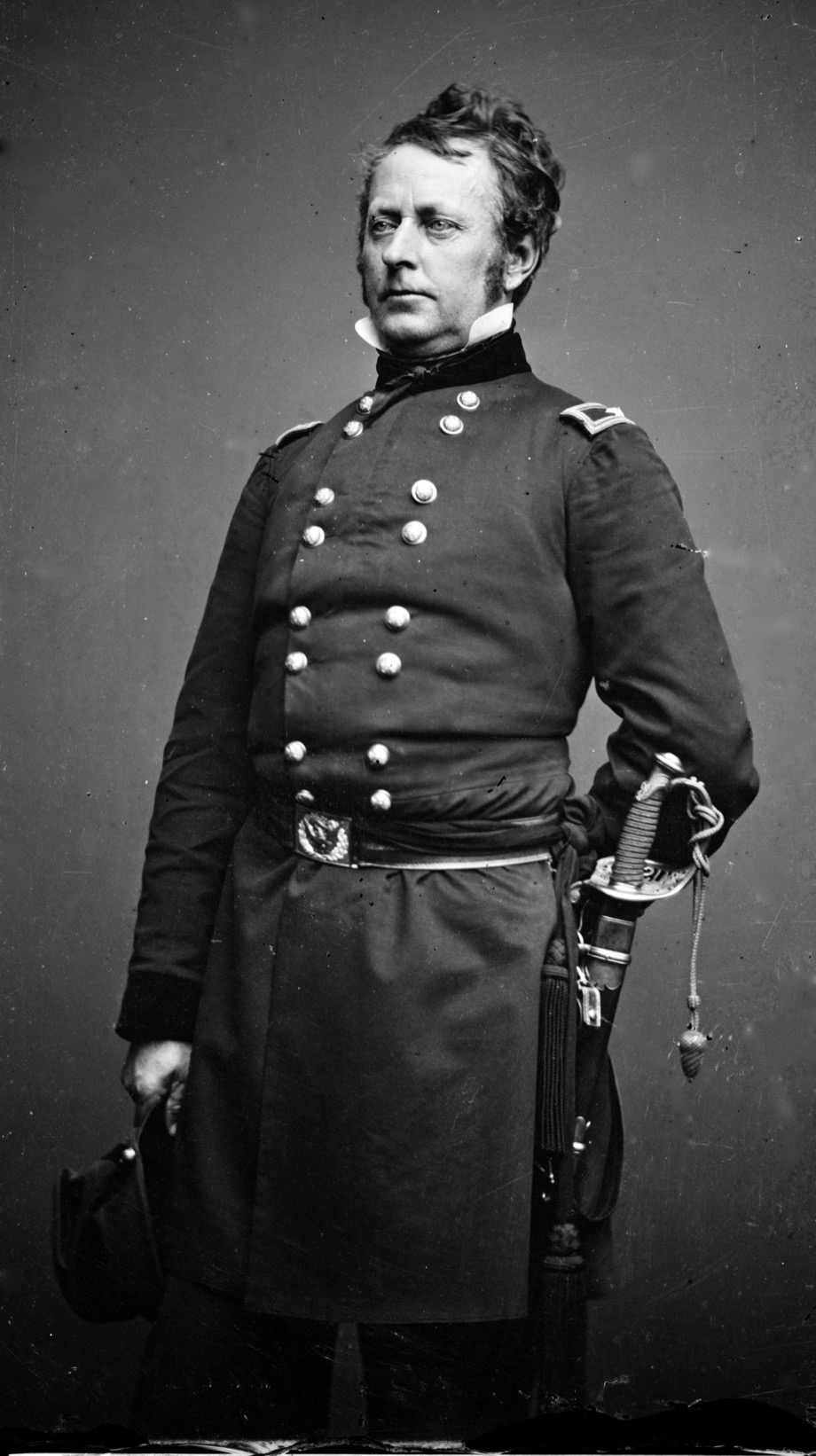
Photograph of Joseph Hooker, c. 1860s
Fighting Joe, Up Close and No Further
He hated the nickname, but it fit anyway. "Fighting Joe" Hooker was a newspaper's typo — a missing dash turned "Fighting — Joe Hooker" into a slogan — and slogans do not care what the man beneath them actually wants. What the man wanted was command, and he got it directly, loudly, and at someone else's expense: through the winter of 1862 he toured Washington's back rooms telling anyone who would listen that Ambrose Burnside was unfit and that he, Hooker, was the man for the job. He was right about the diagnosis and shameless about the cure. In January 1863 Lincoln gave him the Army of the Potomac anyway — with a letter warning him that ambition was a dangerous friend.
Lincoln understood something about Hooker that Hooker would not understand about himself until Chancellorsville forced the issue. He was a magnificent organizer of the immediate — a general who could walk a camp, see what was broken, and fix it by nightfall, rebuilding the army's morale, rations, sanitation, and cavalry in weeks. What he could not do was hold a plan against resistance he had not personally seen coming. As an ESTP, Hooker lived entirely in what was immediate and within reach of his own hands — and when the war handed him a battle that required trusting a plan he could no longer see, the confidence that carried him to command simply stopped.
Hooker was an ESTP built for the five feet in front of him — dominant Se made him magnetic at the point of contact, and that same instinct abandoned him the moment the point of contact moved out of sight.
The General Who Was Always Right There
Hooker's Se was the whole of his early reputation. He was a battlefield general in the oldest sense — physically fearless, visibly present, riding the line where his soldiers could see him rather than directing from a map three miles back. When he took command, that same sensory instinct turned administrative: he walked the camps himself, checked the rations and the latrines himself, and fixed what he found broken with dispatch. The corps badge system he instituted — cloth insignia that let a man be identified by unit at a glance — is a perfectly Se solution, a problem of the eye solved with something you can see.
But dominant Se reads the present with total clarity and the future hardly at all. Hooker's plan at Chancellorsville — a wide flanking march onto Lee's exposed side with superior numbers — was bold and, in its opening moves, brilliant. Then his advanced units brushed against resistance in the tangled Wilderness, out of his direct line of sight, and the general who had built his identity on seeing the fight pulled back into a defensive crouch rather than press an advantage he could no longer personally verify. Stonewall Jackson found the opening two days later. A shell fragment that concussed Hooker against a porch post has often taken the blame, but the men around him agreed the retreat into passivity began before the shell ever landed — the moment the battle left the range of his own eyes.
An Army Taken Apart and Rebuilt Correctly
Underneath the bravado was a real analytical mind, easy to miss because Hooker spent it so quietly compared to how he spent everything else. The army he inherited in January 1863 was demoralized and organizationally incoherent — its cavalry scattered in small detachments rather than massed as a strike force. Hooker's fix was structural logic, not showmanship: he pulled the cavalry into a single unified corps capable of operating independently for the first time in the war's Eastern theater, a template Union and Confederate commanders alike would copy afterward.
That same Ti shaped the plan he built for Chancellorsville itself — as dispassionate calculation, one of the best the army produced all war, a wide double envelopment against an enemy he outnumbered more than two to one. Even Lee and Jackson later credited the opening design. Hooker's failure was never an inability to think a battle through in the abstract; it was that once his tidy internal model met a battlefield that refused to cooperate, he had no Ni to fall back on — no instinct for holding a long-range read steady under pressure.
The Nerve That Went Missing
Inferior Ni is where Hooker's whole psychology comes to a point. Se and Ti gave him a formidable machine for reading a scene and reasoning through a plan; neither gave him what a commander needs the moment a battle stops matching that plan — a settled conviction he can hold without fresh sensory confirmation. When his lead corps met unexpected resistance on May 1, 1863, in ground he could not survey, Hooker did not push forward on the design he himself had built. He froze, then reversed, choosing to fight on his own ground instead of the enemy's. It is the single decision historians agree turned a probable Union victory into a rout.
The pattern was not new, and it recurred: supremely confident up to the point of contact, strikingly brittle past it — bold in the planning room, then unable to trust anything he could not verify with his own eyes. Halleck's later complaint that Hooker wanted certainty about the enemy's exact position before committing to Gettysburg's opening moves cost him the army days before the war's largest battle — the same inferior-Ni failure that lost Chancellorsville, in different clothes.
Why ESTP Over ESFP
Why not ESFP?
ESFP fits the charisma and the hard living but flattens the sharper edge underneath. Hooker's gift was not performance for its own sake — reorganizing an entire army's cavalry, supply, and sanitation took genuine Ti insight, not just a magnetic presence among troops. And his collapse at Chancellorsville was not social in nature; it was a tactical failure, a plan abandoned the moment it left the range of direct confirmation. That is a Ti-Ni story, not an Fi-Te one.
ESTP explains both halves of Hooker without contradiction — the general who could rebuild an army in six weeks, and the general who lost his nerve six hours into the battle that army was built for. Se and Ti made him superb at everything within reach of his own senses and logic; the absence of a steady Ni left him with nothing to stand on once the fight moved past what he could see.
Connected Figures
Further Reading
- Chancellorsville — Stephen W. SearsThe definitive campaign study, unsparing on Hooker's collapse in command.
- Fighting Joe Hooker — Walter H. HebertThe standard biography, strong on his reforms as army commander.
- Battle Cry of Freedom: The Civil War Era — James M. McPhersonPlaces Hooker's rise and fall within the war's broader arc.
