 Historical Figure MBTI
#837 · 6-17-26 · The American Civil War
Thomas J. "Stonewall" Jackson
Confederate General · Valley Campaign Architect · Christian Soldier
1824 — 1863
7 min read
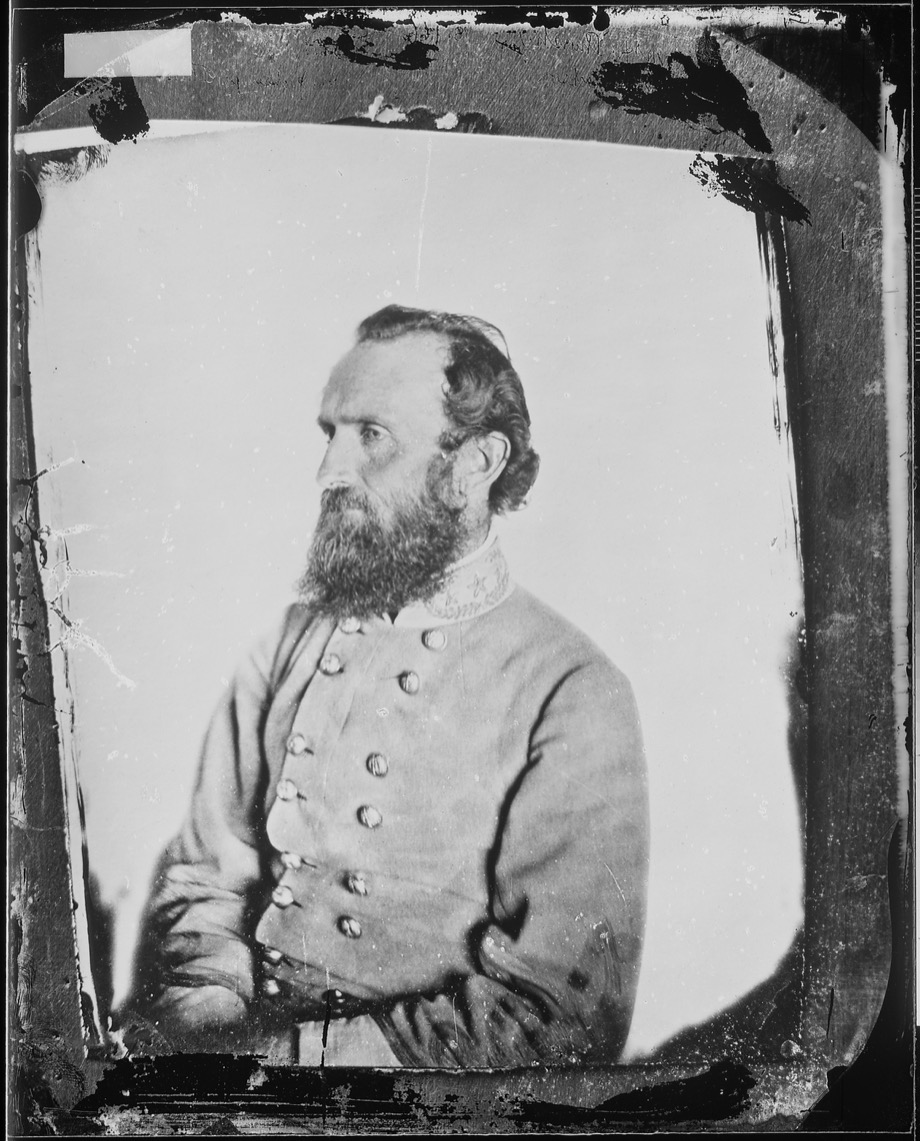
Photograph of Thomas J. "Stonewall" Jackson, c. 1860s
The Man Who Marched by the Clock
The cadets of the Virginia Military Institute called him Tom Fool. He stood bolt upright in the lecture room, recited the day's passage on optics and gunnery in the exact words he had memorized the night before, and if a student asked a question, repeated the same words again — louder, slower, unchanged. He held one arm above his head to balance what he believed was an uneven circulation of blood. He would not mail a letter that might travel on a Sunday. In 1860 nobody in Lexington would have guessed that this stiff, dyspeptic professor of natural philosophy was about to become the most feared field commander in America.
Two years later Thomas Jonathan Jackson was marching an outnumbered army up and down the Shenandoah at a pace that broke shoes and men alike, tying down three Union armies with a force smaller than any one of them, without telling his own generals where they were going. The transformation is a mystery only if you assume the professor and the general were different men. The same machinery produced both: an internalized standard held with absolute rigidity. In Lexington that standard was the syllabus and the Presbyterian Sabbath; in the Valley it was the road, the schedule, and the enemy's flank. He was an ISTJ whose duty happened to be war, prosecuting it with the same unsmiling literalism he brought to a Sunday school lesson.
An ISTJ general: dominant Si turned the world into a memorized inventory — terrain, Scripture, marching order — and extraverted Thinking spent that inventory without hesitation or explanation.
The Memorized World
Jackson arrived at West Point in 1842 an orphan from the Virginia backcountry with almost no schooling, and nearly washed out in the first year. He did not get better by being quick. He got better by refusing to move past a page until he owned it — sitting up after lights-out with a fire built high enough to read by. He graduated seventeenth of fifty-nine, and the class joke was that if the course had run ten years he would have finished first. That is dominant introverted Sensing in its purest form: knowledge acquired slowly, stored whole, never lost.
The habit became the man. He memorized Scripture in bulk and quoted it as naturally as an order; he kept a private code of health rules — the erect posture that kept his organs "properly aligned," the plain diet — and obeyed it in camp as strictly as in Lexington. The eccentricities were not affectation but a stored inventory of the correct, defended against revision.
In the field that faculty became terrain. Jackson had ridden the Shenandoah for years and supplemented memory with Jedediah Hotchkiss, a schoolteacher-turned-cartographer ordered to map the Valley from Harpers Ferry to Lexington. The 1862 campaign was fought over ground he had converted into a mental object he could rotate at will, against opponents reading it for the first time off bad maps.
Foot Cavalry
Jackson's infantry marched twenty-five miles in a day and did it again the next. He fixed the rhythm himself — fifty minutes of movement, ten minutes flat on the back, no exceptions — and enforced it against exhaustion, weather, and his own officers. Richard Garnett withdrew at Kernstown when his ammunition ran out; Jackson had him relieved and court-martialled. The reason was sound and Jackson did not care, because the order had been to hold. Extraverted Thinking here is not cleverness but the imposition of a standard on the world, at whatever cost.
The Valley Campaign was that method at full extension. Outnumbered three to one in aggregate, he used the mapped ground and the mountain screen to beat Union columns in detail — Front Royal and Winchester within thirty-six hours, then Cross Keys and Port Republic on consecutive days against two separate armies. Washington held McDowell's corps back from the Peninsula because of it, which was the point: a system with an objective, not a run of battles won.
Secrecy was part of the machinery: he told his division commanders nothing, not their destination and often not their next turn, because the standard did not require their consent. It made him hated by subordinates and nearly unbeatable against an opponent like George B. McClellan, who needed to know where the enemy was before he would move. At Second Bull Run he marched fifty-four miles in two days, burned Pope's supply base, then held an unfinished railroad cut through two days of assault until James Longstreet broke the Union left.
The Sealed Interior
Nothing about Jackson's public manner suggested feeling. He was silent at dinner, prayed alone, gave orders in a flat, high voice that carried no warmth. Yet the sternness was not emptiness. His letters to his second wife, Anna, are startling to anyone who knew only the general: playful, affectionate, full of pet names, written by a man who reserved his entire emotional register for one person and one God.
The clearest instance came before the war. In Lexington, Jackson organized and personally taught a Sunday school for enslaved and free Black children — an activity that sat uneasily with local opinion and, by some readings of Virginia law, outside it. He kept attendance rolls, continued the class for years, and corresponded about its pupils after the fighting began. He was himself a slaveholder and no abolitionist; the point is that a private conviction about souls owed instruction was sufficient on its own to override community pressure, without a word of public justification.
That is tertiary introverted Feeling: values held absolutely, defended stubbornly, almost never explained. It accounts for the severity too — when Jackson broke an officer he was enforcing an inner code that admitted no appeal, and found the resulting hostility irrelevant.
Dusk in the Wilderness
Inferior extraverted Intuition rarely surfaces as inventiveness in an ISTJ. It surfaces as a narrow grip on one possibility: from 1861 onward Jackson pressed a single idea, an invasion of the North to carry the war to Pennsylvania cities, repeated to anyone who would listen regardless of whether the army could support it.
Chancellorsville, May 1863, was the flank march at its perfect pitch and its breaking point. Lee split an already outnumbered army; Jackson took 28,000 men twelve miles across the Union front and rolled up Howard's corps at dusk. Then, with the attack stalling in the dark, he rode out ahead of his own lines to reconnoiter a night pursuit — the one thing his method could not survive. Returning, his party was fired on by North Carolina pickets who could not identify them. Three bullets; the left arm amputated the next morning.
He lived eight days and died of pneumonia at Guinea Station on 10 May, reportedly saying, "Let us cross over the river, and rest under the shade of the trees." Lee, who said he had lost his right arm, never again had a subordinate who would execute an order without needing to be told why.
Why ISTJ Over ISTP
Why not ISTP?
The ISTP reading is tempting: a quiet, fearless soldier with an uncanny feel for ground, indifferent to social nicety, lethal in motion. But ISTP runs on extraverted Sensing — present-tense reading of the field, improvised, loose about procedure. The Valley Campaign was the opposite: a fixed marching schedule, a pre-surveyed map, a doctrine of secrecy applied without exception, and a general relieved for making a sensible on-the-spot judgment that departed from the order. ISTPs bend the rule to fit the situation. Jackson bent the situation, his officers, and his men's feet to fit the rule — Si-Te, not Se-Ti.
The distinction explains his failures as well as his brilliance. When the standard fit the problem — a mapped valley, a known enemy, a clear objective — nobody in America executed better. When it did not, as during the Seven Days, where an exhausted Jackson crossed unfamiliar swampland he had never surveyed, he was slow, literal, unrecognizable. An ISTP would have improvised through the Chickahominy bottoms; Jackson had nothing stored to draw on, and stalled. His genius was never flexibility but the remorseless application of something already learned by heart.
Connected Figures
Further Reading
- Stonewall Jackson: The Man, the Soldier, the Legend — James I. Robertson Jr.The standard scholarly biography — exhaustive on the Lexington years, the Sunday school, and the eccentricities.
- Rebel Yell: The Violence, Passion, and Redemption of Stonewall Jackson — S. C. GwynneThe most readable modern narrative, strongest on the Valley Campaign as a piece of executed method.
- Stonewall: A Biography of General Thomas J. Jackson — Byron FarwellA compact, briskly critical life that resists the Lost Cause hagiography.
- Stonewall Jackson at Cedar Mountain — Robert K. KrickBattle-level study showing the command style — and its friction with subordinates — in close detail.
- Make Me a Map of the Valley: The Civil War Journal of Stonewall Jackson's Topographer — Jedediah Hotchkiss (ed. Archie P. McDonald)The mapmaker's own journal — the campaign seen from inside Jackson's staff.
