 Historical Figure MBTI
#843 · 6-18-26 · The American Civil War
George B. McClellan
Union General-in-Chief · Organizer of the Army of the Potomac · Lincoln's Rival
1826 — 1885
7 min read
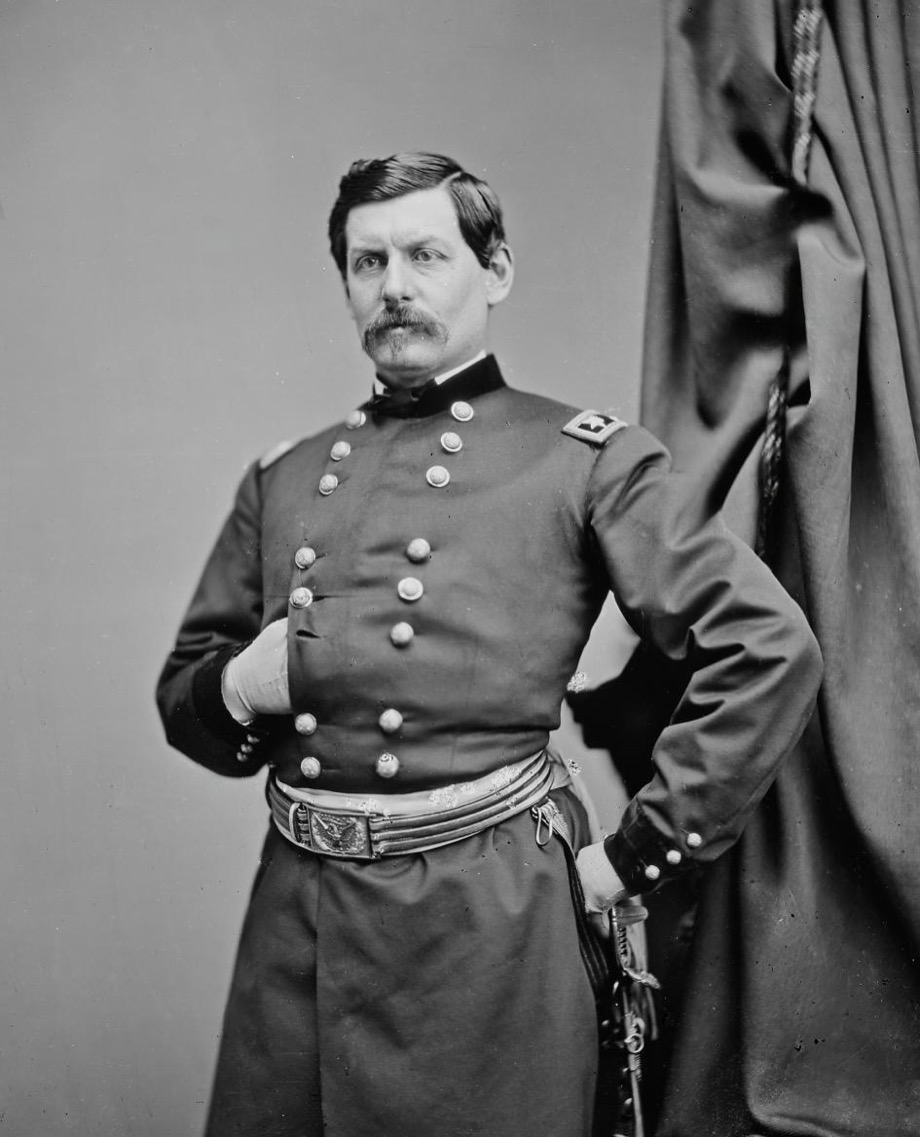
Photograph of George B. McClellan, c. 1860s
The Man Who Built the Sword and Could Not Swing It
In the late summer of 1861, after the Union army had run from Bull Run in a panic that swept congressmen and picnickers along with it, a thirty-four-year-old railroad executive rode into Washington and found a mob in uniform. Within three months George Brinton McClellan had turned it into the Army of the Potomac — corps properly constituted, drill schedules, a supply system that delivered, a chain of command that functioned. He did it almost single-handed.
Then he took that army into the field and could not bring himself to spend it. The pattern repeated with the regularity of a mechanism: a grand plan, flawlessly staffed; an advance; a sudden conviction that the enemy was twice his strength; a halt; a telegram demanding reinforcements. At Antietam he fought Lee to a standstill holding a captured copy of Lee's own orders and two corps he never committed, then watched the Confederate army walk back across the Potomac unmolested. The temptation is to call this cowardice, and it is not. He was personally brave and genuinely beloved by men with every reason to resent generals. What failed was structural — an ENTJ intelligence that could design the machine, staff it, and love it, but could not tolerate the moment the machine had to be risked.
An ENTJ commander whose dominant Te built the finest army in America and whose buried Fi would not let him gamble it — the organizer who mistook his instrument for himself.
The Organizer — Te as Dominant
McClellan graduated second in the West Point class of 1846, served as a staff engineer under Winfield Scott in Mexico, studied the Crimean War in Europe, then left the army to run railroads. That résumé is the purest possible Te apprenticeship: systems, schedules, throughput, large bodies of men and material driven toward a measurable output. In Washington he applied railroad logic to an army and made the Army of the Potomac into an institution durable enough to outlast every commander who followed him. None of them had to rebuild it.
But Te judges by external criteria, and his came to him pre-corrupted. He outsourced enemy strength estimates to Allan Pinkerton, a detective with no military background, whose agents doubled and sometimes tripled Confederate numbers. McClellan accepted the figures because they arrived as data, in the form data is supposed to take, and built his caution on them like a bridge on rotten piles. The Peninsula Campaign of 1862 — a hundred thousand men moved by water to Fort Monroe and up the tidewater toward Richmond — was a feat of administration no one else in the Union army could have executed, and it stalled short of the city against an enemy he outnumbered nearly two to one. A dominant Te that will not interrogate its own inputs is not rigor. It is the appearance of rigor.
The Grand Design — Ni as Auxiliary
McClellan was not a small thinker. Almost alone among senior Union officers in 1861 he understood the war as a single continental problem rather than a series of battles, and the memorandum he handed Lincoln that August sketched a coordinated national strategy — armies in the west, a blockade, a decisive thrust at Richmond. His approach to the capital was genuinely elegant: not the bloody overland march everyone else imagined, but a turning movement by sea that made the intervening geography irrelevant.
That is auxiliary Ni doing what Ni does — collapsing contingency into one clarifying picture and holding to it. The trouble is that it furnished a single vision with no alternates. His campaigns were designed to unfold; when Lee refused to let them, he had no second image to fall back on. In the Seven Days he was winning most of the tactical fights, but Lee's relentless attacks did not match the picture in his head, and he read them not as costly Confederate failures but as proof that Pinkerton's phantom army was revealing itself. He changed base to the James and called it a redeployment. It was a retreat — and because Ni supplies conviction rather than evidence, no contradiction ever dented his certainty that he alone could see what the war required.
Little Mac on Horseback — Se as Tertiary
There is a reason the men called him Little Mac and meant it fondly. McClellan understood physically that command is performed — the reviews outside Washington, seventy thousand men in motion under his eye; the gallop to the front with staff streaming behind him and regiments erupting as he passed. Tertiary Se gives an ENTJ that sense of the room: bearing, timing, the gesture that fixes loyalty faster than any order can. It was not empty. It is what let him rebuild morale in weeks after Bull Run, and again in September 1862, when Lincoln handed him the beaten remnants of John Pope's army and he turned a rout back into an army in days.
But tertiary Se responds to the present; it does not push into it. McClellan could seize a moment when the moment was ceremonial and freeze when it was lethal. Antietam damns him. He held Special Order 191 — Lee's army divided, its movements in the hand of Lee's own staff — and moved slowly, attacked in disconnected sequence, and left Fitz John Porter's corps idle while the bloodiest single day in American history burned itself out in front of him. Then he let Lee withdraw across the Potomac and told Washington he had won a great victory. He had, in a sense. He simply could not take the rest of it.
"My Army" — Fi as Inferior
The possessive is everywhere in his correspondence. Not the army — my army. It is the tell of an inferior Fi that has fused personal worth to a single external object and can no longer tell protecting the one from protecting the other. He loved those men sincerely, and the love was the problem: an army held that way cannot be expended, and armies exist to be expended. Lee and Grant could order men into fire they knew would kill thousands, because the object was the war. McClellan could not, because the object had become the instrument.
The same inferior function produces the other McClellan — the one in the letters to his wife Ellen, wounded and grandiose by turns. "I have been called upon to save the country." And of the president who had given him everything he asked for: a "well meaning baboon." One night in November 1861 Lincoln called at his house; McClellan came home, was told the president was waiting, walked past the parlor and went to bed. That is not a confident man but one whose sense of his own value is brittle enough that being outranked by a lesser intellect registers as injury. It followed him out of uniform: running against Lincoln in 1864, he repudiated his own party's peace plank — unable, finally, to disown the war he had organized — and lost in a landslide to the soldier vote he thought was his.
Why ENTJ Over INTJ
Why not INTJ?
The caution and the strategic vision tempt an INTJ reading, but an INTJ's center of gravity is interior — ideas first, worked out privately, the external performance an afterthought. McClellan's confidence was staged. He needed the reviews, the cheering columns, the visible fact of a hundred thousand men wheeling at his word, and the self-mythologizing required an audience to be worth writing down. That is Te running the show with Se supplying the theatre. His failure was not a shortage of vision but an inability to convert it into action once the outcome stopped being controllable — exactly where an ENTJ's Te judgment gets quietly overruled by an anxious inferior function.
Read him as an ENTJ and the contradictions dissolve. The organizational genius, the appetite for command, the contempt for civilian superiors he judged less able, the need to be seen at the head of the column — one type at full strength in its comfortable register. What broke was the register underneath. An ENTJ whose Fi never matured cannot separate the mission from his own worth, and the mission becomes unspendable.
Connected Figures
Further Reading
- George B. McClellan: The Young Napoleon — Stephen W. SearsThe standard modern biography, and the one that made the psychological case against him from his own letters.
- Landscape Turned Red: The Battle of Antietam — Stephen W. SearsThe definitive account of the Lost Order, the uncommitted reserves, and the bloodiest day in American history.
- McClellan's War: The Failure of Moderation in the Struggle for the Union — Ethan S. RafuseA more sympathetic reading that places his caution inside a coherent conservative theory of the war.
- McClellan's Own Story — George B. McClellanHis posthumous memoir and apologia — indispensable, and to be read as evidence rather than testimony.
- The Civil War Papers of George B. McClellan — Stephen W. Sears, ed.The correspondence, including the letters to Ellen where the private McClellan is unguarded.
