 Historical Figure MBTI
#1104 · 8-17-26 · The Han Dynasty
Liu Bang
The Commoner Who Founded an Empire
256 – 195 BCE
11 min read
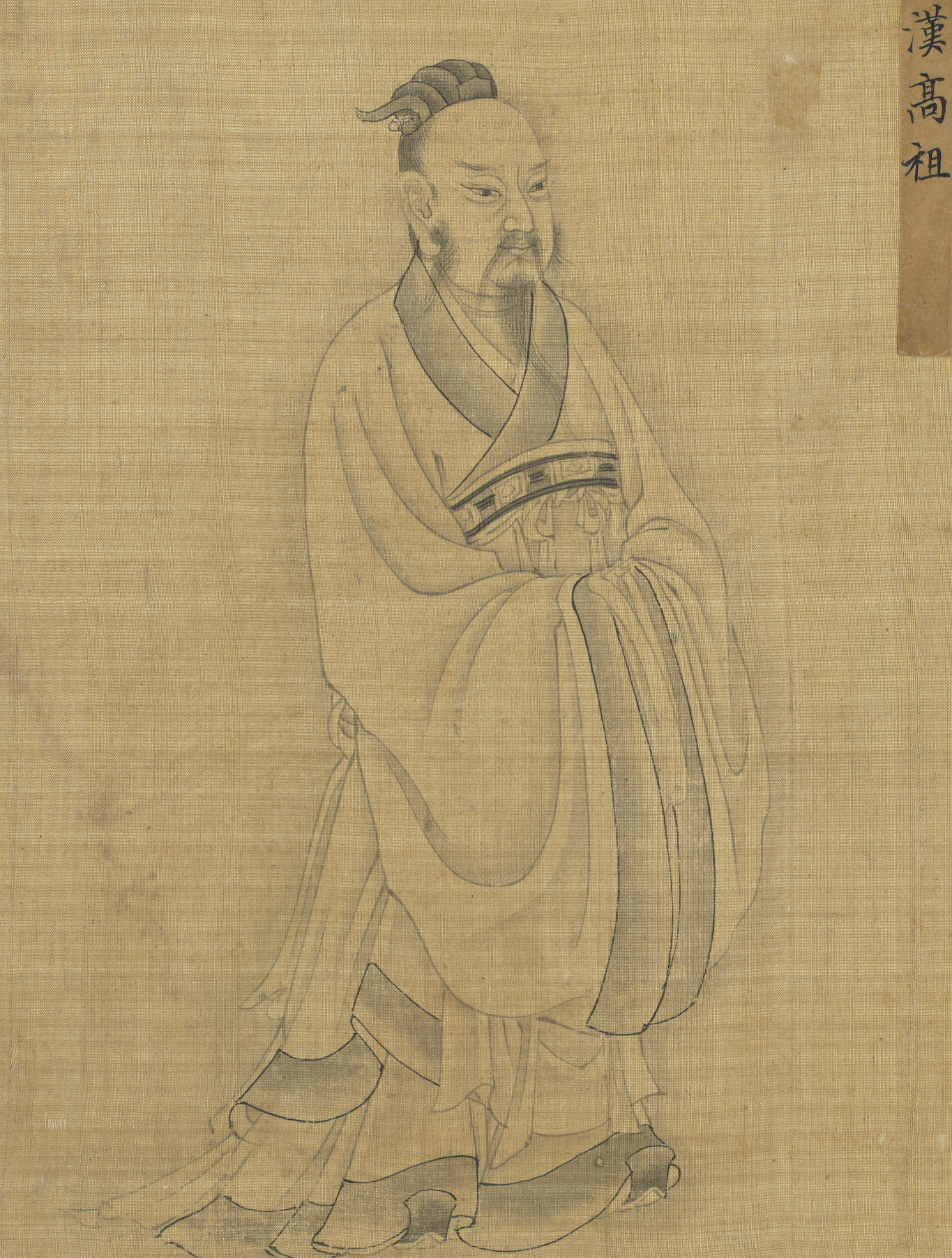
Traditional Chinese portrait of Liu Bang, Emperor Gaozu of Han
The Man Who Lost Every Battle and Won the World
He drank too much, laughed too loudly, and had a habit of insulting the scholars who came to advise him. He was a village headman in Pei County — a minor functionary of the Qin state, the sort of man whose name should have vanished into the tax registers. Contemporaries who met Liu Bang did not see an emperor. They saw an easy, physical, unbookish man with a gift for making strangers like him, and the peculiar quality of never seeming to be performing. Fourteen years after he left Pei, he ruled everything between the Gobi and the Yangtze, and the dynasty he founded lasted four centuries and gave the Chinese people the name they still call themselves.
What makes him one of history's strangest founders is that he was not, by any military measure, good at war. Against Xiang Yu — the aristocratic warrior of Chu, the finest field commander of the age — he lost engagement after engagement: routed at Pengcheng, besieged at Xingyang and escaping in disguise, struck by a crossbow bolt and pretending it had hit his foot so his troops would not see him fall. What he had instead was an unerring instinct for people. He could tell within minutes who was worth trusting, and once he trusted a man he handed over the whole task and stayed out of the way.
Asked at a victory banquet why he had won, he did not claim genius. He said he could not plan a campaign like Zhang Liang, could not feed and govern a state like Xiao He, could not command a hundred thousand men like Han Xin — but he could use all three, and Xiang Yu could not even keep one. This is the self-assessment of an ESFP: a man whose talent was not for systems or abstractions but for the live, immediate reading of the human beings in front of him.
Liu Bang was an ESFP whose dominant Extraverted Sensing read the room rather than the map — he won an empire by seeing exactly who was standing in front of him, and handing them everything.
Reading the Room, Not the Map
The defining scene of Liu Bang's life is not a battle. It is a banquet. In 206 BCE, having been first of the rebel commanders through the passes and into the Qin capital at Xianyang, he found himself summoned to Xiang Yu's camp at Hongmen, outnumbered ten to one, with Xiang Yu's advisor Fan Zeng openly urging his murder over the wine. A sword dance was staged as cover for the killing. Liu Bang did not argue, did not posture, did not appeal to principle. He read the room in real time — flattered his host, minimized his own achievements, apologized for a misunderstanding he had not committed — and then, on a pretext of relieving himself, simply walked out and rode away, leaving Zhang Liang behind to make his excuses. Survival by pure situational feel.
That same live-wire responsiveness governed his entry into Xianyang itself. The city was the accumulated plunder of the first empire: treasuries, palaces, the harem of the Qin. His soldiers expected sack; he himself, Sima Qian tells us, was tempted to stay among the women and the furnishings. Fan Kuai and Zhang Liang talked him out of it within the hour, and — this is the point — he changed course instantly. He sealed the treasuries, withdrew his army to Bashang, and left the city untouched. An intuitive would have needed a theory to abandon a pleasure. Liu Bang needed only to be told, credibly, that the room had changed.
His physical presence did the rest. He was famously coarse — he once urinated into a scholar's ceremonial cap to make a point about scholars — and famously magnetic, drinking on credit at village taverns whose owners tore up his tab because his custom brought crowds. Men followed him not for an ideology but because being near him was vivid.
Three Laws and Nothing Else
Within days of taking Xianyang, Liu Bang called together the elders of the districts around the capital and made the single most consequential gesture of his career. The Qin legal code — a lattice of mutilations, collective punishments and death sentences for administrative lateness — was the very brutality that had triggered the rebellion. He abolished it. In its place he announced three laws: he who kills shall die; he who injures another, or steals, shall be punished according to his offense. Everything else was swept away. The people of Guanzhong came out with oxen and wine to feed his army, and he refused the food, saying his stores were full.
It is easy to read this as calculation, and it was certainly good politics — when he returned to Guanzhong two years later the region welcomed him as its own. But the impulse underneath is Fi, not Te: a personal, felt revulsion at cruelty, and an equally personal need to be seen as the decent man in a war of butchers. The contrast was deliberate and it was real. Xiang Yu arrived weeks later, massacred the surrendered Qin royal house, burned the palaces of Xianyang for three months, and buried two hundred thousand surrendered soldiers alive at Xin'an. Liu Bang did not need a doctrine to know which of them the empire would eventually choose.
The same auxiliary shows in his loyalties, which were fierce, personal, and unsystematic. He pardoned enemies who had impressed him and executed friends who had not; he tried repeatedly to disinherit his heir in favor of a younger son by a favorite consort, and abandoned the attempt only when Zhang Liang arranged for four famous recluses to appear at the crown prince's side — theatre that convinced him by feel rather than by argument. Fi in an ESFP does not build codes. It registers, instantly and unshakably, what it cannot stomach.
The Art of Handing Over the Whole Thing
Liu Bang's Te is not the Te of the systematizer. He never designed an institution in his life; the Han state he left behind was largely Qin's machinery inherited intact, softened at the edges, assembled by Xiao He out of the Qin registers and maps he had the presence of mind to rescue from Xianyang while everyone else looted gold. What Liu Bang supplied was the organizing decision — the willingness to put the right man in charge of an entire domain and then genuinely leave him to it.
The clearest case is Han Xin. A deserter and a nobody, recommended by Xiao He after chasing him down a road at night, Han Xin was raised in a single ceremony from obscurity to commander-in-chief of the armies — a promotion so absurd that the veterans were stunned. Liu Bang then sent him north with an independent command to conquer Wei, Dai, Zhao, Yan and Qi while he himself absorbed Xiang Yu's hammer blows in the center. When Han Xin, at the crisis of the war, wrote demanding to be made acting King of Qi before he would march, Liu Bang's first reaction was fury; Zhang Liang trod on his foot; he corrected himself mid-sentence and made him a full king on the spot. The price was paid in the same breath the anger was felt.
That is tertiary Te in service of results, not of order for its own sake. He kept Xiao He in Guanzhong for four years running conscription, grain and taxation, and never once interfered. And when the war was won and his followers had begun to mutter about rewards, he asked Zhang Liang whom he hated most, was told Yong Chi, and ennobled Yong Chi first — a cold, wholly instrumental act from a man who otherwise governed by feel.
The Long Shadow He Could Not See Around
For a man of no vision, Liu Bang was heavily supplied with omens — the dragon over his mother, the cloud of vapor that hung above him in the marshes, the white serpent he cut in half while drunk on a night march. The stories are court propaganda, but their shape is telling: the founder needed a destiny retroactively, because in life he had visibly proceeded without one. He did not set out to found a dynasty. He set out because a work gang he was escorting to the imperial tomb had scattered, and the Qin penalty for losing them was death.
Inferior Ni surfaced in his last years as dread. Victory left him with kings he had made and could not now unmake, and he spent the rest of his reign dismantling them one by one — Zang Tu, Peng Yue, Ying Bu, and at last Han Xin, executed in the Changle Palace while Liu Bang was away on campaign. Sima Qian gives him a single unforgettable reaction on hearing the news: he was "both pleased and sorry." The pattern he could not consciously articulate — that the delegation which had won him the world was the thing that most endangered it — arrived instead as suspicion, and suspicion turned into a decade-long purge of the men who had carried him.
His one act of genuine foresight came on his deathbed, and it was characteristically concrete. Refusing treatment for the arrow wound — Heaven had given him the empire, he said, and his fate was Heaven's business now — he answered Empress Lü's question about the succession of chancellors: Cao Shen, then Wang Ling with Chen Ping to steady him, then Zhou Bo, who is dull but will be the one to save the house of Liu. Every name proved right, Zhou Bo included. It was not a vision of the future. It was a lifetime of reading men, cashed in at the very end.
Why ESFP Over ESTP
Why not ESTP?
The Se-dominant warlord is a familiar figure, and Liu Bang has the surface markers — the physicality, the improvisation, the appetite. But the ESTP's edge is tactical: reading a fight and winning it personally. Liu Bang did the opposite. He lost nearly every head-to-head engagement he fought against Xiang Yu, from Pengcheng to the long attrition at Xingyang, and he won the war anyway by absorbing punishment in the center while other men maneuvered on the flanks. His genius was for people, not for the field — whom to trust, whom to raise, whom to forgive, and what a population would feel about three laws replacing a code of mutilations. That is Fi-driven judgment of persons, not Ti-driven judgment of situations. Xiang Yu is the ESTP-shaped man in this story, and he lost.
The distinction explains the war's outcome. Xiang Yu was the superior soldier by every measure and could not hold an ally, an advisor, or a province; Fan Zeng, the only strategist he had, left him in disgust and died on the road. Liu Bang could not win a battle and never lost a lieutenant he had not chosen to destroy. Auxiliary Fi creates loyalty because it is personal — it attaches to individuals and gives a man like Han Xin the unmistakable sense of being seen. Set against Xiang Yu's aristocratic contempt, that was decisive at Gaixia in 202 BCE, where the Chu army heard the songs of their own homeland sung in the encircling camp and melted away.
Connected Figures
Further Reading
- Records of the Grand Historian: Han Dynasty I — "Basic Annals of Emperor Gaozu" — Sima Qian, trans. Burton WatsonThe founding account, written within a century of his death — the Hongmen Banquet, the three laws, and the victory-banquet speech on knowing how to use men.
- The Early Chinese Empires: Qin and Han — Mark Edward LewisThe best single-volume synthesis of what the Han inherited from Qin and what it deliberately discarded.
- The Men Who Governed Han China — Michael LoeweProsopography of the officials and kings around the throne; essential for understanding the post-victory purges.
- The Cambridge History of China, Vol. 1: The Ch'in and Han Empires, 221 B.C.–A.D. 220 — Denis Twitchett and Michael Loewe, eds.Standard reference treatment of the Chu-Han Contention and the founding of the Han state.
