 Historical Figure MBTI
#1106 · 8-17-26 · The Han Dynasty
Han Xin
The General Who Never Lost, Then Never Recovered
c. 231 – 196 BCE
7 min read
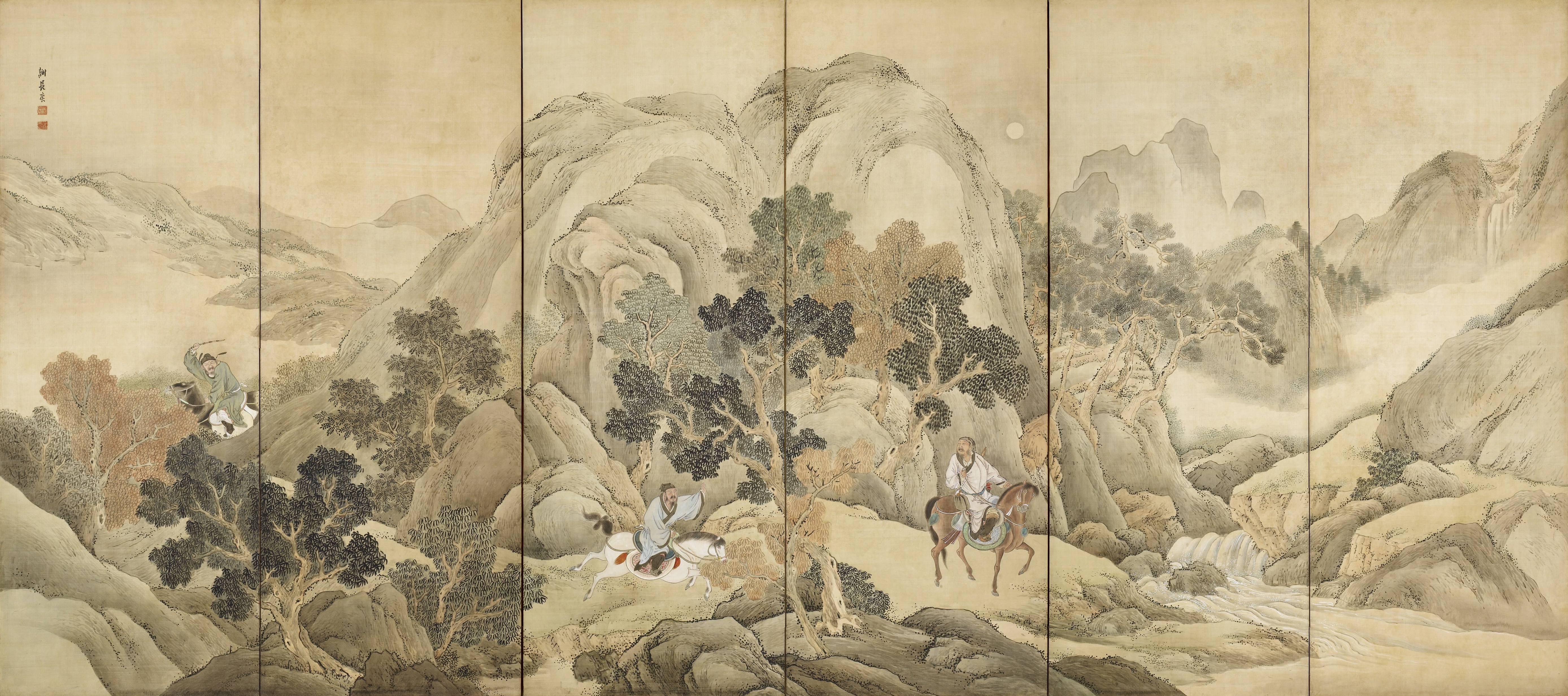
Xiao He Chases Han Xin, ink painting by Yosa Buson (Edo period)
Between the Bully's Legs, a War Already Won
Before he commanded armies, Han Xin was a poor young man in Huaiyin with a sword he could not afford to use. A butcher's boy blocked his path in the market and offered him a choice: kill me, or crawl beneath my legs. A crowd gathered to watch him decide. Han Xin looked at the odds — a dead butcher, an arrest, a life ended before it began, against one public humiliation he could survive — and got down on his hands and knees. He crawled. The crowd laughed. He walked on.
That single episode contains the whole man. He was not fearless, and he was not proud in the way that gets men killed early. He was INTJ, a mind that ran on long, private calculation and struck only when the calculation was finished — a trait that looked like cowardice in a marketplace and looked like genius a decade later at a riverbank, when he staked an entire army's life on the same instinct: that survival now buys the chance to win everything later. Xiao He recognized what the crowd could not and chased him down by night to bring him back to camp. Liu Bang gave him an army. Within four years Han Xin had out-maneuvered and out-fought every general China had to offer, and within six of the empire's founding he was dead, executed on a rebellion charge his own patience had never taught him to see coming.
Han Xin was an INTJ whose dominant Ni read the whole board before anyone else had finished reading the opening move — patience so total it looked, to everyone watching, like an absence of nerve.
The Insult He Let Pass
Ni does not react to the present moment; it reads the present moment as one frame inside a much longer film, and asks what the next frames need to look like. In the marketplace at Huaiyin, the immediate insult was total — but Han Xin was already living several years past it, in a future where he commanded armies, and a corpse or a prison sentence had no place in that future. Crawling cost him nothing that mattered to the man he intended to become.
The same pattern governed his early career. He drifted first to Xiang Yu's camp and went unnoticed, offering strategic advice that was ignored; rather than force the issue, he quietly left for Liu Bang's camp and waited there too, initially as an obscure quartermaster, until Xiao He's recommendation finally opened the door. He never manufactured a confrontation to prove himself. He watched, assessed the whole shape of the unfolding civil war between Chu and Han, and moved only when a real opening — a command, a river, a divided enemy — presented itself.
An Army With Nowhere to Retreat
Te is the engine that turns an internal read of the situation into a system other people execute. Once Liu Bang handed him command, Han Xin ran a string of campaigns — Wei, Zhao, Yan, Qi — that read less like a general improvising in the field and more like a strategist implementing a plan he had already finished solving. Every unconventional tactic he used had a hard logistical justification, not a flourish for its own sake.
His most famous stroke, at the Battle of Well Ford against a Zhao force many times the size of his own, was pure organizational nerve: he deployed his soldiers with their backs to a river, a position every textbook of the era called suicidal, because retreat was the one option his outnumbered troops could not be allowed to consider. Denied an escape, they fought as if their lives depended on it — because they did — and broke a much larger army. It was not bravado. It was Te turning psychology into infrastructure: build the system so the only rational choice left to your own men is total commitment.
He closed the civil war the same way, engineering the encirclement of Xiang Yu at Gaixia through coordinated multi-army maneuvers that boxed China's greatest warrior into a position with no way out. Xiang Yu, for all his personal ferocity, was out-organized. Han Xin did not need to be the more heroic fighter. He needed to be the one who had already arranged the battlefield so that heroism could not save the other side.
Backs to the River
An inferior function shows up under pressure, in short and forceful bursts, once the long internal calculation has finally run its course. Han Xin's Se surfaces exactly there — not as a habit of action, but as a capacity for it, held in reserve until the moment the plan demanded total physical commitment. At Well Ford he did not merely draw up the river deployment on a map; he stood inside it, in the field, with his own life staked on soldiers who could see there was no ground behind them.
It is telling that his single most decisive act of physical daring — putting an entire army in a position with zero margin for error — happened only once the strategic architecture around it was already complete. Se, for him, was never the source of the plan. It was the trigger that executed it, pulled at the one instant the calculation said pull it.
Why INTJ Over ENTJ
Why not ENTJ?
ENTJ commands out loud — it builds institutions, gives public orders, and holds visible political authority over the people it leads. That was Liu Bang's role, not Han Xin's. Han Xin's genius operated through deep, private strategic calculation, worked out largely alone and applied to specific battlefield problems, not through open charisma or the patient construction of political power. He accepted rank when Liu Bang granted it and lost it just as passively when Liu Bang or Empress Lü took it away — he never built a faction, cultivated loyalty as a political tool, or angled for the throne himself, all of which an ENTJ in his position would have found almost irresistible.
The clearest evidence is the shape of his downfall. An ENTJ who had won an empire single-handedly would have moved to convert battlefield authority into lasting political leverage — alliances, patronage networks, a visible base of loyal officers. Han Xin did none of it. He seems to have assumed, with the same detached confidence that let him crawl through the marketplace, that his usefulness alone would secure his position. It did not, and by the time Empress Lü moved against him, his introverted intuition had no political system built to protect him — only the record of what he had already won.
Connected Figures
Further Reading
- Shiji (Records of the Grand Historian) — "Biography of the Marquis of Huaiyin" — Sima QianThe primary ancient source for Han Xin's life, including the marketplace humiliation and Well Ford.
- The Men Who Governed Han China — Michael LoeweProsopographical study situating Han Xin among the founding Han elite and their fates.
- Cambridge History of Ancient China — Michael Loewe & Edward L. Shaughnessy (eds.)Scholarly context for the Chu-Han contention and the early Han court's consolidation of power.
- China: A New History — John King Fairbank & Merle GoldmanGeneral narrative background on the fall of Qin and the Chu-Han civil war.
