 Historical Figure MBTI
#1103 · 8-17-26 · The Han Dynasty
Xiang Yu
The Hegemon-King Who Lost the Empire He Won
232 – 202 BCE
11 min read
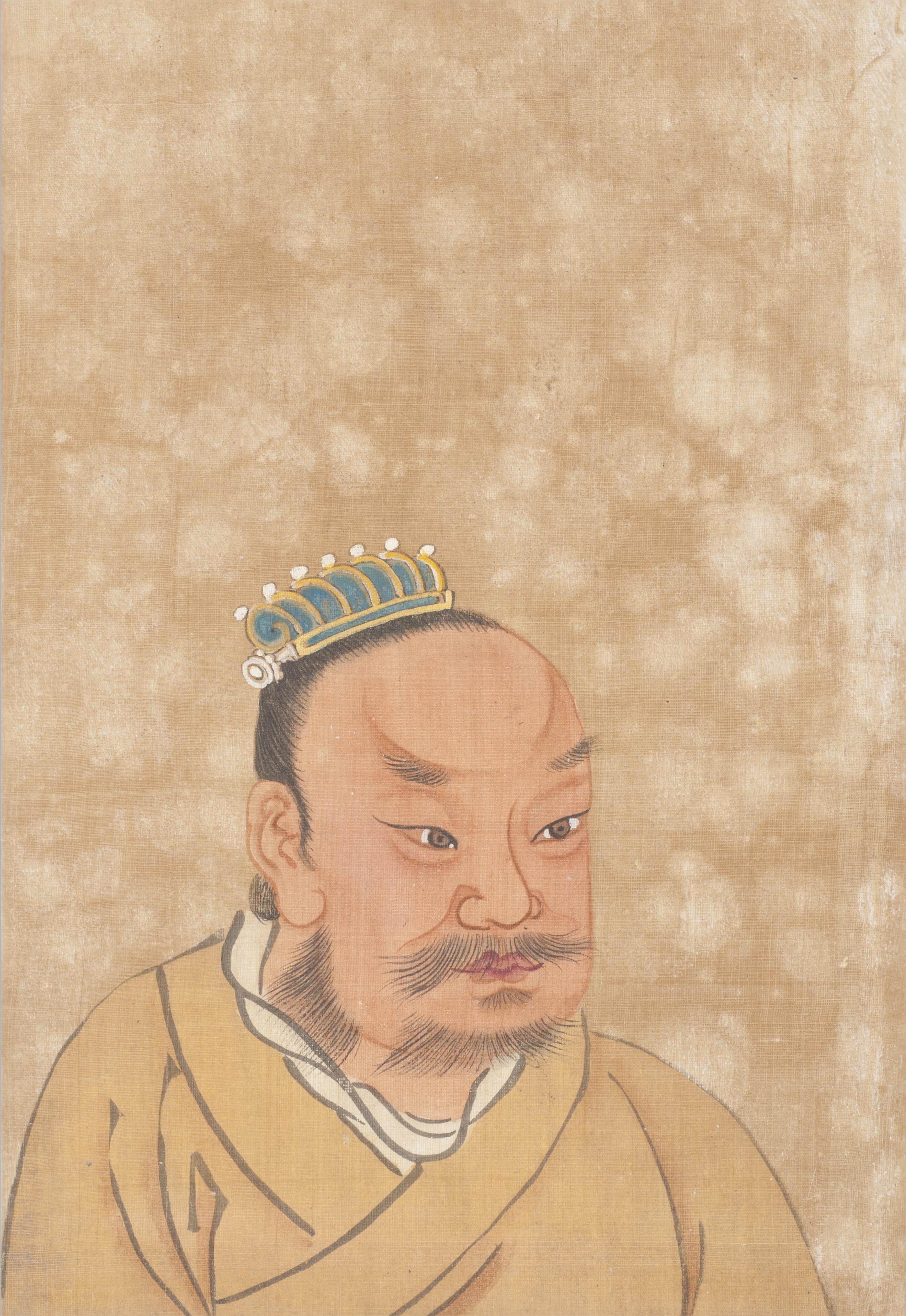
Traditional Chinese portrait of Xiang Yu, from Portraits of Famous Men
The Man Who Broke the Pots
Before the Battle of Julu, Xiang Yu did something no competent general is supposed to do. He led his army across the Yellow River, and then he sank the boats. He ordered the cooking pots smashed. He had the camp huts burned. Each soldier was given three days' rations and nothing else — no way back, no second meal, no fallback position. Then he threw that army at the main field force of the Qin empire, the machine that had conquered all of China, and he shattered it. The other rebel commanders, Sima Qian tells us, watched from behind their palisades and did not dare come out; when it was over they entered Xiang Yu's tent on their knees and would not look up at him. He was twenty-four.
That gesture is the whole man in miniature — the physical daring, the theatrical instinct for how a decision lands on the men watching it, and the total absence of a plan for the day after. Xiang Yu was, by nearly every ancient and modern account, the most dangerous soldier of his generation. He is said to have been able to lift a bronze cauldron; he fought in the front rank; over seven years of civil war he beat Liu Bang in nearly every engagement they had. And he lost anyway, comprehensively, to a middle-aged former village constable who could barely ride and who ran away from battles as a matter of policy.
The gap between those two facts is the most instructive thing about him. Xiang Yu was an ESTP operating at the absolute ceiling of what that type can do with a battlefield in front of it — and at the floor of what it can do with an empire that must be held for thirty years. He read terrain, morale, and the flinch in an opponent's face with something close to perfect accuracy. He could not read time.
Xiang Yu was an ESTP whose dominant Extraverted Sensing made him unbeatable in any moment he could see — and whose inferior Intuition left him with no map for the moments he could not.
Se — The Present Tense as a Weapon
Extraverted Sensing is the function that takes in the physical world as it is right now and acts on it without a layer of interpretation in between. In most people it produces good reflexes. In Xiang Yu it produced a career. His first recorded act of consequence, as a young man in Kuaiji with his uncle Xiang Liang, was to help cut down the local governor in his own hall and then, when the governor's guards rushed the room, to kill dozens of them personally — the rebellion began not with a manifesto but with a body count in a single room.
Julu is the mature version of the same instinct. Sinking the boats was not a philosophy of war; it was a manipulation of the immediate sensory environment so that his men had literally nothing to perceive except the enemy in front of them. He removed the alternatives from the field of view. And he was right about the effect: the Chu troops attacked nine times, broke the Qin siege lines, and captured the Qin commander Wang Li. The strategy worked because Xiang Yu understood, at a level below argument, that soldiers do not fight for reasons — they fight for what is in front of them.
This is also why he kept winning after the war turned against him. At Pengcheng he took thirty thousand men against a coalition army many times that size, attacked at dawn while they were still drunk on captured wine, and drove them into the Sui River until, in Sima Qian's phrase, the water stopped flowing. Even at the very end, surrounded at Gaixia with twenty-eight riders left, he split them into four groups, promised to break the encirclement, kill a commander, and cut down a standard — and then did all three, on schedule, to prove a point. He never lost the immediate engagement. He only ever lost the war.
Ti — Cold Arithmetic Inside the Chaos
Introverted Thinking gives the ESTP something the pure daredevil lacks: an internal logic engine running underneath the improvisation, calculating leverage, ratios, and what a given move actually buys. Xiang Yu's battles are not brawls. Pengcheng was a precise reading of an enemy's worst hour. His river crossings, feints, and night marches show a man solving a concrete problem with the pieces on the board, and solving it faster than anyone opposite him.
But Ti is a local instrument. It optimizes the problem it has been handed; it does not question whether that is the right problem. After Qin fell, Xiang Yu carved the empire into eighteen kingdoms and handed them out — an elegant-looking solution to the immediate question of how to pay off allies, and a catastrophic one for the question of who would still be loyal in three years. He gave Liu Bang the remote, defensible Hanzhong basin because it looked like an exile. It was in fact a fortress and a granary, and Liu Bang came out of it with an army.
The same cold logic turned monstrous when the problem was logistics. After the Qin general Zhang Han surrendered, Xiang Yu found himself with roughly two hundred thousand defeated Qin soldiers he could not feed, could not trust, and could not disband near his own lines. He had them buried alive in a single night near Xin'an. It is one of the great atrocities of the ancient world, and it reads exactly like what it was — a man solving a supply-and-security equation with no term in it for the future. Those dead men were the reason the population of the Qin heartland never accepted him and welcomed Liu Bang instead.
Fe — Beloved in the Tent, Ruinous in the Realm
Xiang Yu's tertiary Extraverted Feeling is the reason his men adored a commander who fed them nothing but risk. The general Han Xin, who served under him before defecting, left the sharpest description we have: when a soldier was sick, Xiang Yu would weep and share his own food with him — but when a man deserved a fief and a seal of office, Xiang Yu would turn the seal over and over in his hand until its corners wore smooth, and could not bring himself to give it away. Han Xin called it the courage of a common man and the kindness of a woman. It is a devastatingly accurate portrait of Fe in the tertiary position: overwhelming warmth in the room, nothing at all at the level of structure.
That warmth was real and it was personal, which is precisely why it did not scale. His loyalty ran to men he could see. His one indispensable advisor, Fan Zeng, he eventually drove away over a crude forgery planted by Liu Bang's side — an old man who had staked everything on him, dismissed on a suspicion, dead of an abscess on the road home. Han Xin went to Liu Bang. Ying Bu went to Liu Bang. Chen Ping went to Liu Bang. The magnetism that made him irresistible at close range dissolved at any distance, and the war was fought at distance.
And the same channel is how he was finally killed. At Gaixia, Liu Bang's besiegers sang Chu folk songs in the night on every side of the camp. It was not an assault; it was a message pitched at exactly the register Xiang Yu received the world in — the sound of home in enemy mouths, meaning the homeland had gone over. His army melted before dawn. He rose, drank, and sang a lament for his horse and for the lady Yu Ji. The greatest fighter of the age was defeated by a choir.
Ni — The Banquet He Should Have Ended
Everything Xiang Yu could not do lives in one evening at Hongmen in 206 BCE. Liu Bang had entered the Qin capital first and was, by the terms of the rebel compact, entitled to the west. Xiang Yu had forty times his strength and Fan Zeng had a plan: kill him at dinner. Fan Zeng raised his jade pendant three times as the signal. Xiang Yu did nothing. A sword dance was staged over the wine to make the killing look like an accident; Xiang Yu let it be blocked. Liu Bang flattered him, apologized, excused himself to relieve himself, and rode away. Fan Zeng smashed the jade cup he had been given and said that the young man was not worth planning for — and that they would all one day be Liu Bang's prisoners.
Inferior Introverted Intuition does not mean Xiang Yu was stupid. It means the future arrived to him only as a vague pressure rather than a picture. In the room at Hongmen there was no threat: there was a nervous, deferential, obviously weaker man apologizing to him, and his Se read that scene correctly. What he could not do was hold in mind a version of that man ten years older with an army behind him. Fan Zeng could see it. Zhang Liang, on the other side of the table, could see it and had already engineered the escape route.
The pattern recurs at every scale. He burned the Qin palaces at Xianyang rather than occupy the strongest position in China, and when an advisor suggested he rule from there, he said that to win glory and not return home was like walking abroad in embroidered clothes at night — then had the advisor boiled alive for calling him a monkey in a hat. He signed the treaty of the Hong Canal partitioning the empire, and Liu Bang broke it within weeks, which anyone with a long view should have expected. At the Wu River a ferryman offered him passage back to Jiangdong, where he could have raised a fresh army. He refused: he had led eight thousand sons of Jiangdong across the river and brought none back, and he had no face left to meet their fathers. He turned, killed several hundred more men, and cut his own throat at thirty-one. Even his death was a scene played for the men in front of him.
Why ESTP Over ESTJ
Why not ESTJ?
ESTJ builds the apparatus — chains of command, tax rolls, appointments, precedent — and its power survives the absence of the man at the top. Xiang Yu's power never once outlived his personal presence on a field. He took the title Hegemon-King of Western Chu, parceled out eighteen kingdoms in an afternoon, and then let the arrangement rot without a bureaucracy, a revenue system, or a capital worth the name. He could not even perform the elementary ESTJ act of handing out a seal of office; Han Xin watched him wear the corners off one rather than delegate. Liu Bang, meanwhile, kept Xiao He behind the lines counting grain and conscripts, and that ledger — not any battle — is what won the war.
The distinction matters because Xiang Yu is often read as simply reckless, and he was not. He was highly competent in a specific mode: the live, physical, reversible situation where speed and nerve compound. Give him a river, an enemy camp, and one morning, and no one in Chinese history does it better. Ask him to build something that runs while he sleeps, and the ESTP's inferior Ni leaves him with nothing to build from — no vision of a state, only a series of magnificent afternoons.
Connected Figures
Further Reading
- Records of the Grand Historian: Qin Dynasty — "The Basic Annals of Xiang Yu" — Sima Qian, trans. Burton WatsonThe primary source for everything above, and one of the great pieces of biographical writing in any language.
- The Early Chinese Empires: Qin and Han — Mark Edward LewisPlaces the Chu-Han contention inside the structural collapse of the Qin state.
- The Men Who Governed Han China — Michael LoeweProsopography of the administrators Liu Bang assembled — the apparatus Xiang Yu never built.
- The Cambridge History of China, Vol. 1: The Ch'in and Han Empires — Denis Twitchett and Michael Loewe, eds.Standard scholarly narrative of the war and the founding of Han.
- The Grand Scribe's Records, Vol. I — Ssu-ma Ch'ien, ed. William H. Nienhauser Jr.Heavily annotated translation of the Basic Annals for readers who want the textual problems.
