 Historical Figure MBTI
#1105 · 8-17-26 · The Han Dynasty
Zhang Liang
The Strategist Who Built an Empire Then Walked Away
c. 250 – 186 BCE
6 min read
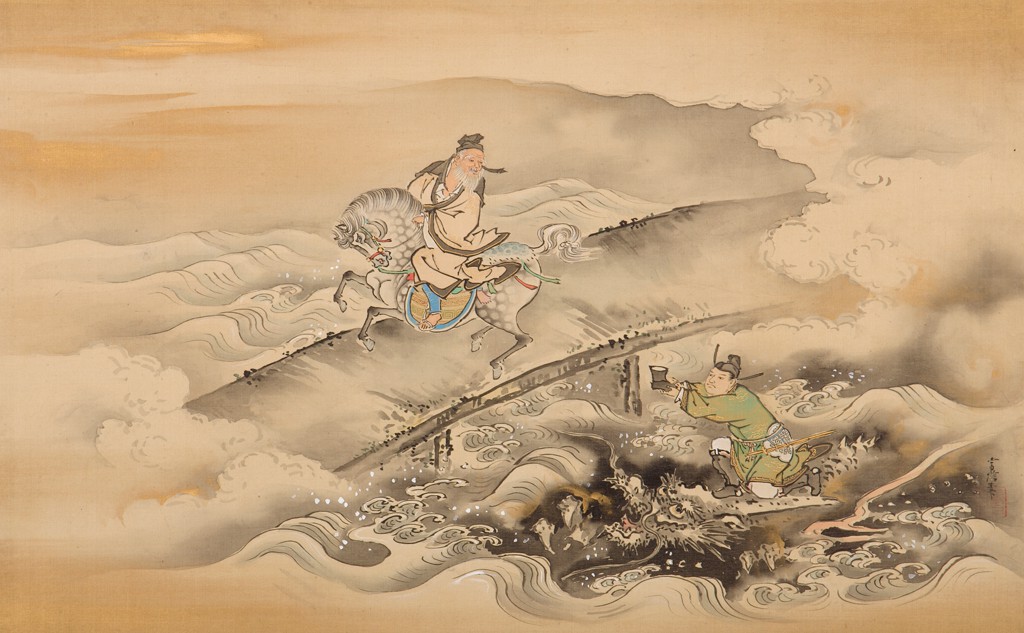
Huang Shigong and Zhang Liang, painting by Kano Tsunenobu (Edo period)
The Hammer That Missed
Zhang Liang was born to lose everything twice over. His family had served for generations as chancellors to the state of Han, until the state of Qin swallowed it whole in 230 BCE and left him a young noble with no court to serve and a grudge with nowhere to go. He spent the family fortune on a single act of theater: a hired strongman, a bronze hammer weighing over a hundred pounds, and an ambush laid for Qin Shi Huang's traveling convoy. The hammer came down on the wrong carriage. The emperor lived. Zhang Liang fled into hiding, and there — rather than plotting a second attempt — he did something almost nobody in his position would have done. He put the sword down and picked up a book.
That pivot is the whole man in miniature. He is remembered today as INTP, and the case is written into the shape of his career: a mind that solved problems by re-reading the situation from first principles rather than by force of will, that advised in flashes of pattern-recognition rather than fixed doctrine, and that — uniquely among Liu Bang's inner circle — recognized exactly when the game had ended and simply left the table.
Zhang Liang was an INTP whose dominant Ti treated strategy itself as the object of fascination — the empire he built was almost incidental to the puzzle of building it.
The Strategist Behind the Strategist
Ti dominance shows up less in what Zhang Liang decided than in how he decided it. He was not the general who led armies or the administrator who ran a state — Liu Bang kept him close precisely because he could take an unstable, half-formed situation and reduce it to its working logic before anyone else in the tent had finished arguing. Sima Qian records him repeatedly stepping in at the moment of crisis, not to rally emotion but to dismantle a plan that only sounded sensible until you traced its consequences.
The clearest case is his intervention against restoring the old Warring States. Advisors around Liu Bang argued for reviving the pre-Qin kingdoms as a gesture of legitimacy and a reward to allies. It had surface appeal — tradition, gratitude, symbolic continuity. Zhang Liang worked through it structurally instead: fragment the coalition into a dozen semi-sovereign states now, he argued, and there would be nothing left to hold together against Xiang Yu. Liu Bang reversed course immediately. It is the signature Ti move — indifferent to how an idea feels, only to whether its internal logic survives contact with the situation.
Even the failed assassination reads this way in hindsight. A century-old grudge against an empire is not, on its face, a rational project — but Zhang Liang approached it as an engineering problem: recruit the right strongman, calculate the right stretch of road, choose the right weapon. The plan failed on a contingency he could not model, and his response was equally Ti — not to double down emotionally, but to conclude that the method itself had been wrong, and to rebuild his entire approach to power from the ground up.
Reading the Board, Not the Book
What made Zhang Liang invaluable during the Chu-Han Contention was not that he had a master plan for defeating Xiang Yu — it is that he never seemed to have one, and adjusted his counsel case by case as the coalition's fortunes shifted. Ne is the function of live possibility-scanning, and his record is a string of situational reversals rather than a single doctrine applied consistently: oppose restoration here, court an alliance there, advise a tactical retreat somewhere else, each judged on the shape of the moment rather than derived from a fixed ideology.
This is also what separates him from the coalition's other great mind, Han Xin, whose genius was narrower and more purely operational — winning battles. Zhang Liang operated one level up, reading how allegiances, timing, and rival ambitions among Liu Bang's own generals were about to move next, and nudging the coalition's shape before those movements hardened into fact. It made him indispensable in exactly the moments when the old playbook stopped applying — which, in a war against Xiang Yu, was most of the time.
The Only One Who Left
When the Han dynasty was founded, Zhang Liang did something none of Liu Bang's other great strategists managed: he read the emotional undertow of the new court — the founder's rising suspicion of the men who had made his rise possible — and got out ahead of it. Han Xin, brilliant and unwilling to diminish himself, stayed, maneuvered, and was eventually executed for treason. Zhang Liang instead withdrew almost entirely from politics, citing an interest in Daoist practices and the pursuit of immortality, and let his public profile fade into irrelevance.
It is an inferior-function move in the truest sense — Fe surfacing not as natural warmth but as a late, decisive read of the room, arrived at only after the internal logic had run its course. He was not a man built to charm or manage Liu Bang's moods day to day; the evidence suggests he never much tried. But at the one moment it mattered most, he correctly sensed which way the emotional current of the court was running and simply stepped out of its path — trading influence for survival, and doing it before anyone had to ask him to.
Why INTP Over INTJ
Why not INTJ?
An INTJ strategist steers a long campaign by an unwavering internal vision, correcting course only to stay on the same trajectory. Zhang Liang did the opposite: his counsel changed shape with the situation, case by case, with no evidence of a fixed master plan he was executing across the Chu-Han Contention. And his final act — walking away from the court he had helped build, at the exact moment it turned dangerous — was not a long-plotted endgame but an adaptive response to a changed situation, arrived at only once the old logic no longer held. That is Ti-Ne improvisation, not Ni-Te vision.
The distinction matters because Zhang Liang is so often flattened into "the mastermind," a term that implies foresight extending years into the future. What the record actually shows is narrower and, in its way, more impressive: a mind exceptionally good at reading whatever situation was directly in front of it, discarding whichever plan no longer fit, and — when the situation itself became the empire turning on its own architects — reading that too, and leaving before it was too late.
Connected Figures
Further Reading
- Records of the Grand Historian: Hereditary House of the Marquis of Liu — Sima QianThe primary account of Zhang Liang's life, from the hammer plot to his retirement.
- The Men Who Governed Han China — Michael LoeweA prosopographical study situating Zhang Liang among the founding Han court's officials.
- The Cambridge History of China, Vol. 1: The Ch'in and Han Empires — Denis Twitchett & Michael Loewe (eds.)Scholarly context for the Chu-Han Contention and the founding of the Han dynasty.
