 Historical Figure MBTI
#948 · 7-12-26 · The Pacific War
Mitsuo Fuchida
Strike Leader · "Tora! Tora! Tora!" · Postwar Convert
1902 — 1976
6 min read
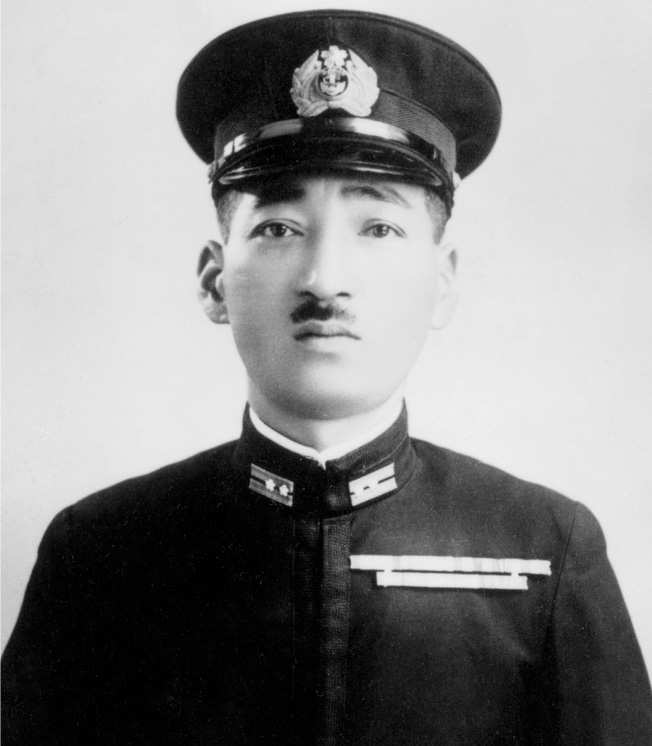
Portrait of Mitsuo Fuchida
The Voice Over Oahu
At about 7:40 on the morning of 7 December 1941, a Nakajima bomber flying above the north shore of Oahu slid back its canopy and fired a flare — then, unsure the dive bombers had seen it, fired a second, which the fighter escort read as a different signal entirely and the whole carefully rehearsed attack sequence went slightly out of order. Mitsuo Fuchida let it. The defence was asleep, the harbour was full, and the plan was close enough. A few minutes later he sent the code phrase that told the fleet six hundred miles away that surprise had been complete: Tora, tora, tora.
He was thirty-nine, a career naval aviator with more than three thousand flying hours, chosen to lead the first wave because he was the best strike commander in the Imperial Navy and because his Academy contemporary Minoru Genda wanted him. Genda designed the operation. Fuchida flew it, and then did the thing that distinguishes him: rather than turn for home with his squadrons, he stayed over the harbour for nearly an hour in a damaged aircraft, watching, counting, assembling in real time the case for another strike.
Fuchida is textbook ESTP: dominant Se that reads the live battlefield faster than any staff report can describe it, and a nerve for being physically present at the exact centre of whatever is happening.
Se — Reading the Battle While It Burns
The flare episode is Se in miniature. A plan-bound commander confronted with a garbled signal aborts and re-forms. Fuchida looked at what was actually in front of him — no fighters up, no flak, battleships moored in pairs — judged that the sequence no longer mattered, and let the attack go in as it fell. The improvisation cost nothing because he had priced the real situation, not the briefed one.
Then he stayed. His aircraft took anti-aircraft damage — a control cable was left hanging by a thread — and he circled through the smoke of the second wave making a personal damage assessment, because he did not trust a count assembled from other men’s impressions. What he brought back to the Akagi was a live tactical picture: which ships were finished, what the fuel farms and dry docks looked like undamaged, where the missing American carriers were not. He wanted to go again.
The rest of his war has the same physical quality. He was aboard the Akagi at Midway, recovering from an emergency appendectomy, when the dive bombers came; he was lowered from the burning ship and broke both ankles in the escape. He was ordered to a conference in Hiroshima in August 1945 and pulled away the day before it convened, then walked into the ruins with a survey party the following day. Se types keep ending up where the event is, and Fuchida’s survival record is improbable enough that he later treated it as evidence of something.
Ti — The Case He Made on the Bridge
Landing back aboard, Fuchida went straight to Nagumo and argued for a third wave — not on the grounds that his blood was up, but on a specific logic. The battleships were a sunk asset; the tank farms holding the Pacific Fleet’s oil, the submarine base and the repair yards were intact, unarmoured, and would take a year to replace. He could tell the admiral where the American defence had failed and how thin it still was. It was a compressed, unsentimental analysis of what would actually degrade the enemy’s capacity, delivered by the only man in the room who had just seen it. Nagumo said no.
Auxiliary Ti also shows in the technical seriousness under the swagger. He was an authority on horizontal bombing accuracy, drilled his crews mercilessly at Kagoshima, and after the war wrote the account of Midway — with Masatake Okumiya — that shaped the English-language understanding of the battle for half a century. That the book turns out to be unreliable in places, embroidered for narrative effect, is itself in character: the Ti is real but it serves a storyteller.
Fe — From the Ready Room to the Revival Tent
Fuchida was a performer. He briefed pilots, he led from the front so they could see him leading, he understood the theatre of a code word repeated three times over an open channel. Tertiary Fe in an ESTP is exactly this: an instinct for the mood of a crowd and a pleasure in moving it, unmoored from any deep ideological commitment.
It is what makes the second half of his life legible rather than bizarre. Called to Tokyo to testify at the war crimes trials, he grew bitter about Allied treatment of Japanese prisoners — and then learned of Peggy Covell, an American woman who cared for Japanese POWs though her missionary parents had been killed by Japanese troops, and was handed a tract by Jacob DeShazer, a Doolittle raider who had spent forty months in Japanese captivity and returned as a missionary. Fuchida read it, bought a Bible, and converted. By 1950 he was an evangelist, touring the United States for the Pocket Testament League, telling the Pearl Harbor story from a stage to audiences that had spent the war hating him.
Nothing in that arc is a repudiation of the man who flew the mission. He remained proud of the airmanship, defended his crews, and never pretended to have been a secret dissenter. He simply changed which crowd he was in front of, and gave it the same complete physical commitment. That is Se-Fe, not conscience arriving late.
Why ESTP Over ISTP
Why not ISTP?
Combat pilots default to ISTP in most typings, and the Se-Ti core is genuinely shared. But the ISTP is a solitary technician whose mastery is private: the flying is the point, the audience is an irrelevance. Fuchida’s entire life ran through other people. He led the largest air formation ever assembled to that date, briefed and drilled hundreds of crews, chose a broadcast code phrase with a showman’s ear, argued his case face-to-face on a flag bridge, wrote a bestselling memoir, and finished as a platform evangelist. That is extraverted energy with Fe in support, not a Ti-Se loner.
The memoir clinches it in an unflattering way. An ISTP’s account of Midway would be dry and technically fastidious; Fuchida’s is vivid, dramatically shaped, and — as later research using Japanese records established — wrong in several places where the better story won. He was not lying so much as playing to the room, which is the recurring signature of tertiary Fe in an ESTP: the truth as it lands on an audience. It is also why the conversion story travelled so far. He had spent his whole career knowing how to make a moment land.
Connected Figures
Further Reading
- At Dawn We Slept: The Untold Story of Pearl Harbor — Gordon W. PrangeBuilt partly on years of interviews with Fuchida himself; the standard account of the attack from both sides.
- Midway: The Battle That Doomed Japan — Mitsuo Fuchida and Masatake OkumiyaHis own postwar narrative — hugely influential, and best read alongside the corrections in Shattered Sword.
- Shattered Sword: The Untold Story of the Battle of Midway — Jonathan Parshall and Anthony TullySystematically documents where Fuchida's memoir embellished or invented, using Japanese primary records.
- God's Samurai: Lead Pilot at Pearl Harbor — Gordon W. Prange with Donald M. Goldstein and Katherine V. DillonThe full biography, including the postwar conversion and the evangelical career in America.
