 Historical Figure MBTI
#326 · 3-27-26 · The Enlightenment
Père Antoine Adam
Jesuit at Ferney · Voltaire's Chaplain and Chess Partner · 'Not the First Man'
1705 — 1787
5 min read
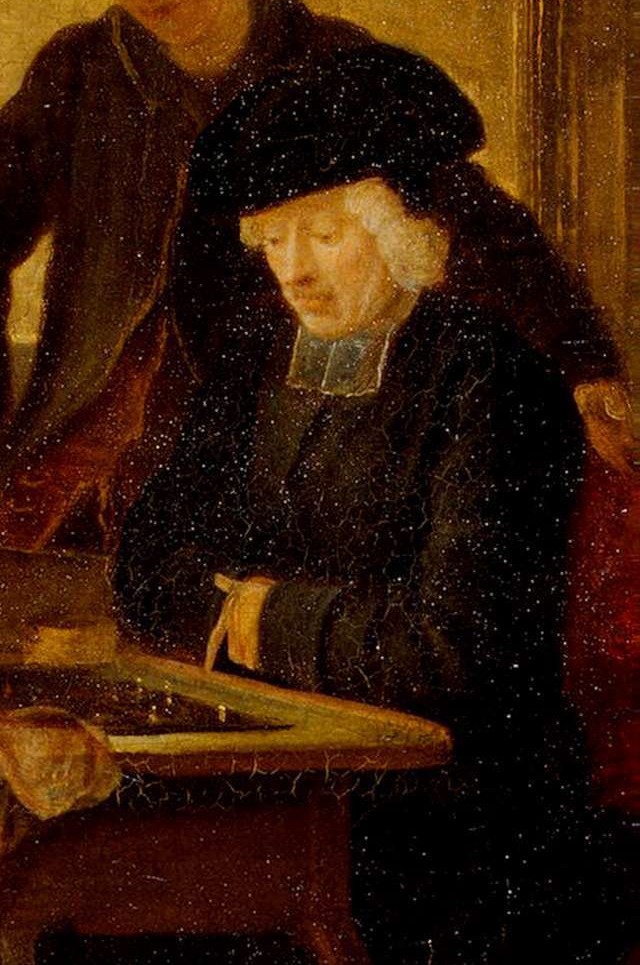
Portrait of Père Antoine Adam
The Priest in the Enemy's House
The most ferocious enemy the Church had faced in a century kept a real, ordained Jesuit under his own roof, sent him each morning to a church inscribed DEO EREXIT VOLTAIRE, and introduced him to every visitor the same way: Voici le Père Adam — mais ce n'est pas le premier homme du monde. The priest was Père Antoine Adam, left without an order when the French crown suppressed the Jesuits in 1764. Voltaire took him in.
The guest would smile at the pun; the priest would bear it. Adam said the masses, kept the old man company in the long evenings, and—above all, to Voltaire's lasting irritation—played chess. He was the better player, beating the great man often and correcting him without ceremony while Voltaire fumed and swept pieces.
Père Adam survives in history only as a fixture in another man's house. Yet the vivid situation is enough to read him: steady religious routine, patient accommodation to an impossible patron, quiet competence at the board. He was an ISFJ—dominant Si in the faithful office, auxiliary Fe keeping harmony under a roof that made harmony nearly impossible, tertiary Ti winning at chess, inferior Ne serene where Voltaire's was on fire.
Voltaire introduced him as “Father Adam — but not the first man in the world,” and the joke is the whole portrait: the quiet ISFJ who found a place and kept it in the household of the Church's most dangerous enemy.
The Faithful Office
Si — dominant
Dominant introverted sensing is the faculty of the kept routine—the duty performed because it has always been performed. A priest's vocation is built on it: the same liturgy every year, the Mass said the same way every morning. When Adam's order was dissolved, the daily office did not collapse. He carried it intact into the house of the man who had spent his life attacking the institution behind it, and went on saying it. What Voltaire wanted was not theology but reliability. Adam wrote no system, founded nothing, advanced no career: the highest virtue is to be found, reliably, at one's post.
The Patience Under the Teasing
Fe — auxiliary
Auxiliary extraverted feeling is the instinct to absorb friction rather than return it. In Père Adam it had a daily test most Fe users never face: living in the household of a man who teased him as sport and raged at the board like a child. He did not argue back or insist on his dignity. He bore it, and by bearing it he kept the peace.
Adam understood that Voltaire's mockery was mostly affectionate, and that the way to remain was to be the steady, unoffended presence the great man could not rattle. The harmony eventually frayed and by the mid-1770s he left. But for years the auxiliary feeling held it—under a roof where almost no one else of his calling could have lasted a season.
The Quiet Win at the Board
Ti — tertiary
Here is where the meek priest had his one undisputed mastery. Ti is the cold logic of the closed system, indifferent to whose feelings are involved. Chess is that logic made into a game, and at it Père Adam was simply the stronger man. Voltaire's proliferating intuition was the wrong instrument; patient, positional calculation won, and the priest had that.
Tertiary Ti in an ISFJ is competence without self-display. Adam did not lecture Voltaire on chess or theorize his superiority. He played the position correctly and let the result stand—correcting the old man the way a quiet expert corrects an impatient amateur, by winning not by explaining. He kept his logic to the chessboard, never turning it outward into argument. The one place the obscure priest was, demonstrably, the master in the house.
The Conventional Mind Beside the Volcanic One
Ne — inferior
Ferney staged a daily contrast: inferior extraverted intuition seated across from Voltaire's dominant Ne at full pitch. In Voltaire, Ne produced fifty major works and reduced the certainties of the age to rubble. In Père Adam it sat dormant at the bottom of the stack—and that is precisely why the two men could share a house. Adam felt no itch to question what he had received.
To Voltaire this made him a comic relic. But it also made him useful and restful: the fixed point the restless mind could orbit, the one man at Ferney not generating a new provocation every hour. In a household built around the most explosive intuition of the century, the most valuable presence may have been the quiet man who felt no need to explode at all.
Why ISFJ Over ESFJ
Why not ESFJ?
The ESFJ shares the same Si–Fe pairing and dutiful service, so the temptation is real. But the ESFJ leads with extraverted feeling—outward, socially prominent, the natural presider who shapes a group from the front. Père Adam did the reverse: quiet, retiring, the chaplain at the edges. He accommodated the household rather than organizing it, absorbing friction from a back seat where the ESFJ would have taken the lead. That is dominant Si steadied by auxiliary Fe, not the front-facing Fe of the ESFJ.
Everything about his life points inward and backward—holding a place, not commanding one. He left no mark beyond the walls of another man's house and does not seem to have wanted one. That self-effacing fidelity is the ISFJ at its purest.
Connected Figures
Further Reading
- Voltaire: A Life — Ian DavidsonThe fullest modern English biography; covers the Ferney years in depth, including Adam's place in the household.
- Voltaire in Exile — Ian DavidsonFocused specifically on the Ferney period — the suppression of the Jesuits, Adam's arrival, and the strange domestic comedy of the château.
- The Smile of Reason: Voltaire — Jean OrieuxA substantial French biography translated into English; richly detailed on the daily life and guests at Ferney.
