 Historical Figure MBTI
#325 · 3-27-26 · The Enlightenment
Edward Gibbon
Historian · Author of the Decline and Fall · The Ironist of Empire
1737 — 1794
7 min read
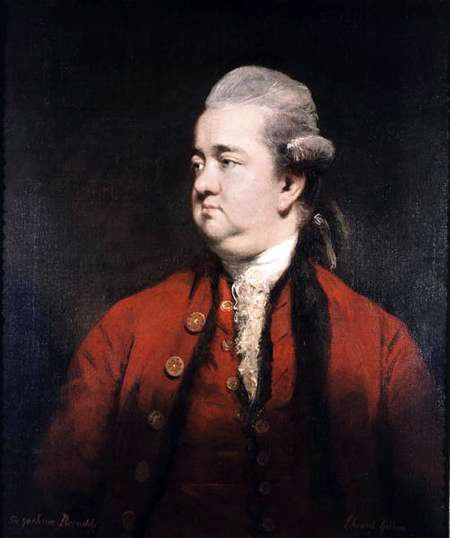
Portrait of Edward Gibbon
The Idea on the Capitoline
On the fifteenth of October, 1764, a short-sighted young Englishman of twenty-seven sat among the ruins of the Capitoline Hill while, somewhere below him, “the barefooted friars were singing vespers in the temple of Jupiter.” Edward Gibbon felt the juxtaposition not as melancholy but as a problem—immense, exact, soluble—and in that moment “the idea of writing the decline and fall of the city first started to my mind.” It would take twelve more years to publish a word, but the architecture was already there, waiting to be reasoned out.
What followed was The History of the Decline and Fall of the Roman Empire, six volumes tracing thirteen centuries from the Antonine summit to Constantinople. Its footnotes—erudite, witty, occasionally scandalous—wander across recorded knowledge with the relish of a man who has read everything and trusts nothing. When Gibbon explained Christianity's rise through a sober inventory of “secondary” human causes, he detonated a controversy that outlived him. He did not attack the faith; he merely declined to exempt it from detached analysis, which to the devout was somehow worse.
The mind that built this is the INTP nearly to caricature: dominant Ti erecting a vast, precise, ironic logical structure; auxiliary Ne weaving connections across the Mediterranean world and forever chasing the interesting footnote; tertiary Si commanding an immense, exact memory of sources; and inferior Fe visible in the bachelor reserve and the habit of subordinating sentiment to duty. He met Voltaire at Lausanne and admired the wit without catching the fever. Where Voltaire fought, Gibbon weighed.
Gibbon was the INTP raised to its highest power—a dominant Ti that built an exact and ironic logical architecture over thirteen centuries, fed by an auxiliary Ne that could not pass an interesting connection without chasing it into a footnote.
The Architecture of Judgment
Ti — dominant
Dominant Ti is analytic thinking that wants to understand precisely and is satisfied by nothing less than internal consistency. The Decline and Fall is its most visible monument. Not a chronicle but an explanatory machine: before answering why Rome fell, Gibbon anatomizes the army, the frontier, the coinage, the succession, the theology, and the temperament of a dozen emperors—each weighed on its own scale, each fitted into a single, vast, self-consistent account.
The signature of that mind is its irony: Ti does not assert, it discriminates, holds two things in suspension, and lets the reader feel the gap. “The various modes of worship which prevailed in the Roman world were all considered by the people as equally true; by the philosopher as equally false; and by the magistrate as equally useful.” The precise, three-edged registration of a fact from three incompatible vantage points—Ti refusing to collapse a complexity into a slogan.
When Gibbon turned this faculty on Christianity, he produced not a polemic but a taxonomy: five secondary causes, soberly listed. Voltaire would have gone for the throat with a joke; Gibbon went for the structure with a scalpel, arranging evidence so the reader reached the devastating conclusion without being told it. His accusers thought he was attacking. He was only classifying—and to dominant Ti, declining to make an exception is simply honesty, not war.
The Wandering Erudition of the Footnote
Ne — auxiliary
Auxiliary Ne supplied the breadth that made the structure worth building. Gibbon's history ranges across the entire Mediterranean and beyond—Persia, the steppe, Arabia, Byzantium, the crusader states—because the author's mind could not resist following the empire's frontiers into every civilization that pressed against them. Encyclopedic not from a will to be comprehensive, but from a temperament that found everything interesting.
The footnotes are pure Ne. A point of Roman law sends him sideways into a question of philology, which suggests a sly aside on a modern scholar's vanity, which becomes a witty observation on human folly across the ages. The main text holds the logical line; the footnotes wander, associate, and amuse—a portrait of a mind that has read everything and delights in showing how all of it secretly rhymes.
His education was itself an Ne education: voracious, self-directed, unsystematic. A sickly child who devoured books faster than any tutor could direct, he briefly converted to Catholicism on the strength of a chain of argument that interested him, was packed off to Lausanne to be cured, and there read his way across all of European learning, met Voltaire, and acquired the cosmopolitan range the Decline and Fall would require. Ne grazes widely first and finds its great object late.
The Storehouse of Sources
Si — tertiary
Tertiary Si is the precise storehouse of what one has read, held in reserve and recalled exactly. Gibbon's command of his sources was legendary: ancient historians, Byzantine chroniclers, church fathers, legal codes, modern antiquarians—held in his head with a fidelity that let him catch a contradiction across authors who wrote centuries apart. The footnotes are not only Ne digressions; they are also a Si inventory, meticulous accounting of exactly where every assertion comes from.
Gibbon's reverence for accuracy—his refusal to invent, his contempt for guessing where he might verify—is Si in the service of dominant Ti. Under the irony lies an enormous, verifiable scaffolding of evidence.
Si also shows in the man's settled, methodical life—the bachelor habits, the fixed routine, the deep attachment to his Lausanne garden. When he wrote the last lines on a June night in 1787 and walked outside, he recorded not only joy but a melancholy at parting from a labor that had ordered his days. A mind anchored by Si feels the loss of a routine as a kind of bereavement, even a triumphant one.
“I Sighed as a Lover, I Obeyed as a Son”
Fe — inferior
The INTP's most exposed point is inferior Fe—the underdeveloped capacity to act upon collective emotion. Gibbon's life supplies the textbook case. As a young man at Lausanne he fell in love with Suzanne Curchod, a brilliant pastor's daughter. His father refused consent. Gibbon's response is one of the most quoted sentences in the literature of suppressed feeling: “I sighed as a lover, I obeyed as a son.” He broke it off; Curchod married the financier Necker; Gibbon never married at all. The feeling was real—simply overruled, quietly and permanently, by duty and reason.
Socially he was vain of his learning, stiff with strangers. As a Member of Parliament he sat for years without once making a speech—a silent vote, content to listen and weigh. As a militia captain he made the dry joke that the exercise had “not been useless to the historian of the Roman empire,” turning even a brush with collective life into private, ironic copy. He understood the passions of thirteen centuries on the page. In the room, in his own life, he sighed—and obeyed.
Why INTP Over INTJ
Why not INTJ?
The INTJ runs on Ni and Te: a focused single-vision intuition marshaling the past toward a thesis, harnessed to an executive thinking that drives conclusions and reshapes the world to fit them. Gibbon's mind worked the other way. His thinking was analytic and ironic, not directive; his method was Ne breadth, not Ni depth. The wandering footnotes ranging across all knowledge are the opposite of a single marshaling vision. He savored ironies and hedged every assertion—sitting silent in Parliament, content in his Lausanne study—where an INTJ would have wanted to wield the history as a weapon.
An INTJ historian would have driven the Decline and Fall toward a verdict—a lesson the present must act on. Gibbon declined, almost as temperament: he explained Rome's fall exhaustively and left the reader holding a structure rather than a sentence. Where Voltaire fought, Gibbon weighed—then qualified the weighing. The irony that is the soul of his prose is the Ti-and-Ne signature: a mind too in love with complexity to flatten it into a thesis.
Connected Figures
Further Reading
- Edward Gibbon: A Life — Patricia CraddockThe definitive modern biography, tracing Gibbon from his sickly childhood through the composition and reception of the Decline and Fall.
- The History of the Decline and Fall of the Roman Empire (Abridged) — Edward Gibbon, ed. David WomersleyPenguin Classics abridgement of Gibbon's own text — the ideal entry point, preserving the ironic prose and legendary footnotes.
- Gibbon and Rome — G. W. Bowersock, John Clive, and Stephen R. Graubard (eds.)A collection of essays by leading historians assessing Gibbon's methods, legacy, and place in the historiographical tradition.
- The Enlightenment: An Interpretation — Peter GayPlaces Gibbon within the broader republic of Enlightenment letters — essential context for his relationship to Voltaire, Hume, and the philosophes.
- Gibbon's Autobiography — Edward Gibbon, ed. M. M. ReeseGibbon's own fragmentary memoirs — the source of his most famous lines, including 'I sighed as a lover, I obeyed as a son.'
