 Historical Figure MBTI
#873 · 6-23-26 · The American Civil War
Philip Sheridan
General · Shenandoah Valley Campaign · Union Cavalry Commander
1831 — 1888
9 min read
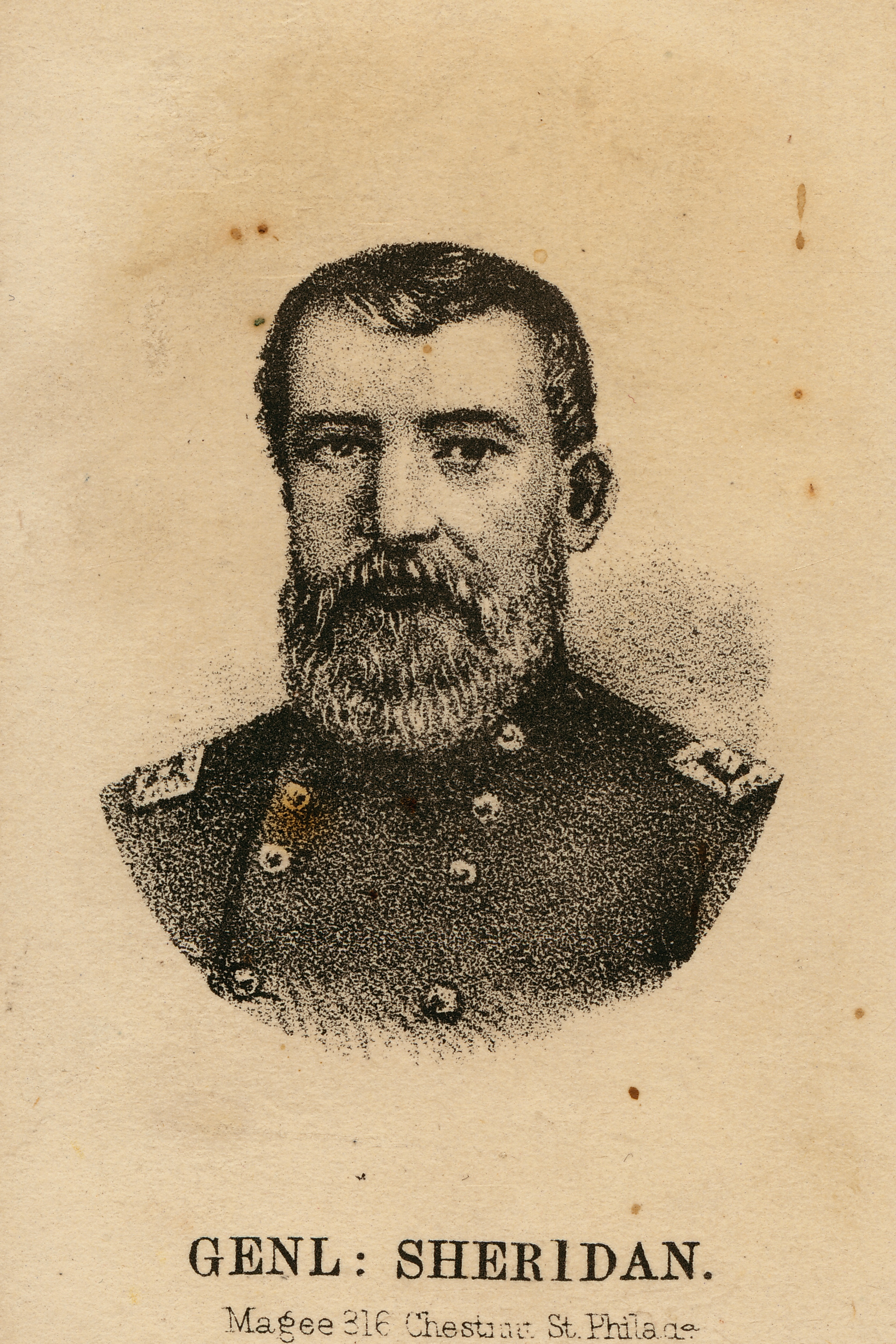
Portrait of Philip Sheridan
The Ride
On the morning of October 19, 1864, Philip Sheridan was fifteen miles from his own army, returning from a strategy conference in Washington, when he heard the guns. Jubal Early had struck the Army of the Shenandoah at Cedar Creek before dawn and broken it — two corps routed, camps overrun, thousands of men streaming north in the kind of panic that does not reverse itself by committee. Sheridan reversed it anyway. He put his horse Rienzi on the Valley Pike and rode toward the sound of his own defeat, gathering fleeing soldiers by force of presence alone, turning them around with his hat in the air and his voice pitched to carry over gunfire, until a broken army was a fighting one again by afternoon and Early's men were the ones running. It is the single most famous image in American cavalry history for a reason: nothing about it was theoretical. Sheridan did not out-plan Early that day. He out-arrived him, and then he out-willed everyone in earshot.
Short, thick-necked, built more like a longshoreman than a cavalier, Sheridan was suspended from West Point for nearly bayoneting a fellow cadet and graduated a year late — a preview of a career built on the conviction that decisive action, however blunt, beats deliberation. He rose fast once Grant found him, because Grant recognized in Sheridan exactly what Grant needed and did not have time to be himself: a subordinate who could take a broad intention and execute it without hesitation, improvisation, or excessive regard for the niceties of nineteenth-century warfare. That combination — physical command presence married to ruthless, uncomplicated follow-through — is the signature of an ESTP, and Sheridan wore it as plainly as any figure in this archive.
Sheridan was not a strategist. He was an instrument of astonishing quality — pointed by Grant, aimed at a target, and trusted to arrive at full speed and improvise the rest.
A Body in the Field
Sheridan's dominant Se is not a metaphor for the Cedar Creek ride — it is the ride, and it is nearly everything else about him besides. He commanded from the front as a matter of habit, not spectacle, because his read on a battle came through what he could see and feel in the moment, not through a plan drawn the night before. At Cedar Creek this was the whole battle: he did not receive a report and issue an order from a map table, he arrived on a lathered horse in full view of his own retreating men and put himself, physically, between them and the rear. The gesture worked because he meant it as pure presence — an ESTP's native trust that a body in the right place, moving with total conviction, changes outcomes faster than instructions can.
The same appetite for direct, immediate, physically decisive action drove the Shenandoah Valley campaign of 1864 that made his name before Cedar Creek ever happened. Ordered by Grant to deny the Confederacy the Valley's grain and livestock, Sheridan did not treat this as a logistical abstraction to be managed from headquarters. He rode the ground himself and had it burned — barns, mills, crops, an estimated two thousand barns and seventy mills put to the torch in a matter of weeks, an operation soldiers and civilians alike simply called the Burning. It was total, immediate, unsentimental, and effective within a single campaigning season. Sheridan felt no need to theorize about total war; he simply executed it, region by region, farm by farm.
Even his postwar record reads as the same function without the uniform. As a Reconstruction commander in Texas and Louisiana he enforced federal authority with blunt physical force rather than political finesse, and in the postwar Indian Wars he applied the Valley's logic again — deny the enemy's means of subsistence, strike hard and immediately, worry about the moral accounting later. It made him one of the most effective and most controversial commanders of his era, and both reputations trace back to the same trait: Sheridan trusted what was directly in front of him, and acted on it without delay.
A Craftsman Inside Someone Else's Frame
Sheridan's auxiliary Ti did not build strategy — that was Grant's department — but it made him unusually good at solving the tactical problem in front of him with whatever tools were at hand. Given the assignment "clear the Shenandoah Valley," Sheridan worked out, on the ground and largely on his own initiative, exactly how cavalry, infantry, and scorched earth should be sequenced to achieve it, adjusting as Early's army maneuvered against him. He absorbed Grant's stated intent and then reasoned out the mechanics himself, which is precisely how a Ti auxiliary operates in service of a dominant, external orientation: not building the system, but taking a system apart and reassembling it to work.
His use of cavalry shows the same trait in miniature. Sheridan reorganized the Union cavalry from a scattered screening force into a concentrated strike arm capable of operating independently of the infantry — massing Merritt's and Custer's divisions to overwhelm Confederate horsemen rather than trading blows piecemeal, as earlier Union commanders had. It was a genuine tactical insight, worked out through trial rather than doctrine, and it paid off at Yellow Tavern and again in the final campaign, when Sheridan's troopers cut across Lee's line of retreat and helped pin the Army of Northern Virginia at Appomattox.
But the Ti never became the wheel that steered the car. Sheridan improvised brilliantly inside Grant's frame and rarely, if ever, proposed the frame itself. He was the man Grant trusted to make a plan work on contact with reality — not the man Grant asked to design the plan.
Loyalty That Ran Both Directions
What tertiary Fe gave Sheridan was not diplomacy — he had little patience for that — but a genuine, reciprocated bond with the men above and below him, which he used consciously as a command tool. His relationship with Grant was built on more than utility; it was a loyalty Sheridan actively cultivated and one Grant returned for the rest of his life, promoting Sheridan repeatedly and defending him in his memoirs against critics of the Valley campaign's harshness. Sheridan understood, in a way many Civil War generals did not, that an army is a network of morale as much as a machine of logistics, and he tended that network deliberately.
The clearest evidence is the ride itself as a piece of leadership rather than pure spectacle. Sheridan did not merely reorganize the fleeing troops at Cedar Creek — he rode among them, calling out by name, making eye contact, staking his own visible authority on the claim that the day was not lost. That is Fe doing tactical work: reading a collapsed group's emotional state and directly repairing it through personal presence. His bond with Custer worked the same way in the other direction — Sheridan promoted and protected his flamboyant young cavalry commander, tolerating Custer's showmanship because he valued the loyalty and aggression it came bundled with, and gave Custer the table at Appomattox on which Lee's surrender terms were later drafted, a gift Custer's wife kept the rest of her life.
None of this softened Sheridan into a people-pleaser. His Fe served his mission and his men, in that order, and it never once talked him out of burning a barn.
What He Left to Others
Sheridan's inferior Ni shows up as absence rather than presence — in the strategic questions he simply never seems to have asked. He did not, so far as the record shows, spend the war theorizing about what total war meant for the shape of the peace to come, or how the destruction of the Valley's agricultural base fit into a larger vision of how the South would be reconstructed after Appomattox. He was given a target and a method and he executed both without evident interest in the longer arc his actions were serving. That is not a criticism so much as a description of where his attention simply did not go.
It shows again in his postwar record, where Sheridan's approach to Reconstruction enforcement and later to the Indian Wars was essentially the Valley campaign transplanted without modification — deny resources, strike decisively, repeat — applied to circumstances that arguably called for something more foresighted than a tactic that had worked once. His reported remark that "the only good Indians I ever saw were dead" (a line he denied ever saying in those words, though its spirit tracked his conduct closely) reflects a man operating on the same immediate, physical calculus that had made him devastating in the Valley, deployed now without Grant's broader strategic hand to aim it.
Sheridan needed someone else to hold the long view — Grant during the war, and no one comparably in the campaigns that followed it. Where Ni was missing, Se and Ti simply kept doing what they had always done, for better and for considerably worse.
Why ESTP Over ENTJ
Why not ENTJ?
An ENTJ conceives the campaign — decides that the Valley must be stripped, that Lee's supply lines must be severed, that a war of attrition is the theory to pursue, and then delegates execution. Sheridan never occupies that seat. The strategic conception of the 1864 Valley campaign, and of the broader war of exhaustion it served, belonged to Grant; Sheridan's genius was entirely in the seizing and exploiting of the moment inside someone else's design. His signature acts — the ride, the Burning — are physical and immediate, not architectural. An ENTJ builds the plan and hands off the execution; Sheridan is what happens when the execution is handed to someone who does it better than anyone alive.
The distinction matters because Sheridan is so often folded into the same "decisive commander" category as Grant himself, when their decisiveness worked in opposite directions. Grant's was the extended, Ni-inflected decisiveness of a man who had already decided how the war would end and was patient about getting there. Sheridan's was Se decisiveness — total commitment to the situation directly in front of him, with no particular investment in what came after it. Both won the war. Only one of them is remembered for a horse.
Connected Figures
Further Reading
- Personal Memoirs of P. H. Sheridan — Philip H. SheridanSheridan's own 1888 account of the Valley campaign and the war's final year.
- Sheridan: The Life and Wars of General Phil Sheridan — Roy Morris Jr.The standard modern biography, strong on Sheridan's temperament and Grant relationship.
- From Winchester to Cedar Creek: The Shenandoah Campaign of 1864 — Jeffry D. WertDetailed operational history of the campaign and the ride, including the Burning.
