 Historical Figure MBTI
#877 · 6-25-26 · The American Civil War
George Armstrong Custer
Cavalry General · Boy General · Appomattox
1839 — 1876
7 min read
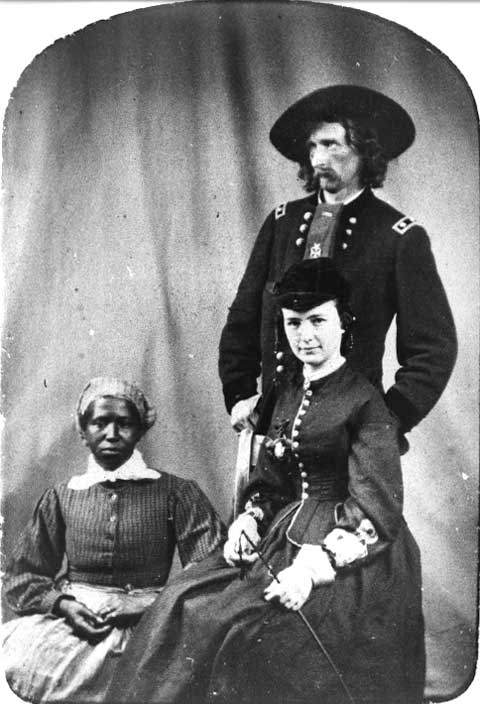
Portrait of George Armstrong Custer
The General Who Graduated Last
He finished thirty-fourth in a class of thirty-four at West Point, a cadet more famous for court-martials and practical jokes than for scholarship, and within three years he was a brigadier general leading a division of Union cavalry at twenty-three — the youngest general officer in the Army. That trajectory is the whole man in miniature. George Armstrong Custer did not rise through study or patience. He rose by riding, personally and repeatedly, at the front of a charge, in a costume he had tailored to be seen. He wore a black velveteen jacket trimmed in gold lace, a scarlet cravat, and let his hair grow into loose, shoulder-length curls — a uniform designed less for camouflage than for legend, and it worked exactly as intended.
Custer is often filed, lazily, with the idealistic showmen — the ENFPs of history, inspired visionaries who charm a room into following them. He was nothing of the kind. His authority was built entirely out of what his body did under fire, not what his voice promised in advance. He is an ESTP, and the distinction matters: an ESTP's charisma is downstream of demonstrated physical dominance, not a substitute for it. Custer had six horses shot from under him in combat; the flamboyance was advertising for a product that delivered, on real ground, again and again.
Custer was Se in dress uniform — a man who understood, with a tactician's precision, that the charge itself was the argument.
The Charge as a Way of Being
At Gettysburg, on July 3, 1863, while Pickett's division was breaking against the Union center, Custer's Michigan cavalry brigade was three miles east, blocking J.E.B. Stuart's attempt to strike the Union rear. Outnumbered, Custer did not wait for the enemy to commit. He rode out in front of his own line, shouted "Come on, you Wolverines!," and personally led the countercharge that broke Stuart's advance. It is the single clearest snapshot of his mind at work: no deliberation over alternatives, no hedged instructions relayed through subordinates — just a body launched into the gap at the exact moment the gap existed.
That pattern repeats with almost mechanical regularity through 1864 and 1865. At Yellow Tavern that May, his brigade's charge broke the Confederate cavalry line and, in the chaos, a trooper in his division mortally wounded Stuart himself — the closest thing the war offered to a duel between cavalry commanders, and Custer's Se had helped stage it. Through Sheridan's Shenandoah Valley campaign that autumn he was everywhere in the front rank, and by the war's final week his division was among the forces physically blocking Lee's roads out of Virginia, forcing the confrontation that ended at Appomattox.
None of this reads as recklessness alone. Se in its healthiest form is not blind risk but total, high-resolution presence in the moment — reading a treeline, a column's gait, the half-second when a line is about to break — and Custer's read of terrain and timing was, by every contemporary account, exceptional. The uniform got the attention. The instinct for the instant is what kept earning it.
A Tactician Underneath the Theater
It is tempting to read Custer's showmanship as the whole story and miss that he was, by the judgment of superiors who owed him nothing, a genuinely skilled cavalry officer. Sheridan trusted him with the decisive strokes of the 1864–65 campaigns not out of sentiment but because his brigades and then his division consistently did what was asked of them, on schedule, against resistance — an internal, working model of how cavalry functions against infantry and artillery, tested and refined charge by charge rather than inherited from doctrine.
In the war's final week, this showed most clearly. Custer's division, operating at the head of Sheridan's pursuit, seized Confederate supply trains at Appomattox Station on April 8, 1865, and then positioned itself directly across Lee's line of retreat the next morning — a maneuver requiring not courage alone but an accurate, fast read of where an army under pressure would try to go and how to arrive there first. It was that blocking position, more than any single charge, that removed Lee's last option and made the surrender talks at Wilmer McLean's house possible.
Sheridan's gesture afterward is its own small proof of how the command structure rated him: he bought the pine table Grant and Lee had used to draft the surrender terms and gave it to Custer's wife, Libbie, crediting Custer's role in the campaign. That is not a reward handed out for a costume.
Built for an Audience
Custer's need to be seen was not vanity in the shallow sense; it was a genuine, consuming appetite for the approval of others, expressed both upward and downward. Upward, it drove the newspaper dispatches, the self-authored after-action reports that read like adventure fiction, and later his own memoir, My Life on the Plains — a man narrating his own legend as it happened, aware at every turn that a public was watching. Downward, the same hunger produced something closer to genuine devotion: the "Custer's Wolverines" of Michigan followed him with a loyalty that outlasted the war, and he wrote to his wife Libbie almost daily from the field, a correspondence of startling warmth and need for a man otherwise built around risk.
That relationship with Libbie is itself a Fe signature — an attachment that ran on constant, explicit emotional exchange rather than quiet or private feeling. He married her in February 1864 over her father's initial objections and made her, for the rest of the war, both confidante and public co-star; it was to her that Sheridan later sent the Appomattox table. The performance of glory and the performance of devotion were, for Custer, the same instinct pointed two directions.
No Room for the Long View
What Custer's cavalry career shows least is any real capacity for the slow, pattern-spotting foresight of a dominant or well-developed Ni. His decisions were consistently local — the field in front of him, the gap in the line, the moment the enemy hesitated — and almost never structured around a multi-step read of how a campaign, or a war, or his own life, was likely to unfold. During the war this weakness cost little, because Sheridan and Grant supplied the strategic frame and Custer simply had to execute brilliantly within it, which he did.
The habit did not disappear when the war ended. He carried the same instinct — commit fully to the vivid present, worry about consequences afterward — into the postwar Army he joined on the Plains, where the stakes had changed but his temperament had not. That mismatch is a story for another chapter than this one, at the Little Bighorn in 1876, but its roots are visible already in the officer who, a decade earlier, never once paused mid-charge to ask what came next.
Why ESTP Over ENFP
Why not ENFP?
An ENFP's magnetism runs on Ne-Fi first — an idealistic, people-centered vision that draws followers toward a possibility, with action arriving as an expression of that inspiration. Custer's magnetism ran the opposite direction: the velvet jacket and the flowing hair were advertising for results already proven in physical, sensory combat, not a vision he was trying to sell in advance. He did not charge because he believed in an idea of himself; the idea of himself existed because he had already charged, successfully, enough times that the reputation became load-bearing. Strip away the documented tactical results at Gettysburg, Yellow Tavern, and Appomattox Station, and there is no Custer left to admire — an outcome an ENFP's more portable, ideas-first charm would survive.
The cleaner test is what happened when the stage disappeared. An ENFP under fire without an audience still has a vision to retreat into. Custer under fire had only the terrain, the horse, and the next half-second — which is exactly where he was most himself, and exactly why ESTP, not ENFP, is the type that survives contact with the record.
Connected Figures
Further Reading
- Custer: The Controversial Life of George Armstrong Custer — Jeffry D. WertThe standard critical biography, strong on the Civil War cavalry campaigns.
- Custer's Trials: A Life on the Frontier of a New America — T.J. StilesPulitzer-winning account situating Custer's ambition within postwar American culture.
- My Life on the Plains — George Armstrong CusterCuster's own 1874 memoir — self-mythologizing, but revealing of his voice and self-image.
- Appomattox Court House National Historical Park — National Park ServicePrimary-source materials on the surrender and the roads Custer's cavalry blocked.
