 Historical Figure MBTI
#862 · 6-21-26 · The American Civil War
Joshua Chamberlain
Union Colonel · Defender of Little Round Top
1828 — 1914
8 min read
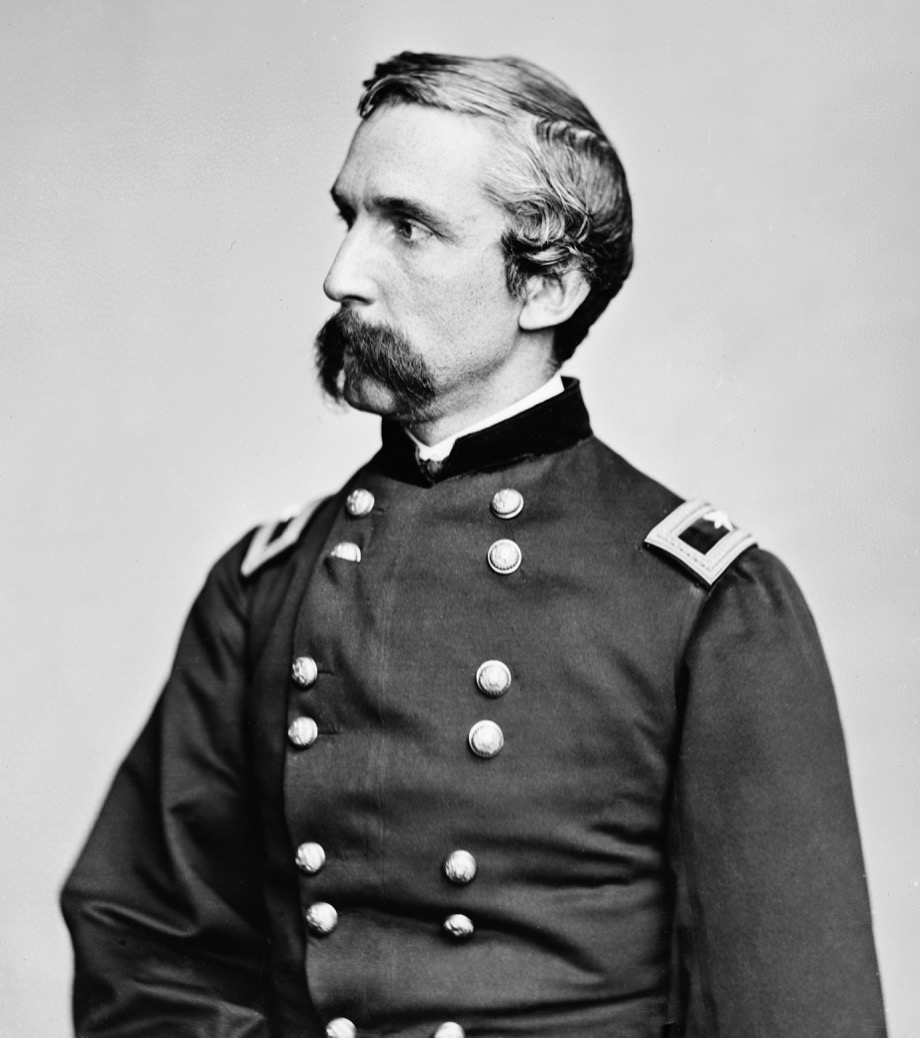
Photographic Portrait of Joshua Chamberlain
The Professor at the End of the Line
He had spent his adult life among grammars. Joshua Lawrence Chamberlain taught rhetoric and modern languages at Bowdoin College, read in nine tongues, and by every ordinary measure belonged to the quietest profession the nineteenth century offered. When he asked leave to enlist, the college was reluctant enough to lose him that his path into the army came sideways — a lieutenant colonelcy in a new Maine regiment. He had no formal military training whatsoever, and learned the trade out of borrowed manuals and the plain fact that men were about to die under his orders.
Two years later he was standing on a wooded slope in Pennsylvania holding the extreme left end of the entire Union army. Little Round Top, July 2, 1863: if the 20th Maine broke, the Confederate line would come around the flank and roll the Army of the Potomac up like a carpet. His men had repelled assault after assault; their cartridge boxes were empty. Retreat was the reasonable order. Chamberlain gave a different one — fix bayonets — and swung his line downhill like a gate on a hinge, into an enemy that did not expect exhausted men without ammunition to attack. The tactic was in no manual he had read. It was invented in the space of a breath, out of a conviction that the ground behind him could not be given up.
Twenty-one months later, at Appomattox, he was chosen to receive the formal surrender of Confederate arms — and as the beaten army marched past to stack its weapons, he ordered his own men to shoulder arms in salute. Some of his fellow officers thought it an outrage. He thought it the only gesture the moment could bear. The same faculty produced both acts.
Chamberlain is the archetypal INFJ in wartime: a dominant Ni that saw, before the evidence was in, what a moment would come to mean — and acted on that seeing while everyone else was still reading the field.
The Hinge — Ni
Introverted intuition does not deliberate its way to conclusions; it arrives at them and then hunts for the reasons. Chamberlain’s decision to leave Bowdoin was made against the advice of colleagues and the interests of his employer, on the strength of a conviction he could articulate only as a sense that the country was in the middle of something that would define everything after it. That is not a career calculation. It is a man seeing the shape of an age before the age has finished happening.
Little Round Top is Ni under maximum compression. The situation admitted of exactly two readings — a line that had run out of ammunition and must fall back, or a line whose only remaining weapon was the enemy’s own exhaustion. Chamberlain took the second, and the wheeling charge that followed was not a maneuver he had been taught but an image he acted out: the left wing swinging forward while the right held, the whole regiment closing like a door. He looked at the hill and knew what it was for, and spent much of the rest of his life explaining, carefully and somewhat unconvincingly, why it had been the sensible thing to do.
The same forward sight shows in the decades after — four terms as Governor of Maine, then the presidency of Bowdoin, and through all of it a steady output of writing circling one question: what the war had meant, and what it obliged the survivors to become.
The Salute — Fe
At Appomattox, Chamberlain had every warrant for triumph. He had been shot through the hips at Petersburg and promoted to brigadier general on the field by a commander who assumed he was dying. What he did instead, as John Gordon led the Army of Northern Virginia past to lay down its arms, was call his line to attention and order the marching salute — arms shouldered, the honor a soldier renders an equal. Gordon wheeled his horse and returned it. Union officers complained. Chamberlain never apologized, and in his account the reasoning is entirely Fe: these were men, they had been brave, and the peace would be built out of how they were treated in that hour or not built at all.
Auxiliary extraverted feeling is what turns an INFJ’s private conviction into something other people can stand inside, and it ran through his command from the start. When a group of mutinous Maine soldiers was dumped on him under guard days before Gettysburg, he heard their grievance out and promised to press their case rather than shooting them as he was technically entitled to do; those men were part of the line that held. His moral gestures were almost always aimed outward and downward — at the enlisted man, at the defeated enemy, at the ones with no standing to demand consideration.
The Autodidact’s Ledger — Ti
A professor of rhetoric who taught himself tactics from books is a tertiary Ti portrait in miniature. Chamberlain approached soldiering the way he had approached nine languages: by reducing it to a system he could hold in his head, then testing that system against use. He asked for the lieutenant colonelcy rather than the colonelcy he was offered, wanting to learn the business before he was responsible for it — an unusually cold-eyed self-assessment from a man on fire to serve.
That analytical layer is why the bayonet charge worked. The order was intuitive in origin but mechanically exact in execution: hold the right, refuse the left, swing the whole on a pivot so the regiment strikes as one body rather than dissolving into a downhill mob. Ni supplied the image; Ti made it a maneuver instead of a suicide.
In later life the same faculty turned inward. His postwar writing takes the war apart repeatedly, weighing what was gained against what it cost and refusing the easy consolations available to him. The Petersburg wound never healed properly and killed him half a century later, in 1914 — the last Civil War soldier to die of his wounds. He was still, at the end, auditing the account.
Six Wounds — Se
The inferior function is where a type goes when pushed past its ordinary range, and in Chamberlain it erupted as an almost reckless physical courage that sat oddly on a man of books. He was wounded six times; at Petersburg in June 1864 a ball passed through both hips, and he propped himself on his sword to keep his men from seeing him fall. Grant promoted him brigadier general on the spot, in the belief that he would not survive the night.
Inferior Se in an INFJ is not tactical alertness — Chamberlain was frequently oblivious to danger in the ordinary sense — but a capacity, under enough pressure, to commit the body absolutely to the vision. The charge down Little Round Top was that; so was standing up at Petersburg. What reads as fearlessness is closer to a temporary disappearance of the physical world behind the thing he could see. It exacted the usual price: he returned to the front before he was fit, more than once, on grounds that convinced no doctor. A man whose inferior function only comes online in crisis will keep finding reasons to be in one.
Why INFJ Over ISFJ
Why not ISFJ?
The reading is tempting — the dutiful volunteer, the scrupulous care for his men, the lifelong service to college and state. But ISFJ works from precedent and the present situation, and Chamberlain’s two defining acts were both departures from precedent taken on his own authority. A procedure-bound officer with empty cartridge boxes falls back; that is what the manual and the situation both said. And a present-focused traditionalist does not salute an army he has spent three years trying to destroy, in defiance of his own peers, on the strength of a judgment about what the next fifty years would require. Both decisions ran ahead of what anyone around him could yet see.
The distinction is between conserving a known good and serving an unproven vision. He improvised the hinge charge because he had already decided the hill could not be surrendered, and he saluted at Appomattox because he had already decided what kind of peace was worth having. Ni supplies the conviction; Fe decides that its object is human dignity rather than victory. That combination is why the professor from Maine, of all the men on that field, is the one whose two most famous acts were both things nobody ordered him to do.
Connected Figures
Further Reading
- The Passing of the Armies — Joshua Lawrence ChamberlainHis own account of the last campaign and the Appomattox surrender ceremony — the primary source for the salute.
- In the Hands of Providence: Joshua L. Chamberlain and the American Civil War — Alice Rains TrulockThe standard modern biography, careful about separating the documented record from the legend.
- Gettysburg — Stephen W. SearsFull-battle narrative that places Little Round Top in the context of the whole second day.
- The Killer Angels — Michael ShaaraThe 1974 novel that revived Chamberlain's fame — fiction, but the reason most readers know his name.
