 Historical Figure MBTI
#864 · 6-21-26 · The American Civil War
Winfield Scott Hancock
Union General · 'Hancock the Superb'
1824 — 1886
7 min read
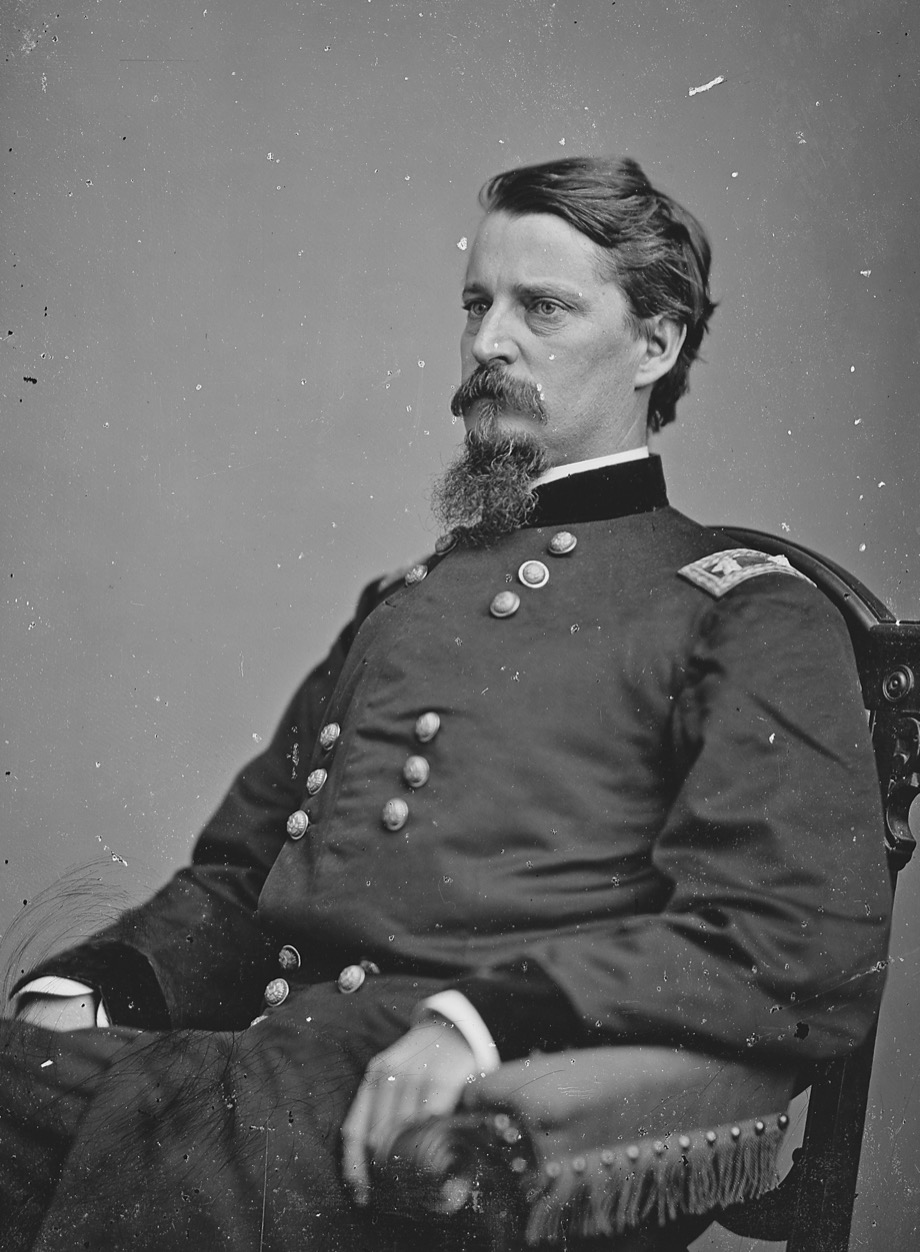
Photographic Portrait of Winfield Scott Hancock
The General Who Stood Where He Was Needed
He was named for Winfield Scott, the aging hero of another war, and by 1863 he had grown into something the old general never quite was: a soldier whose mere arrival on a field could steady an army. When George Meade sent him ahead to Gettysburg on the first day of July, with Reynolds already dead and the Union line dissolving through the streets of the town, Hancock did not improvise a rescue. He surveyed the ground, made a rapid, confident judgment about where the army could stand, and began issuing the orders that turned retreat into a defensive line on Cemetery Hill — a line the Army of the Potomac would hold for two more days. It was not inspiration. It was execution, delivered instantly, under fire, by a man whose subordinates trusted every word he said because he had never given them reason not to.
Two days later he did it again, riding the length of his line during Pickett's Charge, visible to every soldier who needed to see him, until a bullet and a fragment of his own saddle drove a bent nail into his thigh. He stayed on his horse. His type, ESTJ, describes a mind built to convert clear-eyed assessment into forceful, immediate command — and Hancock the Superb, as McClellan had already nicknamed him for exactly this quality, was that description made flesh on two of the war's worst afternoons.
Hancock did not lead by vision. He led by presence — a dominant Te that treated the battlefield as a problem to be solved decisively, in full view of the men who had to trust the solution.
Command as a Visible Act
At Gettysburg on July 1st, Hancock arrived to a scene of chaos: broken corps streaming through town, no unified command, and a Confederate army pressing its advantage. He did not call a council or wait for confirmation of rank. He rode the ground personally, identified Cemetery Hill and the ridge running south of it as the position the army had to hold, and began placing units there himself, overriding officers senior to him on Meade's authority. Within an hour the retreat had a shape. That is dominant Te at full strength — not analysis for its own sake, but analysis instantly converted into orders, delivered with enough certainty that men who had never served under him fell into line.
The same quality carried him through the Overland Campaign under Grant in 1864, where his Second Corps was thrown at fortified Confederate lines again and again at the Wilderness, Spotsylvania, and Cold Harbor. Hancock never softened an order to spare feelings or wait for a better mood on the field; he assessed what the situation required, said so plainly, and expected it done. Subordinates who served under lazier commanders elsewhere spoke of Hancock's staff meetings as blessedly free of ambiguity — you left knowing exactly what your regiment was to do and why.
It showed off the battlefield too. As a Reconstruction-era administrator in Louisiana and Texas, he issued General Orders No. 40, promising civil authority over military rule wherever possible — a decisive, top-down policy statement, characteristically Te, that happened to run against the political current of Radical Reconstruction and cost him standing with his own party. He was not built to trim a position to fit the room; he stated it and let the consequences follow.
Drill, Bearing, and the Fundamentals Held to the Letter
Hancock's brilliance was rarely tactical novelty; it was a near-total command of established military fundamentals, applied without deviation until they worked. Officers who watched him form a line under fire described a man executing textbook procedure with such crisp confidence that it looked like genius — parade-ground precision transplanted directly onto a killing field. His famous immaculate turnout, even mid-battle, was not vanity so much as auxiliary Si made visible: the uniform, the posture, the bearing all signaled that the standard held regardless of circumstance, and his men read that signal correctly.
It showed in how he built his corps. Hancock drilled the Second Corps relentlessly, insisted on established procedure in camp and on the march, and drew on remembered precedent — what had worked at Williamsburg, what had worked at Antietam — rather than reinventing his approach each time. That fidelity to proven method, paired with the Te drive to act on it instantly, is what let him convert a chaotic retreat into an orderly defensive position in under an hour: he was not improvising a plan so much as recognizing, from experience, exactly which known solution the ground called for.
The Wound He Refused to Acknowledge
Inferior Fi in an ESTJ tends to surface not as ordinary sentiment but as sudden, stubborn personal conviction — a line the person will not cross or abandon, defended with more feeling than the rest of their outward manner would suggest. Hancock's came into view the moment he was shot on the third day at Gettysburg. Bleeding badly, with a bent nail from his own saddle lodged in his thigh, he refused to be carried off the field until Pickett's Charge had been fully repulsed, insisting — against the urging of his own staff — that his visible presence still mattered more than his safety. It was not calculation. It was a personal, almost private stand on what he owed the men watching him.
The same undercurrent surfaced, more controversially, during Reconstruction. Hancock's comparatively conciliatory stance toward former Confederates in Louisiana and Texas cost him politically and drew fierce criticism from Radical Republicans in his own party. He held the position anyway, on what read as a private conviction about magnanimity and the restoration of civil order rather than a popular or strategic calculation — inferior Fi asserting itself, briefly but immovably, against the pragmatic Te that governed the rest of his career.
Why ESTJ Over ISTJ
Why not ISTJ?
An ISTJ would carry the same procedural fidelity and quiet competence, but would not need to be seen doing it. Hancock's reputation rested specifically on his conspicuous, dramatized presence at the front — riding the length of his line under fire so his men could see him stand there, choosing visibility as the mechanism of command rather than a byproduct of it. That is Te expressed outward, not the reserved, behind-the-scenes reliability an ISTJ typically shows. Hancock commanded by being watched; an ISTJ commands by being depended on unseen.
The distinction matters because it explains why contemporaries reached for a nickname like "Superb" rather than "reliable" or "steady." Hancock's genius was theatrical in the best military sense — decisive judgment paired with the instinct to perform that judgment visibly, at exactly the moment his men needed proof that someone still had the field in hand. That combination of blunt, outward-facing Te and disciplined Si fundamentals is ESTJ, not its introverted cousin.
Connected Figures
Further Reading
- Winfield Scott Hancock: A Soldier's Life — David M. JordanThe standard full-length biography, covering his military and political careers alike.
- Gettysburg — Stephen W. SearsDetailed narrative history situating Hancock's first- and third-day roles within the full battle.
- Hancock the Superb — Glenn TuckerA focused study of Hancock's Gettysburg command and the nickname that followed him.
- Grant Takes Command — Bruce CattonCovers Hancock's Second Corps service during the grinding 1864 Overland Campaign.
