 Historical Figure MBTI
#866 · 6-21-26 · The American Civil War
George Pickett
Confederate General · Pickett's Charge
1825 — 1875
6 min read
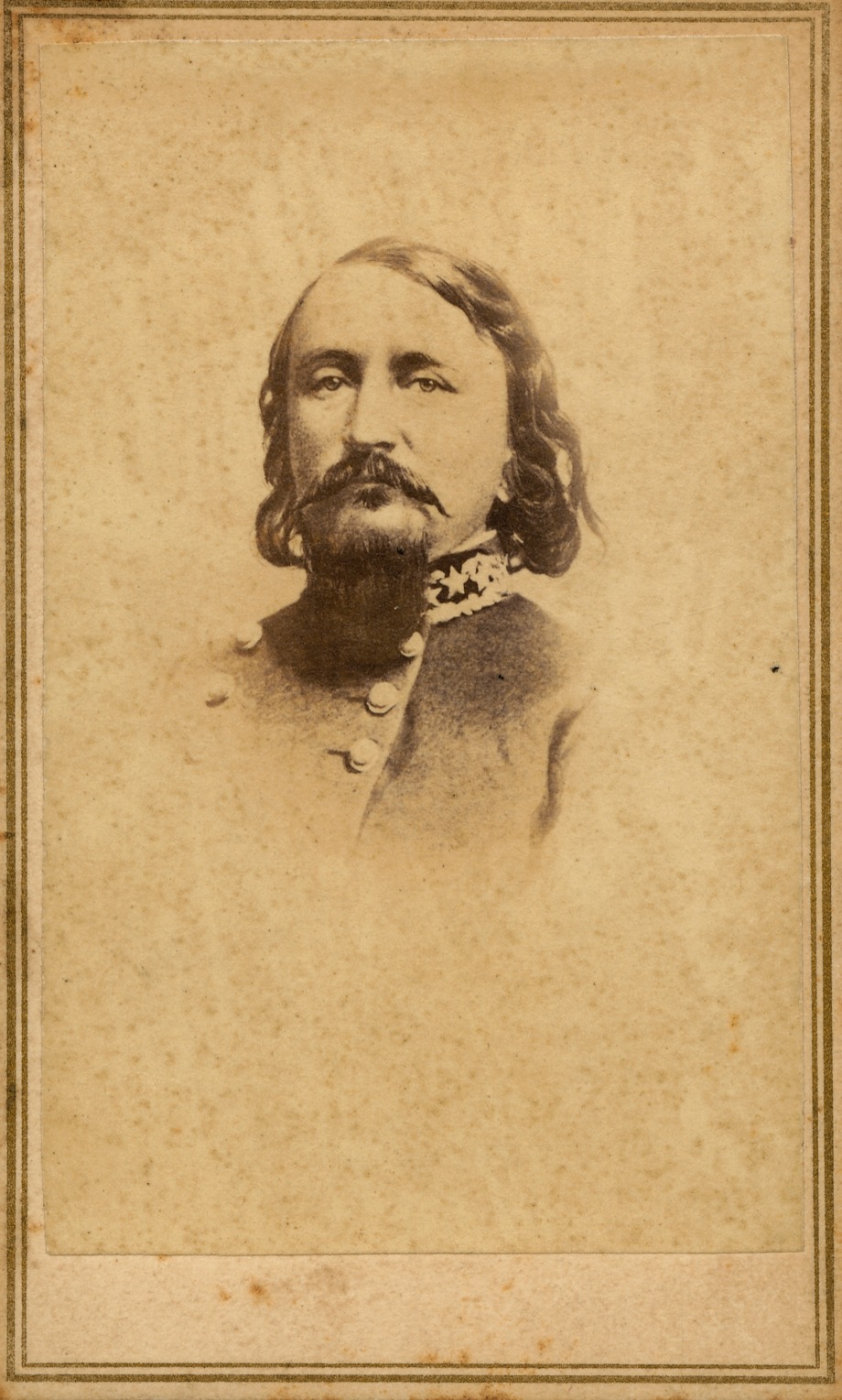
Photographic Portrait of George Pickett
Ringlets, Ribbon, and an Hour on Open Ground
George Pickett arrived at Gettysburg already a figure of some theater — long perfumed curls worn well past regulation, a courtly, romantic manner that made him look more like a cavalier out of Walter Scott than a career soldier who had graduated last in his class at West Point. On the afternoon of July 3, 1863, that theater became history. Ordered by Robert E. Lee to send roughly 12,500 men across nearly a mile of open field into the fortified center of the Union line, Pickett led his division forward with visible, personal courage, and for a few minutes his men actually broke through at a stone wall near a small copse of trees — the "high water mark of the Confederacy." Then the line came apart. Within an hour, more than half his division was dead, wounded, or captured.
What makes Pickett a study in ESFP is not the charge itself so much as what came after it. He did not retreat into strategy or self-examination. He retreated into grievance — sharp, personal, and permanent. When Lee asked him to rally his division for a possible counterattack, Pickett's reply became one of the war's bitterest lines: he had no division left to rally. He never forgave Lee, and reportedly received him coldly years later when Lee came to visit. It is the reaction of a man who felt something done to him, not a general auditing a failed plan.
Pickett led the charge with his whole visible self — and when it broke, so did he, personally and permanently, rather than tactically.
A Mile of Open Field, Led From the Front
Dominant extraverted sensing lives entirely in the immediate, physical moment — in motion, in visible action, in the body committed to the field rather than held back to watch it. Pickett's entire public persona was built from this. The ringlets, the perfume, the courtly flourish of manner were not incidental eccentricities; they were a man who understood himself through how he appeared and moved in the world, performed in real time for an audience that included his own troops. It is no accident that "Pickett's Charge" is remembered as much for its terrible visual grandeur — a mile-wide wall of men advancing in open ground under fire — as for its tactics.
When the order came on July 3, Pickett did not direct the assault from a hilltop with a spyglass. He rode with it, in front of his men, exposed the same way they were exposed, briefly reaching the stone wall where the fighting became hand to hand. That is Se under maximum pressure: total physical presence, total commitment to the concrete moment, no retreat into abstraction or hesitation. It made him beloved by his division and it is precisely why the disaster landed on him so completely — he had put his whole visible self into it.
"General Lee, I Have No Division"
Auxiliary introverted feeling processes experience privately and personally, judging events not by whether the plan was sound but by whether he, specifically, was wronged. Pickett's response to Lee in the aftermath of the charge is the clearest evidence of this in the entire archive. He did not offer an assessment of what had gone wrong tactically — the artillery preparation that failed to silence the Union guns, the exposed flank, the sheer distance of open ground. He offered a wound: he had no division left, and the way he said it made clear who he blamed.
That grievance never cooled into analysis. It calcified into a permanent, personal resentment toward the man who gave the order, one Pickett reportedly carried to his own postwar meetings with Lee, receiving him coolly when a warmer man might have made peace with an old commander. This is Fi's signature failure mode as much as its strength — an unwavering personal compass that, once it decides it has been betrayed, does not easily forgive, because the injury was never processed as strategy. It was processed as character.
One Afternoon, Fixed Forever
Inferior introverted intuition rarely shows up as patient foresight in a type like this; it shows up in flashes of dread, or in a single fixed meaning imposed retroactively on an event that could have had many. For Pickett, that fixed meaning was total: the charge became not one action in a long war but the entire shape of his identity, the lens through which everything before and after it was read, by history and by himself.
He served competently for the rest of the war and lived another twelve years afterward, fleeing briefly to Canada over fears of prosecution for the execution of deserters under his command, then returning to a quiet life in Virginia. None of it mattered to the verdict Ni-under-stress had already handed down. Pickett spent his remaining years as a man permanently defined by a single collapsed vision of himself — not the officer who did many things, but the one who led the doomed charge, forever.
Why ESFP Over ISFP
Why not ISFP?
An ISFP would live the same values-driven inner life but express almost none of it outward. Pickett did the opposite at every turn: the ringlets and perfume and courtly manner were performed for an audience, not private eccentricities, and leading the charge was as much visible spectacle as maneuver — a display, not a retreat into quiet self-containment. His bitterness toward Lee, too, was voiced, remembered, and enacted in cold receptions rather than nursed silently. That is an extraverted sensing lead, not an introverted one.
Strip away the surface theater and Pickett resolves cleanly into ESFP: a man who lived and led through vivid, visible, present-tense action, whose deepest reactions were intensely personal rather than tactical, and whose entire postwar identity calcified around one afternoon he could never stop performing, even in memory.
Connected Figures
Further Reading
- Gettysburg — Stephen W. SearsThe standard single-volume narrative of the battle and Pickett's role in it.
- Pickett's Charge: The Last Attack at Gettysburg — Earl J. HessThe definitive tactical study of the assault itself, minute by minute.
- General George E. Pickett in Life and Legend — Lesley J. GordonA biography examining how Pickett's postwar reputation was shaped and mythologized.
