 Historical Figure MBTI
#861 · 6-21-26 · The American Civil War
George Meade
Union General · Victor of Gettysburg
1815 — 1872
7 min read
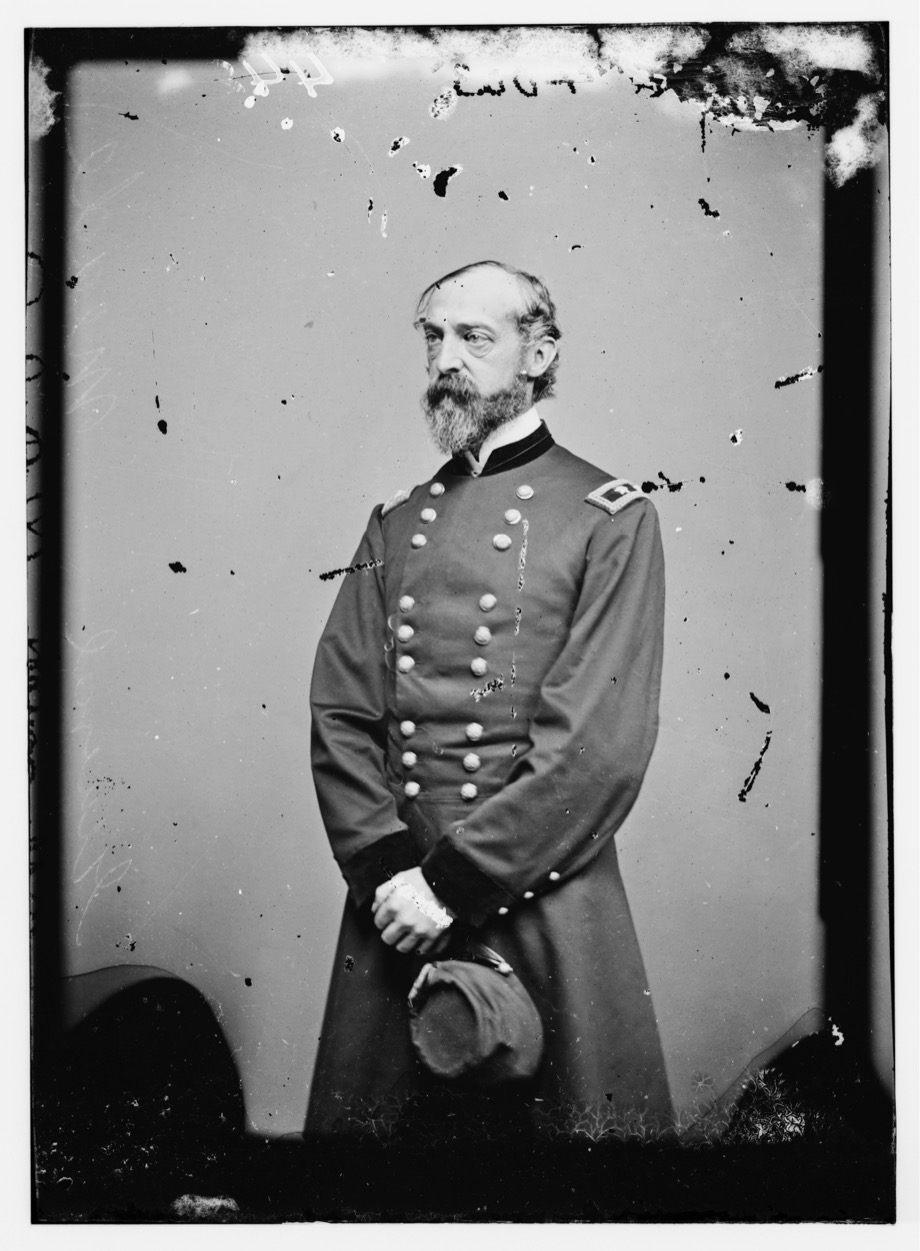
Portrait of George Meade
Three Days' Notice
On the night of June 27, 1863, a staff officer from Washington woke George Gordon Meade in his tent and handed him an order placing him in command of the Army of the Potomac. His first reaction was to assume he was under arrest; his second, to protest that other men had a better claim; his third — the one that mattered — to read the returns, find out where his seven corps actually were, and start issuing marching orders. In seventy-two hours the two armies would collide at a crossroads town neither commander had chosen.
He was not a glamorous soldier and never pretended to be. Thin, bespectacled, with a temper that detonated on contact, he was known through his own headquarters as the "Old Snapping Turtle." What he had instead of charm was an engineer's memory for ground and an absolute unwillingness to be hurried into anything he had not first verified. Those qualities won the largest battle ever fought in the Western Hemisphere — and kept him, ten days later, on the north bank of a flooded Potomac while the beaten Army of Northern Virginia slipped across it.
Meade is the archive's cleanest portrait of the ISTJ commander: a dominant Introverted Sensing that stored terrain, precedent, and doctrine with total fidelity — and that could execute a known problem flawlessly while flinching from an unknown one.
The Man Who Read the Ground
Meade was a topographical engineer before he was a general — lighthouses on the Florida reefs, survey work on the Great Lakes, a corps whose whole business was measuring the world precisely and writing it down. Introverted Sensing is not merely a good memory; it insists that the situation in front of you be established in detail before anyone acts on it. Meade's first act on taking command was not a speech but an inventory.
Gettysburg is the proof. He did not intend to fight there — his own preference was a prepared line along Pipe Creek — and when the battle opened without him on July 1 he sent Hancock forward to judge the position. Told the high ground south of town was strong, he committed on the evidence, then rode the line himself in the dark: Culp's Hill at the barb of the fishhook, Cemetery Hill at the bend, the ridge running south to the Round Tops. Interior lines meant he could shift a division end to end in an hour while Lee's messengers went the long way around.
That is what carried July 2. Sickles blew a hole in the line by pushing his corps into the Peach Orchard without orders, and Meade spent the afternoon plugging it with brigades pulled from quiet sectors — repairs possible only because he knew exactly what he had and where it stood.
Orders, Councils, and the Machinery of Command
Extraverted Thinking turns a stored picture into a working system, and Meade's Gettysburg was above all an administrative achievement. He steadied a whipsawed army in three days by doing what almost no Civil War commander did well: telling everyone precisely what was expected of them, then checking that it happened.
On the night of July 2 he convened the council of war at the Leister house and put three questions to a vote: stay or withdraw, attack or receive, and if we wait, how long. He had already decided to stay — the council was Te converting a private judgment into a shared, recorded decision every subordinate had signed his name to. He also told John Gibbon, whose division held the centre, that Lee would strike there in the morning, having run the arithmetic: Lee had tried both flanks and had one thing left.
The same competence shows after. When Grant became general-in-chief in 1864 and chose to travel with the Army of the Potomac, Meade was left commander in name while the strategy came from the next tent. It was a humiliating arrangement, and he made it work from the Wilderness to Petersburg — because Te obeys a functioning chain of command whatever it costs the ego inside it.
The Snapping Turtle's Private Ledger
The temper was real and is the most legible thing about him. Meade exploded at staff officers, at correspondents, at subordinates who improvised without leave. Tertiary Introverted Feeling is a narrow, fiercely held private code, poorly expressed and easily wounded; Meade's code was duty done properly, and violations produced not a reprimand but an eruption.
What the code did not include was self-promotion. He never courted the newspapers or cultivated the Washington constituency that protected lesser generals from consequence. When the Joint Committee on the Conduct of the War let Daniel Sickles testify in 1864 that Meade had meant to retreat from Gettysburg, Meade's defence was documentary and dull, and he lost to a better storyteller. Fi in the third slot does not bargain and does not perform: it keeps score in private, and the ledger is never shown to anyone who might have settled it.
The Flooded Potomac
Pickett's Charge broke on July 3, and for a few days the war was open in a way it had not been before: Lee mauled, low on ammunition, pinned against a Potomac swollen past fording with his pontoon bridge destroyed. Lincoln believed the rebellion could be ended at Williamsport. Meade followed cautiously, reconnoitered, called another council — which advised against attacking — and spent July 13 preparing a probe. That night the river fell and Lee crossed.
Inferior Extraverted Intuition is the reason. Ne sees the unrealized branch — the thing that could be true if you moved before you were certain — and in the ISTJ it sits last, engaged under pressure and then as anxiety rather than vision. Meade could see the entrenchments at Williamsport; what he could not credit was that behind them stood an army too broken to hold them. He had lost twenty-three thousand men in three days, and the certain thing was that frontal assaults on fortified infantry killed the attacker — Fredericksburg had proved it, and Si had filed the proof.
Lincoln's unsent letter said it plainly: Lee was within your easy grasp, and you did not close upon him. He complained elsewhere that the Army of the Potomac behaved like an old maid who could not be brought to marry an eligible suitor. Meade's greatness and his ceiling were one function running in two directions — the man who would not move without verification won the defensive battle of the war and could not convert it, because conversion required a hunch.
Why ISTJ Over ISTP
Why not ISTP?
The reserve, the technical competence, and the flat unsentimental manner all point at ISTP, and the archive types his own cavalry commander John Buford exactly that way. But ISTP is a present-tense type: it improvises against the situation as it stands and is most itself when the rulebook has run out. Meade is the opposite case — his Gettysburg was won by disciplined adherence to established defensive fundamentals, by staff machinery and formal councils of war, and by refusing to leave a framework he had verified. Williamsport, where an ISTP would have gone forward on feel, is where the difference becomes unmistakable.
The distinction separates two soldiers who look alike from a distance. Buford, with no authority to start a general engagement, made a snap read of ground and committed the army to a battle nobody had planned; Meade, given the same ground twelve hours later, made it into a system. Neither man could have made the other's decision. Meade was a professional in the fullest and most limiting sense — his gift was doing the known thing perfectly, at scale, and his flaw was that the unknown thing never became available to him.
Connected Figures
Further Reading
- Gettysburg — Stephen W. SearsThe standard modern narrative of the battle, unusually fair to Meade's three days of command.
- Meade: Victor of Gettysburg — Richard A. SauersA compact military biography focused on the campaign and the controversies that followed it.
- Searching for George Gordon Meade: The Forgotten Victor of Gettysburg — Tom HuntingtonPart biography, part travelogue, on why the man who won the battle vanished from its memory.
- Battle Cry of Freedom: The Civil War Era — James M. McPhersonThe one-volume history that places Gettysburg and the Williamsport pursuit in the war's wider strategic arc.
