 Historical Figure MBTI
#860 · 6-20-26 · The American Civil War
William H. Carney
First Black Medal of Honor Recipient
1840 — 1908
6 min read
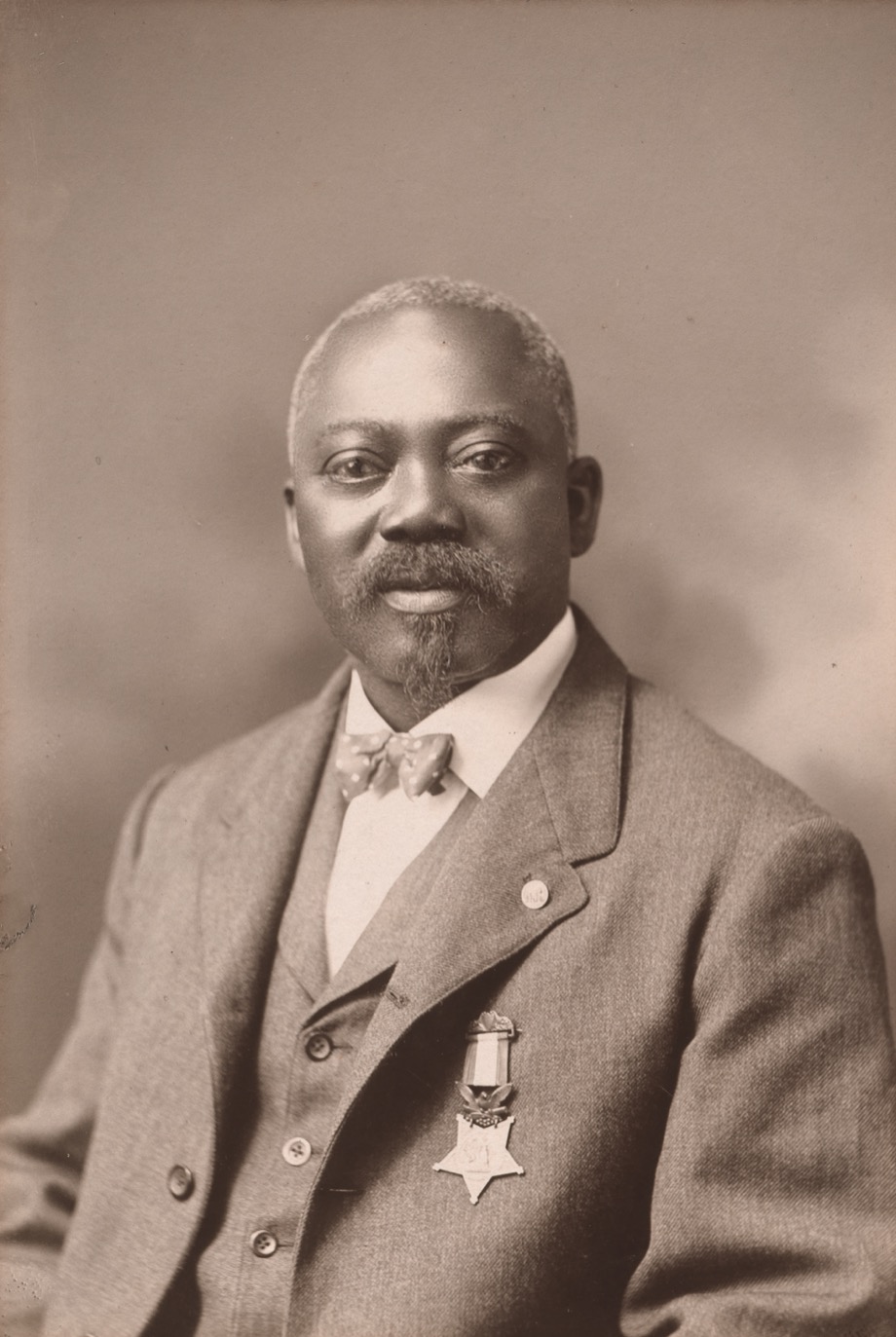
Photographic Portrait of William H. Carney
The Flag Never Touched the Ground
William H. Carney was born enslaved in Norfolk, Virginia, and freed as a boy when his family made its way north to Massachusetts. He had once weighed the ministry as a calling — a life of quiet, disciplined service to others — before deciding, in his own account, that he could serve God and his people more directly by taking up arms. When the Union began recruiting Black soldiers, he enlisted at once in the newly formed 54th Massachusetts Infantry under Colonel Robert Gould Shaw, one of the first men in the country to answer that call.
On the night of July 18, 1863, the 54th led the doomed assault on Fort Wagner, a Confederate earthwork guarding Charleston harbor. Grapeshot and rifle fire tore the regiment apart in the dark, and Shaw fell near the parapet. When the color-bearer carrying the national flag went down mortally wounded, Carney — already hit himself — did not think to retreat. He caught the flag before it touched the sand, carried it forward through the collapse of the charge, and then carried it back across a quarter mile of open, fire-swept ground as the assault broke around him, taking further wounds to his leg, chest, and arm along the way. He would not relinquish it until he reached his own lines.
It took the government until 1900 to award him the Medal of Honor for that night — decades of bureaucratic neglect common to Black soldiers of the era — but by the date of the act itself, Carney was the first African American ever to earn it. He spent his life afterward almost exactly as he had spent the moments at Wagner: steadily, dutifully, without asking for notice. Decades at the postal service, faithful attendance at veterans' reunions, and one sentence, offered without embellishment, that says more about his mind than any citation could: "Boys, I only did my duty; the old flag never touched the ground."
Carney is an ISFJ — dominant Si so thoroughly internalized as duty that catastrophic wounds could not loosen its grip on the flag.
Duty as Reflex
Carney's dominant introverted sensing shows up less in what he did at Fort Wagner than in how automatically he did it. There was no deliberation in the moment the color-bearer fell — no weighing of odds, no calculation of what carrying an exposed flag through grapeshot would cost him. The obligation was already internalized, a standard so deeply grooved into him that catching the colors was simply what happened next, the way a hand catches a falling object before the mind has finished registering the fall.
That same Si shows in the shape of his whole life before and after Wagner. He had considered the ministry — another vocation built entirely on steady, internalized obligation to others — and when he chose the army instead, he treated soldiering the same way: as a discipline to be honored precisely, not an adventure to be embraced. After the war he spent roughly three decades at a single, unglamorous post — the postal service — the kind of long, faithful, repetitive service an Si type finds not tedious but affirming, proof that a commitment once made stays made.
Even his own account of Wagner is built from concrete, remembered particulars rather than grand abstraction: the flag, the ground, the fact that it never touched it. He measured the entire battle by one tangible standard he had set for himself beforehand and never let go of, wounds notwithstanding.
What the Flag Meant to Everyone Else
What separates Carney's act from mere stubbornness is auxiliary extraverted feeling — an acute sense of what the flag meant to the men around him and to the cause the regiment carried on its back. The 54th Massachusetts was not fighting only for the Union; every Black soldier in its ranks understood that its performance under fire would be read as an argument about the fitness of an entire people for freedom and citizenship. Carney felt the weight of that shared symbol as keenly as he felt his own wounds, which is why letting it fall was never a live option in his mind.
His postwar life bears the same signature. Rather than trade on his heroism, he spent decades in quiet civic and veteran fellowship, showing up for reunions and commemorations that mattered to his fellow soldiers more than they advanced his own name. The famous line — "I only did my duty" — is Fe speaking as much as Si: it reframes an extraordinary act back into a shared, communal register, refusing to let his individual glory eclipse the collective sacrifice of the regiment.
Why ISFJ Over ISTJ
Why not ISTJ?
An ISTJ reading of Carney would frame Fort Wagner mainly in terms of correct military conduct — a soldier fulfilling procedure under fire. But Carney's own words and his whole postwar life point somewhere warmer: he speaks of duty to the flag and to his fellow soldiers, not to a code of regulations, and his decades of quiet fellowship with veterans show a man oriented toward the people around him rather than toward abstract internal rules. That relational, Fe-inflected sense of obligation, layered over an Si-steady bedrock, fits ISFJ far better than ISTJ's more procedural Te.
The distinction matters because it changes what the flag was actually standing for in Carney's mind. An ISTJ carries the colors because doing so is correct. Carney carried them because letting them fall would have betrayed the men who had already died beside him and the larger cause their deaths were meant to serve — a difference of warmth, not of resolve.
Connected Figures
Further Reading
- Thunder at the Gates: The Black Civil War Regiments That Redeemed America — Douglas R. EgertonThe fullest modern account of the 54th and 55th Massachusetts, including Carney's role at Fort Wagner.
- One Gallant Rush: Robert Gould Shaw and His Brave Black Regiment — Peter BurchardA close narrative of Shaw's command and the Wagner assault, with Carney's flag-bearing prominent in the climax.
- A Grand Army of Black Men: Letters from African-American Soldiers in the Union Army — Edwin S. Redkey (ed.)Primary-source letters that place Carney's act in the context of how Black soldiers understood their own service.
