 Historical Figure MBTI
#867 · 6-22-26 · The American Civil War
William Tecumseh Sherman
General · Total War Strategist · March to the Sea
1820 — 1891
9 min read
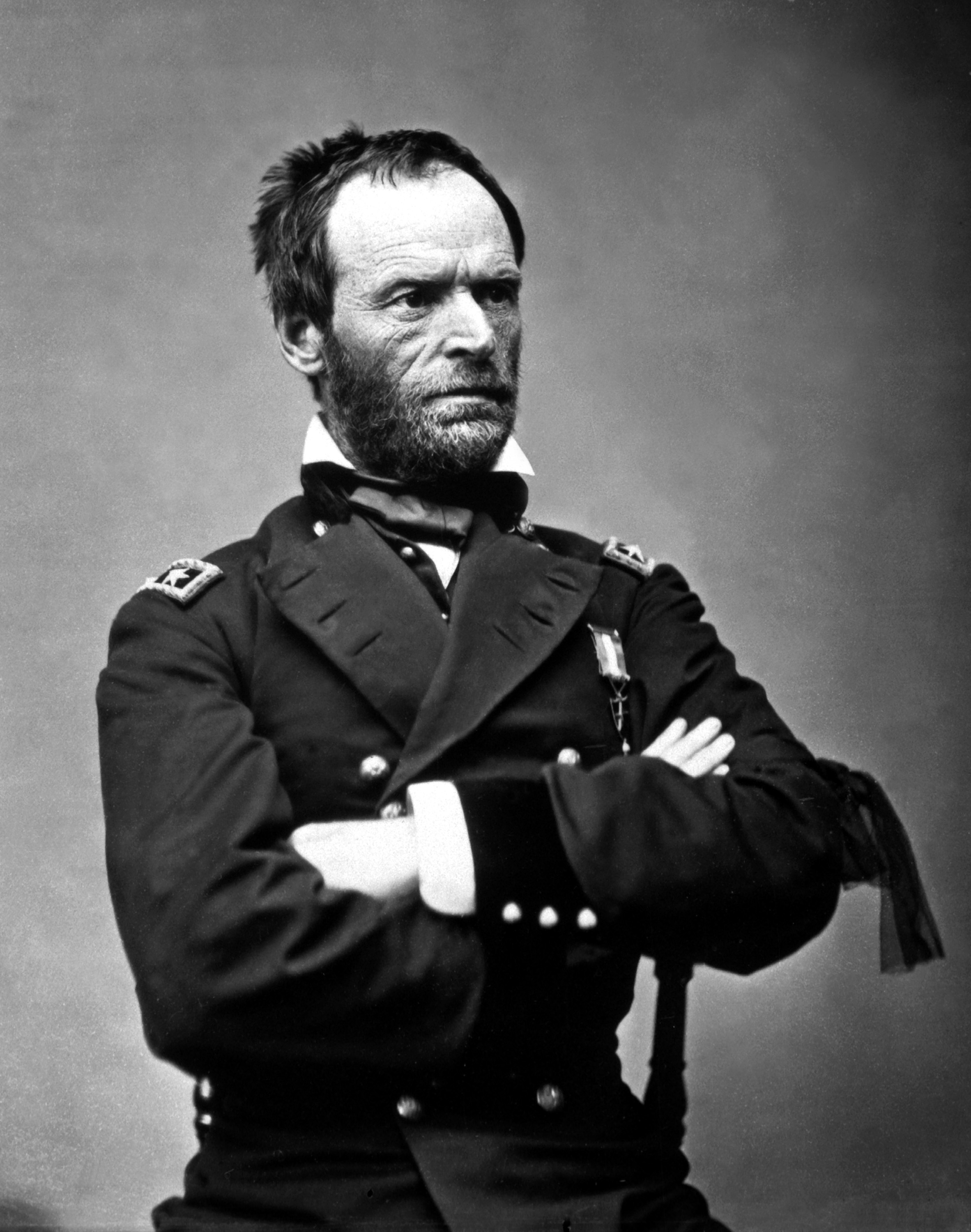
Portrait of William Tecumseh Sherman
The mind that thought by marching
William Tecumseh Sherman broke down before he broke the Confederacy. In the fall of 1861, given command in Kentucky, he wired Washington for two hundred thousand men to hold a theater everyone else thought needed a fraction of that, grew convinced the whole war was slipping past saving, and was relieved of duty amid newspaper whispers that he had gone insane. It is one of the strangest opening acts in American military history, and it is also the key to him: Sherman's mind did not calm down by thinking harder in private. It calmed down by moving, by commanding, by doing something with its hands. Grant took him back to Shiloh, put an army under him, and the man who could not sit still with an abstraction reorganized himself entirely around motion.
What follows — Vicksburg, Atlanta, the March to the Sea, the wheel north through the Carolinas — is not the record of a strategist who solved the war on paper and then executed the solution. It is the record of a man who thought out loud, in telegrams, in arguments, in orders revised on the march, and who discovered that the intellectual act and the physical campaign were the same act. He burned depots and tore up railroads not as an afterthought to strategy but as the strategy itself, delivered in real time to an enemy population whose will to fight he meant to break along with its supply lines. "War is cruelty, you cannot refine it," he told the mayor of Atlanta, refusing to soften an order to evacuate the city — a sentence that could stand as his whole method: judgment, spoken bluntly, acted on immediately, argued for afterward rather than justified in advance.
Sherman was ENTJ, and his dominant function, Extraverted Thinking, did not draft the total-war campaign in his head and then unveil it — it built the campaign by executing it, correcting course with every mile of track torn up and every barn burned behind him.
Logistics as argument
Sherman's signature decision of the war — cutting loose from his supply lines outside Atlanta and marching an army of sixty thousand men through hostile territory without a line of communication — is Extraverted Thinking in its purest form: an external, operational system, rebuilt on the fly, judged entirely by whether it worked. He did not theorize a new doctrine of war and then apply it. He looked at the map of Georgia, decided the army could feed itself off a countryside rich enough to support it, and simply did it, informing Grant of the plan more than asking permission for it. When Grant hesitated, Sherman argued the case in blunt, practical terms — supply, terrain, the psychological effect on a Southern public watching an army move unopposed through the heart of the Confederacy — until the case carried itself.
The same voice runs through his correspondence with civil authorities. Ordering Atlanta evacuated before he burned its military value to the ground, he did not hide behind orders from above or soften the reasoning for the mayor and council who begged him to reconsider. He answered them point by point, in writing, arguing that removing civilians was itself the more merciful course given what the city was about to become — a debate conducted in real time, in public, with the outcome already decided and the persuasion happening alongside the execution rather than before it. That is the Te pattern: judgment rendered fast, spoken aloud, defended by results.
It shows again in how he ran a headquarters. Sherman kept almost no secrets from his corps commanders about his reasoning, dictated orders in torrents, revised them as reports came in, and treated the whole apparatus of an army — rail lines, foraging parties, pontoon trains, the telegraph — as a single instrument to be tuned continuously rather than designed once. Where a purely internal strategist polishes a plan until it is ready to reveal, Sherman thought by issuing orders and watching what happened next.
The shape of the whole war
Beneath the improvisation sat a strategic vision Sherman held years before he had the army to act on it. As early as 1864 he was writing to Grant that the Union did not need to defeat every Confederate army in the field — it needed to destroy the South's capacity and will to sustain the war, to make its civilian population feel the conflict directly enough that continued resistance became unbearable rather than merely unwinnable. That is a long-range, symbolic read of the entire war's structure — Introverted Intuition working beneath the tactical noise, seeing the conflict as a single object with a single vulnerable point.
It is why Atlanta mattered to him not primarily as a rail junction to be seized but as a psychological weight to be dropped on both sides at once — its fall in September 1864 helped secure Lincoln's reelection and told the North the war could still be won, while its burning told the South that no interior city was safe. It is why the March to the Sea targeted railroads, warehouses, and cotton gins rather than Confederate armies at all; Sherman had concluded, correctly, that Joseph Johnston's and Hood's forces mattered less than the infrastructure and morale sustaining them. The Ni is visible in how early and how completely he saw that shape, well before the campaign that proved it.
Comfortable inside the wreck
The 1861 breakdown is instructive precisely because of how Sherman recovered from it: not by retreating into quiet reflection but by throwing himself back into the physical chaos of command. At Shiloh, restored to a field role under Grant, he was in the thick of the fighting on both days, had three horses shot from under him, and by most accounts steadied the army's center through sheer presence rather than any elegant plan. He needed to be in the noise, not above it.
That same appetite for disorder — rather than tolerance of it — carried through the March to the Sea, where an army without a supply line, moving through enemy country on foraged rations, was for Sherman not a crisis to be managed from a safe distance but the natural element he worked best in. Soldiers on the march remembered him riding constantly up and down the column, inspecting foraging parties, adjusting the day's route on immediate reports rather than a fixed timetable. He trusted his senses and his nerve under pressure more than he trusted a plan drawn in advance, which is exactly why the campaign could survive contact with a hostile, unmapped countryside and still arrive at Savannah on schedule.
The loyalty under the bark
Sherman's public voice was sardonic and often cruel, but it sat above a private loyalty fierce enough to shape his whole career. His devotion to Grant was total and specific: when rumors circulated in 1862 that Grant would be relieved after Shiloh, Sherman went to talk him out of resigning, and Grant later credited that conversation with keeping him in the army. Sherman returned the debt without hesitation two years later, backing Grant's Overland Campaign publicly when Northern newspapers called it a bloody failure, and the two men's correspondence — blunt, affectionate, unguarded — reads like nothing else in the Union high command.
The same current runs, more painfully, through his family life. He married Ellen Ewing, his foster sister, and the marriage was loving but strained for decades by his long absences, his religious disagreements with her devout Catholicism, and the deaths of two of their children, including nine-year-old Willy in 1863 — a loss that visibly shook a man who rarely let anything else show on the surface. Fi is not what Sherman led with; it is what occasionally broke through the Te and the sarcasm, in a handful of letters, and in a bond with Grant that never once wavered under public pressure.
Why ENTJ Over INTJ
Why not INTJ?
An INTJ commander would have refined the total-war concept privately, tested it against every objection in his own head, and presented Grant and Lincoln with a finished plan. Sherman did the opposite: he proposed the march to Grant while still working out its logistics, argued its merits back and forth by telegram as it was already underway, and adjusted the route and method daily based on what foraging parties and cavalry patrols reported. His reasoning lived in conversation and correspondence, not in a private theory he unveiled complete — that is Extraverted, not Introverted, Thinking, and it is the difference between an INTJ's architecture and Sherman's construction site.
The mistake is easy to make because Sherman had real Ni — the long-range read of the war as a single object with a single breaking point. But vision is not where his type lived; execution was. He is ENTJ because the decisive, world-shaping act of his career was not a plan he perfected and then handed down, but a campaign he built, argued for, and corrected in real time, four hundred miles of it, with the enemy's countryside as his workshop.
Connected Figures
Further Reading
- Memoirs of General W. T. Sherman — William T. ShermanHis own account, written 1875 — blunt, self-justifying, and indispensable for his voice.
- Sherman: A Soldier's Passion for Order — John F. MarszalekThe standard modern biography, strong on the 1861 breakdown and recovery.
- Citizen Sherman — Michael FellmanA psychologically probing biography focused on Sherman's contradictions.
- Battle Cry of Freedom — James M. McPhersonThe essential one-volume Civil War history, for the campaign's wider context.
