 Historical Figure MBTI
#522 · 4-21-26 · The Wars of the Roses
The Princes in the Tower
Edward V & Richard of Shrewsbury · The Boys Who Vanished
1470/1473 — 1483?
4 min read
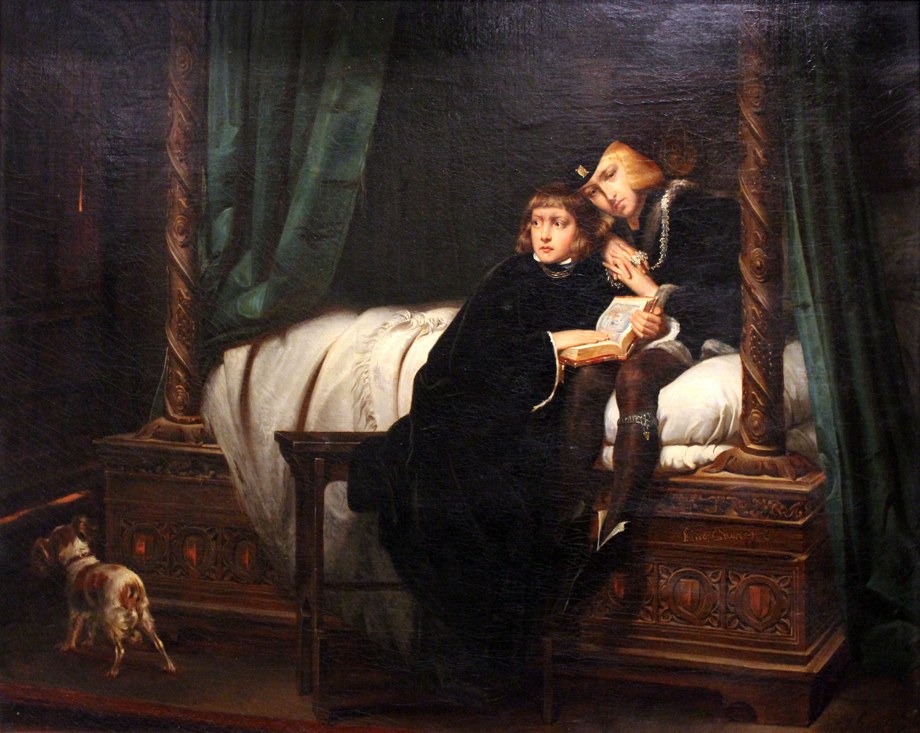
AI-assisted Portrait of The Princes in the Tower
The Silence at the Heart of the Wars
Two boys, remembered forever for an absence. Edward, born in 1470, and his younger brother Richard of Shrewsbury, Duke of York, born in 1473, were the sons of Edward IV and Elizabeth Woodville. History does not know them as children, as personalities, or as the men they might have become. It knows them only as the Princes in the Tower — the most famous victims of the Wars of the Roses, and the subjects of England's most enduring unsolved crime.
When Edward IV died suddenly in April 1483, his twelve-year-old heir became king as Edward V. He would never be crowned.
They are remembered not for who they were but for what was done to them — a vanishing so complete that even their bones are a matter of dispute.
The Usurpation
The boys' uncle, Richard, Duke of Gloucester, moved with speed. Named protector of the realm, he intercepted the young king's party on the road to London and arrested the boys' maternal uncle and guardian, Anthony Woodville, who was soon executed without trial. Edward V was escorted to the royal apartments of the Tower of London — then a working palace as much as a prison — ostensibly to await his coronation.
His mother fled into sanctuary at Westminster with her younger son. Under pressure, she surrendered him too, and Richard of Shrewsbury joined his brother in the Tower. Within weeks Gloucester produced his justification: a claimed “precontract” of marriage by Edward IV that, if true, rendered his union with Elizabeth Woodville invalid and their children illegitimate. Parliament obliged, the boys were barred from the succession, and Gloucester took the crown himself as Richard III.
Through the summer of 1483, the two princes were seen at play in the Tower grounds — and then seen less, and then never again. They simply ceased to appear. No deaths were announced, no bodies displayed, no funerals held. The silence was the event.
The Unsolved Crime
That the boys were murdered is the near-universal verdict; by whom remains the question that has never closed. Richard III, who had the most to gain and the most direct custody, is the prime suspect, and the case against him hardened into national memory through the unsparing account of Sir Thomas More, written a generation later under the Tudors. Yet More wrote as a partisan of the regime that supplanted Richard, and his hostility has always shadowed his authority.
Other names have been offered across the centuries. The Duke of Buckingham, briefly Richard's closest ally before his own revolt, had access and motive of his own. Some have even pointed forward to the Tudors, who profited as much as anyone from a Yorkist line that no longer existed. The princes' fate became a weapon in every succeeding propaganda war, which is precisely why the truth is so hard to recover.
In 1674, workmen demolishing a staircase within the Tower uncovered a wooden box containing the bones of two children. Assumed to be the lost princes, the remains were reburied with ceremony in Westminster Abbey — though they have never been conclusively identified, and a modern examination has never been permitted.
The Verdict
There is no personality here to reconstruct. Edward was perhaps twelve and Richard perhaps ten when they disappeared, and between them they left no letters, no recorded words, no formed character — nothing from which a temperament could be drawn. A boy-king who never ruled and a younger brother who never grew up cannot be typed, because there is almost nothing of the inner person to type.
They are remembered not for who they were but for what was done to them. To attempt a psychological portrait would be to invent one, and the honest thing is to leave the page blank where the people should be. The princes stand in this archive as a deliberate silence — two children at the center of a dynastic crime, defined wholly by their absence at the heart of the Wars of the Roses.
Connected Figures
Further Reading
- The Princes in the Tower — Alison WeirThe most thorough popular reconstruction of the case, marshaling the evidence toward Richard III's guilt.
- The History of King Richard III — Sir Thomas MoreThe early-Tudor account that fixed the damning version in the English imagination — vivid, influential, and unavoidably partisan.
- The Princes in the Tower: Solving History's Greatest Cold Case — Philippa LangleyRecent research that gathers new documentary leads and presses the case that the boys may have survived — a counterweight to the traditional verdict.
