 Historical Figure MBTI
5 min read
#225 · 3-21-26 · The Age of Alexander
Thessalonice of Macedon
The Daughter of Victory
c. 352 – 295 BCE
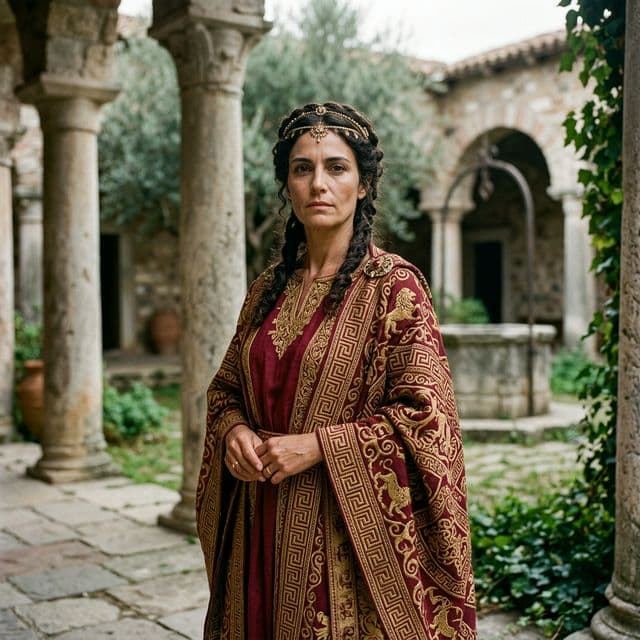
AI-assisted portrait of Thessalonice of Macedon
The Architecture of Continuity
Thessalonice of Macedon did not just live in an age of change; she became the bedrock of its stability. As the daughter of Philip II and the Thessalian princess Nicesipolis, her life was defined by a profound, internal sense of duty and the preservation of her family’s legacy (Si-Fe). While her half-brother Alexander chased infinite horizons, Thessalonice’s genius was profoundly oriented toward the tangible reality of the Macedonian homeland and the nurture of its future. She was the anchor of the Argead house, the one who valued the known, the relational, and the traditional over the chaotic visions of the successors.
She was the master of the long endurance and the relational truth. From the trauma of her family’s destruction to her influential role as the wife of Cassander, Thessalonice’s cognitive mode was focused on the internal comparison of her reality to the established standards of royal duty. For Thessalonice, power was a sacred trust to be held for the sake of the people and the continuity of the state.
Historical Context
Thessalonice of Macedon was a princess of the Argead dynasty, named to commemorate Philip II's victory in Thessaly on the day she was born. After the death of her father and brother, and the execution of her mother Olympias, she was married to Cassander, who founded the city of Thessaloniki in her honor. She spent her life as a symbol of Argead legitimacy, providing a bridge between the old world of Philip and the new Hellenistic kingdom of Macedon. Her influence was so great that she reportedly governed as a powerful mediator between her sons after Cassander's death. She was eventually murdered by her own son, Antipater II, a move that so shocked the Macedonian people that it paved the way for the end of the Antipatrid dynasty.
The Psychological Verdict
Thessalonice of Macedon is a definitive ISFJ. She was a leader defined by her deep, internal loyalty to tradition and personal history (Si), supported by a pragmatic, relational approach to her external environment (Fe) and an unwavering, if quiet, sense of internal logic (Ti).
Si — Dominant
Her primary mode was the preservation of the past as a guide for the present. Thessalonice’s identity was rooted in the memory of the Argead court at its height. Her decisions were characterized by a focus on the reliable, the repeatable, and the traditional. She functioned as the living embodiment of the Macedonian spirit during the dark years of the Diadochi, maintaining the standards and protocols of the old dynasty within her new marriage. She was the guardian of the memory of what it meant to be Argead.
Fe — Auxiliary
Supporting her sense of tradition was a deep, relational engagement with her world. Thessalonice was a master of diplomacy through connection and nurture. Her role in the court of Cassander was not just as a queen-consort, but as a bridge between the new regime and the Macedonian people. She sought harmony and stability, using her status to mitigate the worst impulses of her husband and her sons. She lead through the soft power of consensus and shared identity.
Ti — Tertiary
Beneath her relational presence lay a tertiary ability to analyze the structures of power. Thessalonice understood the legality and the "rules" of the game perfectly, using her influence to safeguard her sons' future and her own position. This function allowed her to be not just a symbol, but a survivor who could exert a quiet, effective logic over the external environment when the social harmony of her world was threatened.
Ne — Inferior
What stayed in the background was the pursuit of an unpredictable, abstract future. Thessalonice flourished in the known geography of traditional monarchy. Her inferior Ne manifested in a relative discomfort with the rapid, often chaotic changes of the Hellenistic age. She sought to anchor the world in the past (Si) rather than explore the possibilities of the new, leading to a life that was profoundly tied to the maintenance of the fire rather than the pursuit of the wind.
The City That Kept Her Name
Thessalonice was the daughter of Philip II and therefore the half-sister of Alexander and Cynane. After Alexander’s death she married Cassander, the man who eventually had Olympias killed — which put her in the strange position of being protected by her mother’s murderer. She bore him three sons, who spent the years after Cassander’s death in 297 BCE fighting each other for the throne. Her eldest son Antipater had her killed in 295 BCE when she favored his brother. She was perhaps 50 years old. The city Cassander had built and named after her — Thessaloniki — survived and grew into one of the most enduring cities of the ancient and medieval world. She is still there, in a sense: on every street sign, in every headline, in the name of the city where nearly a million people live today. Not many figures of the Diadochi era left a mark that durable.
Connected Figures
Further Reading
- Women and Monarchy in Macedonia — Elizabeth Donnelly CarneyTreats Thessalonice's role mediating between Cassander's warring sons and her murder by her own son Antipater.
- Dividing the Spoils: The War for Alexander the Great's Empire — Robin WaterfieldPlaces her marriage to Cassander and the founding of Thessaloniki within the wars that followed Alexander's death.
- The Legacy of Alexander: Politics, Warfare, and Propaganda under the Successors — A. B. BosworthExplains why an Argead princess like Thessalonice remained politically indispensable long after Alexander's line had ended.
