 Historical Figure MBTI
#714 · 5-28-26 · The Aztec Empire
Tlacaelel
Architect · Kingmaker · The Power Behind Five Thrones
c. 1398 — 1487
8 min read
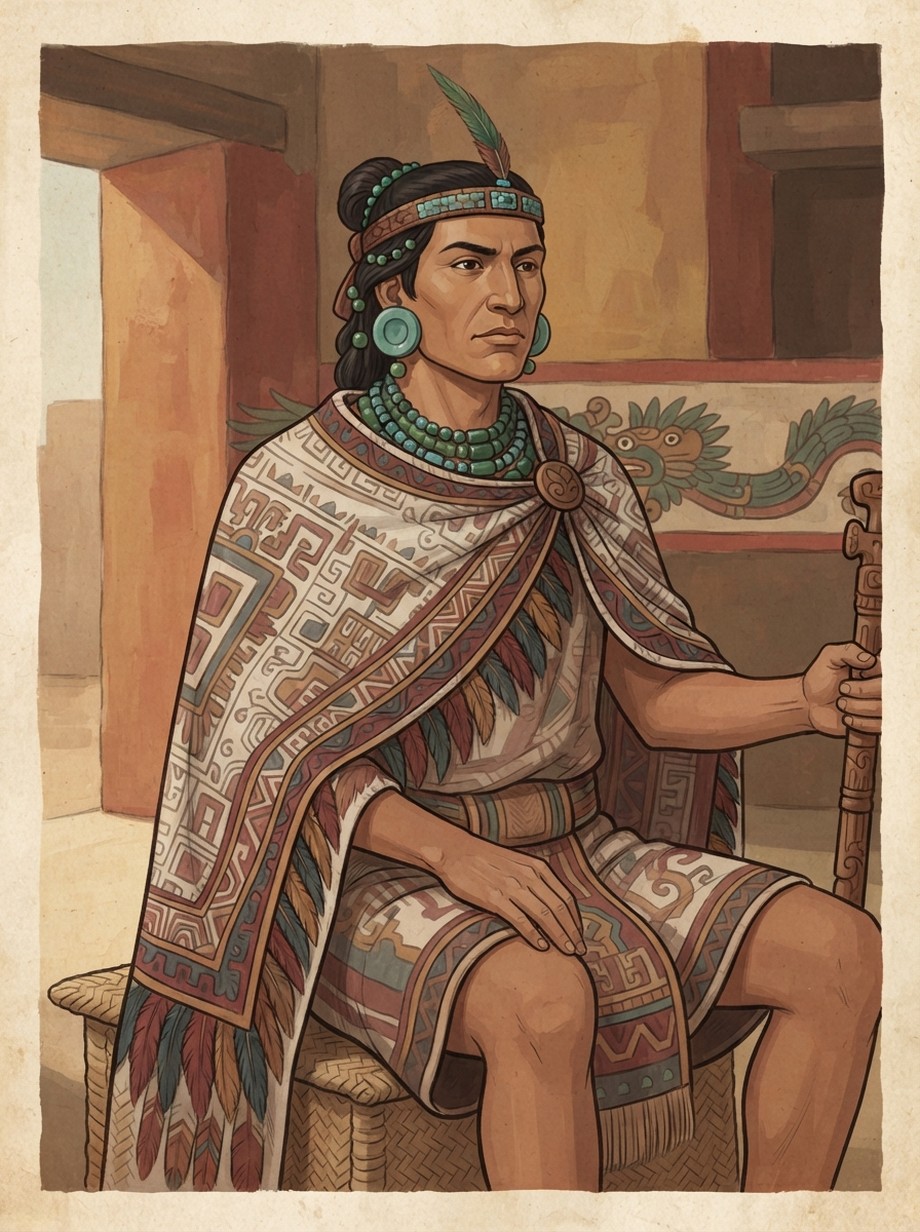
AI-assisted Portrait of Tlacaelel
The Man Who Refused the Throne Four Times
Four times, by the account of the Dominican chronicler Diego Durán, the lords of Tenochtitlan came to Tlacaelel and offered him the turquoise diadem — and four times he declined it. He had, he is said to have answered, already been king in every way that mattered; what more would the title add? Read as modesty, or as a chronicler's flourish, the refusal is the single most revealing act of his life — because a man who declines the crown four times and keeps the power anyway has grasped something almost nobody in the fifteenth century had: the office is a costume, and the machinery underneath it is the actual thing.
He held the office of cihuacoatl — "Snake Woman," a priestly and judicial title borrowed from the earth goddess — for roughly sixty years, from the Tepanec war of 1428 until his death around 1487, serving four tlatoque: his uncle Itzcoatl, his kinsman Moctezuma I, then Axayacatl, then Tizoc. Rulers came and went, one of them notoriously feeble, and the empire kept expanding on the same trajectory throughout, because the trajectory was not theirs. He found the Mexica a tributary client of a stronger city and left them the hegemon of Mesoamerica. In between, he rewrote their gods, burned their history, and invented a form of permanent war.
Plenty of viziers held power without the title. What makes Tlacaelel the archive's cleanest case is that he built the legitimating apparatus that made the title worth having — and then handed it to other men, knowing that whoever sat on the mat would be sitting inside a structure he had designed.
Tlacaelel is the archive’s purest INTJ: a dominant Ni that saw the Mexica empire whole — religion, war, tribute, and origin myth as one interlocking system — decades before any part of it existed.
Burning the Books to Build the Future
In 1428, immediately after the Mexica broke Azcapotzalco, Itzcoatl ordered the old painted histories gathered and burned. Durán records the reasoning as Tlacaelel's: it was not fitting that the common people should hold the ancient books, because what was written in them was false. This is not vandalism. It is Ni doing what Ni does — refusing the given account of reality in favor of a truer one glimpsed internally, then clearing the given account away so the real one can be installed. The books said the Mexica were latecomers, a mercenary tribe of marsh-dwellers chased out of better places onto an island nobody wanted. Tlacaelel replaced that with a chosen people marching under a sun god toward an appointed destiny.
The same instinct promoted Huitzilopochtli. He had been one tribal patron in a crowded pantheon; Tlacaelel raised him to co-equal with Tezcatlipoca and Tlaloc and made him the sun itself, locked in a nightly war for survival that only human blood could sustain. That one theological move made conquest a cosmic obligation rather than an appetite, gave the state a non-negotiable demand for captives, and turned every subject city's tribute into a contribution to the continuation of the world. Religion, foreign policy, and fiscal policy welded into a single mechanism.
Ni sees a system as a finished shape long before its parts exist, then works backward. Tlacaelel wrote a myth in 1430 whose payoff was a tribute empire in 1480, under rulers not yet born. He was not solving the problem in front of him; he was solving the problem the Mexica would have in sixty years — how to keep expanding without the expansion running out of reasons.
The Flower War as an Institution
The xochiyaoyotl — the flower war — is Tlacaelel's masterpiece of administrative engineering, and the clearest evidence that his vision came equipped with working parts. Ranged against Tlaxcala, Huexotzinco, and Cholula, these were scheduled, mutually agreed engagements fought not to take territory but to take prisoners. Historians since Ross Hassig have argued over how much of the arrangement was consensual and how much was Mexica attrition dressed as ceremony. The design logic is not in dispute: a renewable supply of sacrificial captives, a live-fire training ground where young nobles earned rank, and a controlled outlet for military ambition that spared the trade routes the empire lived on.
That is Te at its purest — identify the output the system requires, then build the cheapest reliable process that produces it indefinitely. Annihilating Tlaxcala would have solved a border problem once and destroyed a permanent resource; leaving it standing and bleeding it on a schedule solved several problems forever.
The rest of the record matches. He is credited with codifying Mexica law, restructuring the nobility so status flowed through military achievement rather than birth alone, reorganizing the tribute rolls that fed Tenochtitlan, and helping engineer the Triple Alliance with Texcoco and Tlacopan that turned one city's victory into a durable regional order. He drove the expansion of the Templo Mayor — the physical stage on which his theology was performed. Vision without plumbing is prophecy; Tlacaelel always built the plumbing.
A Private Conviction, Never Spoken Aloud
The refusals of the throne are where Fi shows. Tertiary Fi in an INTJ is not warmth and not sentiment; it is a closely held, unargued conviction about what is right that surfaces mainly as a line the person will not cross. Tlacaelel's line was the diadem. He would command armies, appoint and instruct rulers, rewrite the gods, and sign the tribute rolls — but he would not be tlatoani, and he never explained the refusal in terms anyone could bargain with. He simply declined, repeatedly, over decades, in a political culture where nobody would have blinked had he accepted.
It looks like prudence — an uncrowned architect outlives factional risk and cannot be blamed for a failed campaign. But sixty years of consistency is more than tactics. It reads as a settled position about the man and the design: the design was the point, the man was its instrument, and the title would have collapsed the distinction he cared most about. He was loyal to the Mexica idea, not to any Mexica ruler — and the four tlatoque he served were interchangeable to him in a way that would have been unspeakable to say aloud.
The Spectacle He Designed and Did Not Need
Tlacaelel fought — as a young war captain in the Tepanec campaign he was remembered as formidable, and the office he later transformed was won on that record. But afterward he moved the action offstage. The Templo Mayor dedications, the mass sacrifices, the processions of captives: overwhelming sensory events, every one engineered for its effect on other people. Inferior Se in an INTJ works exactly this way — the physical world handled as an instrument of design rather than inhabited for its own sake.
It is also where the system's blindness lived. A machine built to convert the present into a supply of captives assumes the neighbors will keep playing. Tlaxcala played for sixty years and then, when Spaniards arrived in 1519, defected to them with the accumulated grievance of three generations of ceremonial bleeding. The flower wars were flawless as a process and catastrophic as a foreign policy, and the failure is precisely the one Ni-over-Se is prone to: an immaculate long-range design that never quite credits the concrete, present-tense hatred of the people inside it.
Why INTJ Over ENTJ
Why not ENTJ?
An ENTJ takes the crown. Dominant Te wants the command position because command is how Te executes, and the ENTJ commander — Nobunaga, Cesare Borgia, Roxelana — reliably converts influence into formal authority at the first opportunity. Tlacaelel had four opportunities and refused all of them, which is not an ENTJ move in any circumstance where the throne is genuinely on offer. His Te is formidable but subordinate: it builds machinery to serve a vision he arrived at first, rather than treating the vision as whatever the machinery currently needs. The tell is the ordering — the myth and the theology came before the tribute rolls, not after.
From a distance his outputs look ENTJ: armies, law codes, tax structures, a reorganized aristocracy. But an ENTJ would have run the empire and hired a priest to explain it. Tlacaelel wrote the explanation himself, burned the competing version, and declined to run the empire — because in his reading the explanation was the empire, and the rulers were downstream of it. The internal model outranking the visible position is the whole of the difference between the two types.
Connected Figures
Further Reading
- The History of the Indies of New Spain — Fray Diego DuránThe primary chronicle behind nearly everything attributed to Tlacaelel, including the refusals of the throne and the burning of the books.
- The Aztec Kings: The Construction of Rulership in Mexica History — Susan D. GillespieArgues that Tlacaelel is partly a structural figure in Mexica historiography — essential for reading Durán skeptically.
- Aztec Warfare: Imperial Expansion and Political Control — Ross HassigThe standard analysis of the flower wars as strategy rather than ritual, and of what they actually cost the empire.
- Aztec Thought and Culture — Miguel León-PortillaReconstructs the Nahua intellectual world Tlacaelel rewrote, from indigenous-language sources.
- The Aztecs — Michael E. SmithThe best single-volume archaeological and social overview; a useful corrective to the chronicle tradition.
