 Historical Figure MBTI
#454 · 4-12-26 · Capetian France
Alphonse of Poitiers
Count of Poitiers and Toulouse · The Administrator Brother
1220 — 1271
7 min read
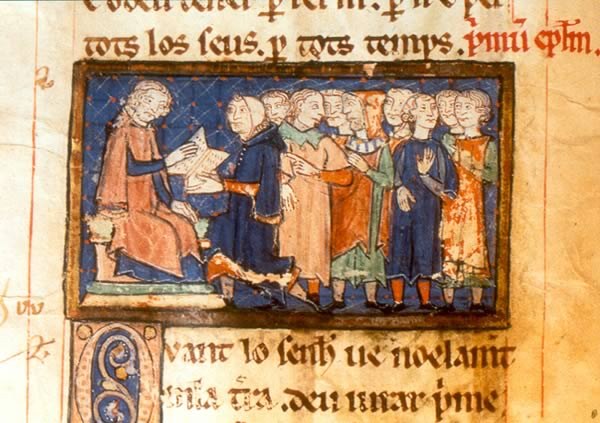
AI-assisted Portrait of Alphonse of Poitiers
The Brother Who Governed by Paperwork
History remembers Louis IX as a saint and Charles of Anjou as a conqueror. The middle brother, Alphonse, it remembers—if at all—as an administrator. He held the county of Poitiers from his father's will, and through his marriage to Joan of Toulouse he came to rule the vast southern county that the Albigensian wars had finally folded toward the crown. Across Poitou, the Auvergne, and Toulouse he governed an appanage nearly the size of a kingdom, and he did it almost entirely from a distance, through letters, ledgers, and audits.
Born in 1220, he made his lands a model of orderly rule in an age that prized the charismatic warrior-lord. Where his brothers led armies and accepted crowns, Alphonse kept records. He commissioned regular investigations into how his officials behaved, demanded written accounts of revenue and justice, and corresponded ceaselessly with the men who ran his territories in his absence. He joined both of Louis's crusades out of duty rather than appetite, and on the return from the second, in 1271, he and Joan died within days of each other, childless. Because no heir survived them, the whole of their immense inheritance—Toulouse above all—passed to the French crown: one of the single greatest territorial gains the monarchy ever made.
Alphonse was the ISTJ in administrative form—dominant Si paired with Te, governing not by presence but by precedent, audit, and the patient accumulation of written record. His power was order itself, and his greatest bequest to France was made, fittingly, by dying on schedule.
The Keeper of Records
Si — dominant
Dominant Si governs through what has been documented, verified, and stored. Alphonse did not rule his appanage by riding through it and impressing its barons; he ruled it by knowing it on paper. His chancery produced an unusually dense archive for the thirteenth century—letters of instruction, registers of revenue, surveys of his rights—and he expected those documents to be kept, consulted, and answered. When a question arose about a tax, a fief, or a privilege, the precedent was retrievable. For an Si dominant, the written record is not bureaucratic clutter; it is the very ground of legitimate decision.
The most revealing instrument of his rule was the enquête—the formal inquiry into the conduct of his agents. Modeled on the investigations Louis used to reform royal government, Alphonse sent commissioners through his lands to hear complaints against his own bailiffs and seneschals and to set right what they found. This is Si as conscience: a methodical checking of the present against established norms, a distrust of unverified report, a conviction that order is maintained only by regular, repeated audit. He trusted process precisely because he did not trust memory or rumor.
What made the style his own was its consistency across an enormous, scattered territory he could not personally see. Poitou lay hundreds of miles from Toulouse; the Auvergne sat between them. Alphonse held the whole together not through perpetual travel but through correspondence so steady that distance became manageable. The routine itself was the achievement—dull, reliable, and almost impossible for a less patient temperament to sustain.
The Architecture of Administration
Te — auxiliary
If Si supplied the impulse to record, auxiliary Te supplied the machinery to act on it. Te organizes the external world into working systems—chains of command, schedules of payment, procedures of justice—and Alphonse built exactly that. He staffed his counties with professional officials, defined their duties, and held them to written account. His financial administration was efficient enough that his treasury could actually fund the crusades it was asked to fund; his courts dispensed a justice regular enough that subjects could predict it.
Te is also the function that measures success by results rather than sentiment, and Alphonse's results were considerable. He consolidated newly acquired Toulouse—a territory only a generation removed from heresy and rebellion—without provoking the revolt that mismanagement would have invited. He did it by extending his bureaucratic grid southward: the same registers, the same inquiries, the same insistence on documented right. He governed conquered land the way he governed inherited land, through administration rather than terror.
The Private Conscience of Duty
Fi — tertiary
Tertiary Fi in an ISTJ rarely shows itself as warmth. It surfaces instead as a quiet, internalized sense of obligation—a personal code that the dutiful administrator obeys without advertising. Alphonse's code was loyalty: to his brother, to the crown, to the Church. He took the cross twice not from the crusading ardor that animated some of his peers but because Louis had asked it and faith required it. The same conviction shaped his governance, where the enquêtes were as much a moral housekeeping—a wish to rule justly and answer for it—as an exercise in control.
That inwardness is why he reads as a steward rather than a sovereign. Charles of Anjou wanted a throne and seized one in Sicily; Alphonse wanted his ledgers to balance and his conscience clear. His values ran deep but stayed private, expressed through faithful administration rather than declaration. The man simply did what he believed he owed, and expected the record to bear it out.
The Roads Not Taken
Ne — inferior
Inferior Ne is the ISTJ's least developed instrument: the capacity to leap toward untried possibilities, to improvise, to gamble on the unproven. Alphonse showed little of it, and his career was the stronger for the absence. He did not speculate on conquests or stake his lands on bold reinvention. He took what came to him—Poitiers by inheritance, Toulouse by marriage—and administered it superbly, but he was not an originator of grand designs. The contrast with his brothers is the contrast between imagination and stewardship.
Where inferior Ne can sting an ISTJ is in the one variable no ledger controls: the future. Alphonse's entire life was an exercise in securing and ordering his inheritance, yet he and Joan produced no child to receive it. The most carefully governed appanage in France had no successor. For a temperament built on continuity and precedent, it is a quietly poignant gap—though, by the accident of inheritance law, it became the crown's windfall rather than his failure.
Why ISTJ Over ESTJ
Why not ESTJ?
The ESTJ shares Alphonse's Te-driven competence but leads with it outwardly, commanding from the front: a visible, directive presence who organizes people in the room. Alphonse worked the opposite way. His power was paperwork—records, audits, and correspondence run patiently from a distance—and he held a territory the size of a kingdom without ever needing to dominate a hall. That reserved, precedent-first mode, where documented order does the governing rather than personal force, is Si-dominant ISTJ, not Te-dominant ESTJ. Set him beside his brother Charles of Anjou, a genuine commanding presence, and the difference is plain.
The deciding question is what came first for him—the system or the spotlight. An ESTJ organizes the world by stepping into it and taking charge; Alphonse organized his by retreating into the archive and trusting the record. His instinct was always to consult precedent before acting, to verify before deciding, to govern through the steady accumulation of documented routine rather than the energy of his own presence. That is dominant Si supported by Te: reliability as a way of life, the administrator who ruled best precisely because he never needed to be seen ruling.
Connected Figures
Further Reading
- Saint Louis — Jacques Le GoffThe definitive life of Alphonse's brother and king; indispensable for the family, the court, and the administrative reforms Alphonse mirrored in his own lands.
- Capetian France 987–1328 — Elizabeth Hallam & Judith EverardThe standard English survey of the dynasty — clear on how appanages like Poitiers and Toulouse were granted, governed, and reabsorbed by the crown.
- Louis IX and the Challenge of the Crusade — William Chester JordanA close study of the Seventh Crusade and its government; essential context for the campaigns Alphonse helped finance and joined.
