 Historical Figure MBTI
#437 · 4-10-26 · The Ilkhanate
Arghun
Ilkhan of Persia · Who Sought a Christian Alliance
c. 1258 — 1291
9 min read
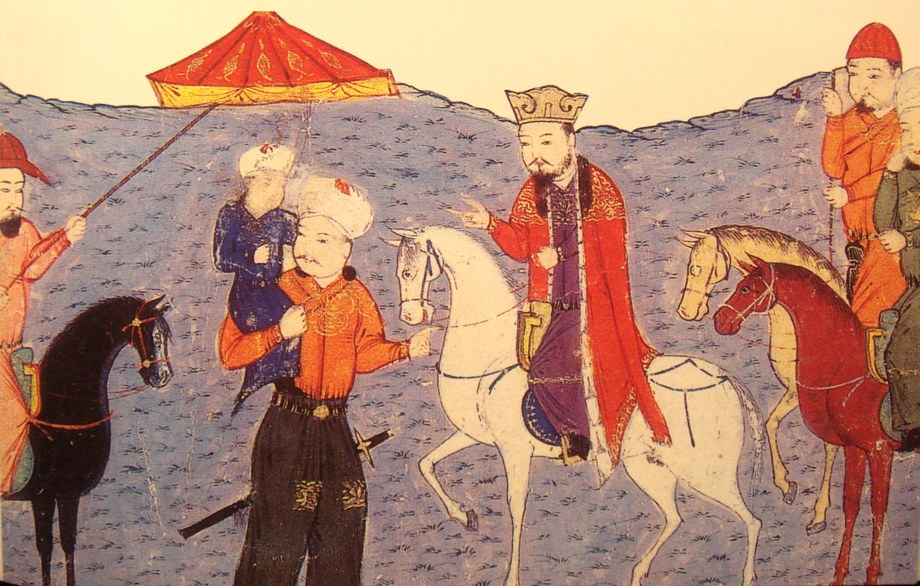
AI-assisted Portrait of Arghun
The Khan Who Looked West
Most of the Mongol khans who ruled Persia after the conquests fought their wars close to home—against cousins in Central Asia, against the Mamluk armies that held the Syrian frontier, against the perpetual revolts of a realm too large to hold. Arghun, the fourth Ilkhan, did something stranger. He looked at a map of the known world and concluded that the way to crush Cairo was to reach across the entire breadth of Christendom—to forge an alliance with the Pope in Rome and the kings of France and England, march two armies at once from opposite ends of the earth, and take Jerusalem in a coordinated stroke. It was one of the most audacious geopolitical designs the thirteenth century produced, and it was his.
He came to the throne in 1284, the son of Abaqa and grandson of Hulagu, the conqueror who had founded the Ilkhanate by burning Baghdad. Arghun seized power by overthrowing his uncle Tekuder, who had converted to Islam and reoriented the dynasty toward peace with its Muslim neighbors; Arghun reversed that course, restored the regime's Buddhist-and-Christian-friendly, frankly anti-Muslim posture, and set about the project that would consume his reign. From his court he dispatched embassies to Europe—the most famous carried by the Nestorian monk Rabban Bar Sauma in 1287—bearing letters that proposed a joint crusade against the Mamluks of Egypt. The plan was strategically sound and diplomatically immaculate. It failed anyway, because Europe was a continent of squabbling principalities incapable of acting as one, and because the last crusader stronghold at Acre fell in 1291, the same year Arghun died.
Arghun was the ENTJ as grand strategist—commanding Te that seized a throne and governed an empire, harnessed to a Ni vision that spanned continents. His design was sound; the world simply could not be marshaled to execute it.
The Commander Who Took What He Was Owed
Te — dominant
Dominant Te is the instinct to impose order on the external world—to organize men, resources, and territory toward a defined objective and to brook no inefficiency in getting there. Arghun's rise was Te in its rawest form. When his uncle Tekuder took the throne and steered the Ilkhanate toward Islam and accommodation, Arghun did not petition or wait. He raised a faction, gathered military backing, and overthrew him, claiming the succession he believed was his by descent from Abaqa. Power, to Te, is not something one is granted; it is a position one secures and then administers.
As Ilkhan he governed like a man running a machine. He restored the dynasty's pre-Tekuder orientation, staffed his administration with capable officials regardless of creed—promoting the Jewish physician Sa'd al-Dawla to run the empire's finances on the strength of competence alone—and kept the military pressure on the Mamluk frontier that defined Ilkhanid strategy for a generation. But the clearest expression of his Te was the alliance project itself, because it was not merely a vision but an operation. He did not simply wish for European help; he built the apparatus to obtain it—commissioning embassies, drafting formal proposals with specific military commitments, coordinating timetables for a two-front campaign, and following up across years when the first overtures stalled. That is Te applied to diplomacy: treat half a continent as a logistics problem and start solving it.
What makes the Te specifically Arghun's, rather than generic Mongol ferocity, is its administrative patience. Hulagu conquered by overwhelming force; Arghun, ruling a realm already won, governed and negotiated. He understood that the Mamluks could not be broken by the Ilkhanate alone, did the strategic arithmetic, and reached for the one lever—a second front from the west—that might have changed the equation. The conclusion was correct. The execution depended on partners he could not command.
The Continental Design
Ni — auxiliary
If Te supplied the will to act, auxiliary Ni supplied the singular vision that act was bent toward. Ni converges—it discards alternatives and fixes on one penetrating read of how the future must unfold, then subordinates everything to it. Arghun's fixed point was the destruction of Mamluk Egypt, and the insight that made him unusual was seeing that the means lay not on his own borders but a world away, in the Latin West. Where a purely tactical mind saw a Syrian frontier to be raided, Arghun saw a global chessboard on which Cairo could be checkmated by pieces moved from Paris, London, and Rome.
The embassies were the vision made tangible. Sending Rabban Bar Sauma—a Nestorian Christian monk who could speak to European courts in the language of shared faith—was an inspired stroke of Ni pattern-reading: Arghun grasped that the lever with the kings of France and England and with the Pope was not gold or fear but the dream of recovering Jerusalem, and he aimed precisely at it. His letters proposed not a vague friendship but a concrete strategic convergence—his armies and theirs closing on the Holy Land from opposite directions at an appointed time. It was a single, coherent picture of the future held with total conviction over many years.
The tragedy of Ni is that conviction is not the same as control. Arghun's reading of what should happen was lucid; his reading of whether Edward I's England, Philip IV's France, and a fractious papacy could ever be made to move in concert was the blind spot. The vision required a unified Christendom that did not exist. When Acre fell in 1291 and the crusading premise collapsed, the design dissolved—not because it was wrong, but because it had outrun the age that was asked to deliver it.
The Soldier's Body and the Hunter's Appetite
Se — tertiary
Tertiary Se gives the ENTJ a real physicality—a capacity for decisive action in the moment and an appetite for the concrete and the sensory that runs underneath the strategic mind. Arghun was, before he was a diplomat, a Mongol prince raised to the saddle and the field. He won his throne by force of arms, led campaigns on the Mamluk frontier, and lived the steppe aristocracy's life of the hunt and the war camp. The same Se that made him a capable commander in the field made him a man who trusted what he could see, seize, and consume.
But tertiary Se is also where the ENTJ's discipline can slip into indulgence, and in Arghun that appetite took a fatal turn. He grew obsessed with alchemy and the prolongation of life—not as abstract philosophy but as a concrete pursuit of potions to be measured, mixed, and swallowed. He kept Indian ascetics at his court to brew elixirs of longevity, and he treated immortality the way he treated everything else: as an objective to be achieved by direct means. The grasping, sensory literalism of the project—drink the right substance and live forever—is Se in the service of a hunger the strategic mind could not regulate.
The Elixir That Killed Him
Fi — inferior
Inferior Fi is the ENTJ's least-developed terrain: the private inner world of personal meaning, mortality, and values felt rather than reasoned. In a mind organized around external command and strategic vision, this dimension tends to stay buried—until it erupts, often around the one thing Te cannot conquer and Ni cannot outmaneuver: death. Arghun's fixation on elixirs of immortality reads as inferior Fi breaking the surface. A man who had ordered armies and reached across continents could not order his own body to endure, and the confrontation with that limit drove him to the irrational.
The end was grimly fitting. The longevity potions his Indian ascetics prepared were compounds of mercury and sulfur—poisons. Arghun swallowed them in pursuit of eternal life and almost certainly poisoned himself; his health collapsed and he died in 1291, still a relatively young man. The dominant function had built an empire-spanning design; the inferior function, grasping clumsily at the unconquerable, killed the man who built it. It is the classic shape of an ENTJ undone—not in the arena where he was strong, but in the interior country he never learned to navigate.
He could marshal continents but not master his own mortality—and the inferior function's panic at that limit, dressed as a quest for immortality, is what finally killed him.
Why ENTJ Over ESTP
Why not ESTP?
The Mongol world produced no shortage of ESTPs—bold, opportunistic war-leaders who read a battlefield in real time and struck. Arghun fought and seized power like one, and his tertiary Se gave him that physical, in-the-moment edge. But the ESTP lives move to move; its genius is tactical improvisation, not the long convergent plan. Arghun's defining act was the opposite—a multi-year, continent-spanning grand design aimed at a single distant objective, pursued through patient embassies and coordinated timetables. That is Te–Ni strategy, not Se–Ti tactics.
The distinction is the difference between a brilliant raider and a grand strategist. An ESTP would have hammered the Mamluk frontier for advantage as openings appeared, winning where he could and adjusting on the fly. Arghun instead conceived of a war that could only be won years out, by forces he did not yet command, on a board the size of the known world—and bent his reign to assembling it. The vision outran the age, but it was a vision, sustained and singular. That sustained subordination of the present to a distant design is the ENTJ's signature, and it is why he reads as a strategist who happened to be capable in the field rather than a tactician who happened to dream big.
Connected Figures
Further Reading
- Voyager from Xanadu: Rabban Sauma and the First Journey from China to the West — Morris RossabiThe definitive account of the embassy Arghun launched — follows Bar Sauma across Asia and Europe and reconstructs the alliance plan in detail.
- The Mongols — David MorganThe standard one-volume history of the empire and its successor khanates; essential context for the Ilkhanate Arghun ruled.
- Mongols and Mamluks: The Mamluk-Ilkhanid War, 1260–1281 — Reuven Amitai-PreissThe authoritative study of the conflict that defined Ilkhanid strategy and that Arghun's western alliance was designed to win.
