 Historical Figure MBTI
#352 · 4-1-26 · The French Revolution
The Comte d'Artois
Brother of Louis XVI · The Dashing Reactionary · Future Charles X
1757 — 1836
4 min read
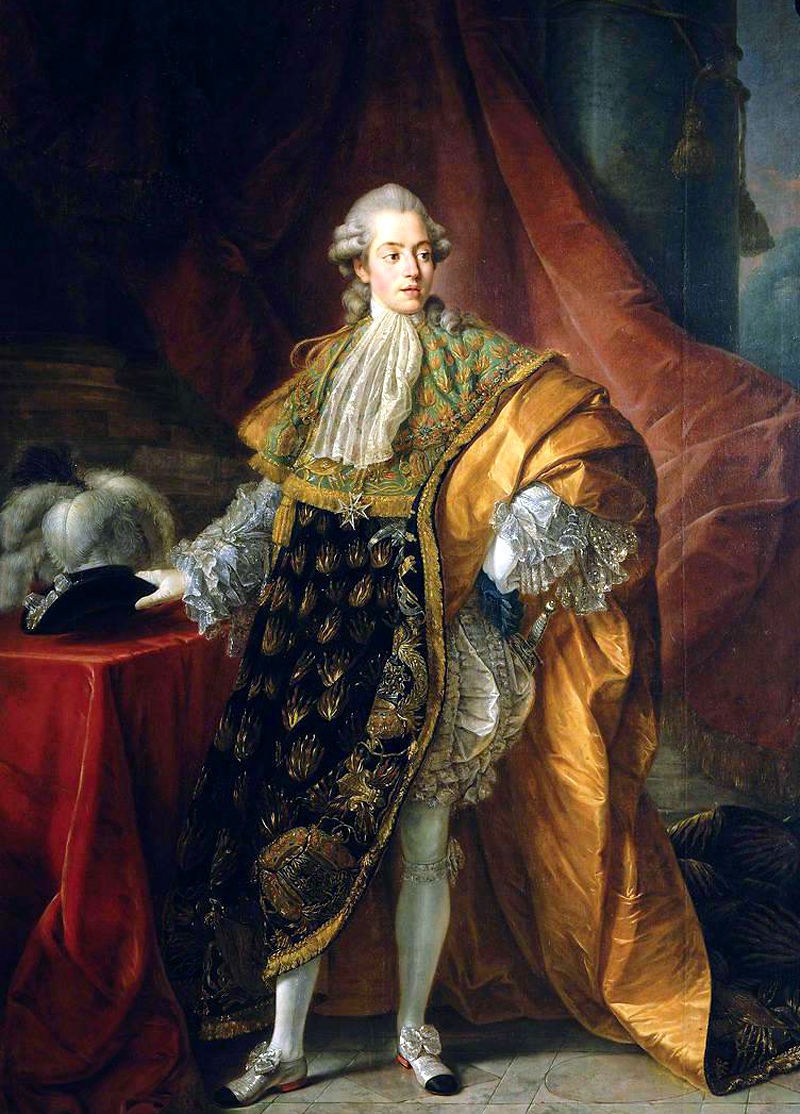
Portrait of The Comte d'Artois
The Prince of the Pleasure-Court
He was the handsome one. Charles Philippe, Comte d'Artois (1757–1836), youngest grandson of Louis XV, was the most dazzling of the three Bourbon brothers—a charming prince who treated Versailles as his personal amusement. When Marie Antoinette arrived, she found the one Bourbon who shared her appetite exactly. Their defining escapade says everything: wagering he could not raise a residence on the Bois de Boulogne before her next visit, Artois threw a fortune and nine hundred laborers at the problem and built the château of Bagatelle in sixty-four days. He won. The cost was ruinous; the point was nothing but the pleasure of winning.
Beneath the playboy lived something harder. Artois held the rights of throne and altar with absolute conviction and never bent in seventy-nine years. The first prince to flee France in July 1789, he spent three decades in exile scheming for a counter-revolution history refused to grant. Restored as King Charles X in 1824, he had learned nothing and forgotten nothing. His antique absolutism provoked the July Revolution of 1830. The dash, the charm, the unbending code, the absence of foresight—all of it is the ESFP.
The Comte d'Artois was the ESFP in a Bourbon skin—a dominant extraverted sensing that lived for the wager, the fete, and the dazzling surface, wedded to an auxiliary Fi whose private code of honour and loyalty never wavered and, in age, curdled into pure reaction.
The Appetite for the Dazzling Surface
Se — dominant
Dominant Se wants the world at its most vivid and goes restless the instant life turns grey. Every catalogue of Artois's youth reads as Se in full appetite: finest horseman among the princes, gambler of legendary recklessness, arbiter of fashion copied across the court. The hunt, the ball, the duel, the racecourse were not vices grafted onto a serious man— they were the whole program of a temperament that pursued sensation as a vocation. Bagatelle is the monument: a problem framed as a dare, solved at staggering expense for no purpose but delight. The future cost, the symbolism of a prince burning a fortune on a folly while France drowned in debt—none of that was sensory, and so none of it was quite real.
The Code That Hardened Into Reaction
Fi — auxiliary
Beneath the gambler ran auxiliary Fi—immovable conviction that answers to no argument but its own certainty. Artois's Fi attached itself to a single object: the sacred, hereditary throne and altar, held with a loyalty that had no interest in whether it was politically survivable. While Louis XVI tried to compromise his way through 1789, Artois led the ultras who would concede nothing—concession was sacrilege. A man whose code is strong and whose judgment is absent will defend the indefensible with perfect sincerity. That his feeling and the century had nothing to say to one another was a problem his Fi could not register.
The Schemer Who Could Not Govern
Te — tertiary
Tertiary Te can organize within the narrow theater the dominant function already cares about, and falls apart when the task demands sustained strategy. Artois could marshal a hunt, stage a fete, produce Bagatelle on time. The trouble was that he believed this extended to politics. From the émigré courts he raised armies that dissolved, courted foreign powers that dropped him—always busy, all tactics, no strategy. The kingship sealed the verdict: Charles X reached for the Four Ordinances of 1830—dissolving the Chamber, gutting the press, rewriting the franchise by royal fiat—convinced that firm authority would settle the matter as plaster had settled the Bagatelle wager. Within three days Paris was barricaded, and the throne was gone.
Learned Nothing, Forgotten Nothing
Ni — inferior
Inferior Ni is the missing organ for the trend beneath the surface. In 1789 a prince with intuitive grasp might have seen that his extravagance and alliance with the hated queen were making him a symbol the nation was preparing to destroy. He grasped none of it, fled first, and his flight became proof of everything his enemies believed. The phrase the age fixed to him—“learned nothing and forgotten nothing”—describes inferior Ni welded to Fi exactly: the forgetting-nothing is Fi, sacred loyalties no experience could revise; the learning-nothing is Ni, a temperament extracting from forty years of disaster no pattern, no trajectory. He died in exile in 1836, as innocent of foresight as the boy who had built a château in sixty-four days to win a bet.
Why ESFP Over ISFP
Why not ISFP?
The ISFP shares the same functional pair—Se hunger for beauty, Fi code that bends to nothing—which is why it is the natural runner-up. But the ISFP turns inward: it savors quietly and is most itself in privacy. Artois was the opposite. His pleasures were performed—the public wager, the racecourse before a watching court, Bagatelle as a piece of theater. The ISFP would have built the same object and never told a soul; Artois built it to win in front of everyone. He was the ESFP who needs the room, the wager, and the watching crowd.
Connected Figures
Further Reading
- Citizens: A Chronicle of the French Revolution — Simon SchamaThe richest single-volume account of the Revolution's human texture, including the court world Artois inhabited and abandoned.
- Marie Antoinette: The Journey — Antonia FraserCovers the Versailles years in depth, including Artois's role as the queen's companion in pleasure and scandal.
- The Bourbons of France — Vincent CroninTraces the dynasty through its final generation, giving Artois his proper place as the last Bourbon to lose the throne.
- Aristocrats: Caroline, Emily, Louisa and Sarah Lennox, 1740–1832 — Stella TillyardIlluminates the aristocratic émigré milieu and the world of royalist exile that defined Artois's decades out of France.
