 Historical Figure MBTI
#351 · 4-1-26 · The French Revolution
The Comte de Provence
Brother of Louis XVI · The Patient Pretender · Future Louis XVIII
1755 — 1824
5 min read
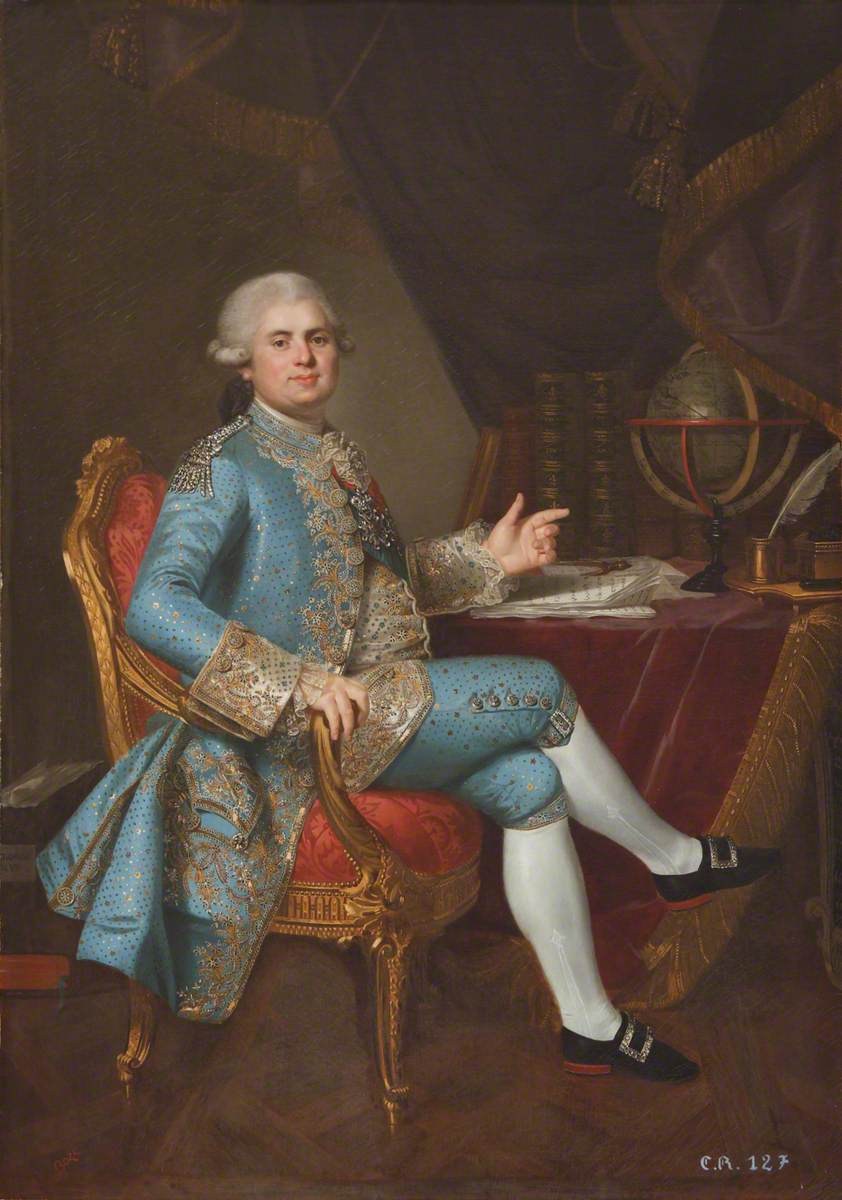
Portrait of The Comte de Provence
The Man Who Out-Waited the Revolution from His Armchair
He was the fat one. Among the three grandsons of Louis XV who would claim the French throne, Louis Stanislas Xavier—the Comte de Provence—was the cleverest, the wittiest, the best-read, and the least active. He quoted Horace from memory and grew, year by year, into a vast, near-immobile bulk, so corpulent and afflicted by gout that walking became an ordeal. While Louis XVI forged locks at Versailles and Comte d'Artois charged about on horseback, the middle prince sat—reading, calculating, resenting, watching everyone else exhaust themselves on the world's stage.
Then the Revolution came, and the indolent analyst found his vocation—not in action, but in patience. He emigrated in 1791, outlasted Robespierre, outlasted his brother the king guillotined in 1793 and his nephew the lost dauphin dead in 1795—at which point Provence declared himself Louis XVIII. He outlasted the Directory, the Consulate, and Napoleon entire. In 1814, restored to the throne at fifty-eight, too heavy to mount a horse, the fat, gouty prince inherited everything he had never lifted a finger to seize. He was a textbook INTP: the armchair analyst who governed nothing for decades and won the whole game by refusing to die first.
The Comte de Provence was the INTP in its most sedentary form—a dominant Ti of cold, ironic analysis married to an auxiliary Ne that read the field of political possibility from a stationary armchair, and out-waited a revolution it never once tried to fight.
The Cold, Calculating Intelligence
Ti — dominant
Dominant Ti builds a private model of how things work and measures everything against it coolly, sceptically. In the Comte de Provence it produced a particular intelligence: detached, ironic, faintly contemptuous. He saw through the court's pieties, his brother's self-deceptions, d'Artois's romantic heroics, and eventually the revolutionary rhetoric that swallowed them all. He intrigued against Marie Antoinette not from passion but from cold calculation—Ti weighing, always weighing, with a coolness that looked like cunning, because that is exactly what it was.
The supreme demonstration came in exile. Stripped of armies and territory, reduced to pure analysis, he understood with a clarity none of his partisans shared that the monarchy could not be restored by foreign bayonets and that the Revolution and Empire would exhaust themselves. While d'Artois and the ultras dreamed of crusading armies, he conserved and waited. He was proved right in 1814 not because he had fought, but because he had reasoned correctly and outlived his errors.
The Wit and the Juggled Possibilities
Ne — auxiliary
Auxiliary Ne supplied the range: the quick, allusive wit for which he was famous, and a gift for juggling contingencies. Through the exile years he kept a dozen scenarios alive—restoration by negotiation, by allied victory, by regime collapse, a regency, a charter, a compromise with men he had once denounced. He did not commit to one; that was d'Artois's error. When the moment came he returned not as a vengeful Bourbon but with a Charter, a pragmatic accommodation with the France Napoleon had actually made. He was the most flexible reactionary in Europe—the only Bourbon who had genuinely thought it through.
The Bookish Caution and the Love of Comfort
Si — tertiary
Tertiary Si: he ate enormously, grew vast, surrounded himself with well-upholstered ease, and the gout that crippled him was the body's rebuke to a lifetime of indulgence. The same temperament in politics produced not the fiery absolutism of the ultras but careful traditionalism—a man who reached for precedent the way a scholar reaches for a citation. His Charter of 1814 was a profoundly Si document. The pathos is in the exile years: a man who craved settled routines spent twenty-three years dragging his aching bulk from Coblenz to Verona to Mitau to Hartwell. The comfort-loving prince had iron underneath the upholstery.
The Coldness and the Stored-Up Resentments
Fe — inferior
Inferior Fe was conspicuously impoverished. Warmth did not come naturally; his marriage to Marie Joséphine of Savoy was loveless and barren, his long attachment to Madame de Balbi read more as habit than passion. He was not a man people loved, and he did not greatly mind. Where inferior Fe surfaced at all, it curdled into resentment—a carefully nursed grudge against the accident of birth that put a duller brother on the throne above him.
And yet inferior Fe is not nothing. The Louis XVIII who returned in 1814 made a calculated effort at reconciliation—a pose of fatherly moderation, graciousness toward former enemies, the mask of the conciliatory monarch France needed. Not felt warmth but a performed and reasoned-out version of it. He grasped, coldly and correctly, that a restored monarchy could not afford to be vengeful—and a coldly correct grasp of feeling is exactly what inferior Fe, at its best, can manage.
Why INTP Over ENTP
Why not ENTP?
The ENTP shares the same Ti–Ne machinery, and a casual reading of his wit might suggest one—but the ENTP leads with Ne, and the ENTP performs. It is active, engagement-seeking, energized by an audience and a sparring partner. Provence did the precise opposite: his cleverness was inward, detached, indolent; he conserved his energy rather than spending it; and he conducted his victorious campaign for the throne from a literal armchair, by waiting, not by performing. His Ne served a dominant Ti that preferred to sit still and let the world come to it.
An ENTP wins by engagement—out-arguing in real time, the way Talleyrand reinvented himself through every regime by always being in the room. Provence won by the opposite method: by being in no room, attaching himself to no losing cause, and simply out-lasting Robespierre, Napoleon, his brother, and his nephew. The ENTP could never have endured twenty-three years of doing nothing and calling it a campaign. Provence could, because for the armchair INTP, patient calculation is the action.
Connected Figures
Further Reading
- Louis XVIII — Philip ManselThe definitive English-language biography — traces the full arc from the Versailles backrooms through twenty-three years of exile to the restored throne.
- The Court of France 1789–1830 — Philip ManselA vivid portrait of the Bourbon court in its final decades, covering the exile years and the Restoration court Provence assembled.
- France Under the Bourbons, 1814–1830 — Guillaume de Bertier de SauvignyThe standard scholarly account of the Restoration period Louis XVIII presided over — essential for understanding his pragmatic constitutionalism.
- The French Revolution: A History — Thomas CarlyleThe great Victorian narrative of the Revolutionary years — captures the sweep of the catastrophe that the Comte de Provence out-waited from his armchair.
