 Historical Figure MBTI
#1184 · 8-29-26 · The Three Kingdoms
Guo Huai
Guardian of Wei's Western Frontier · The General Who Held Off Jiang Wei · Unsung Architect of Wei's Defense
? — 255
3 min read
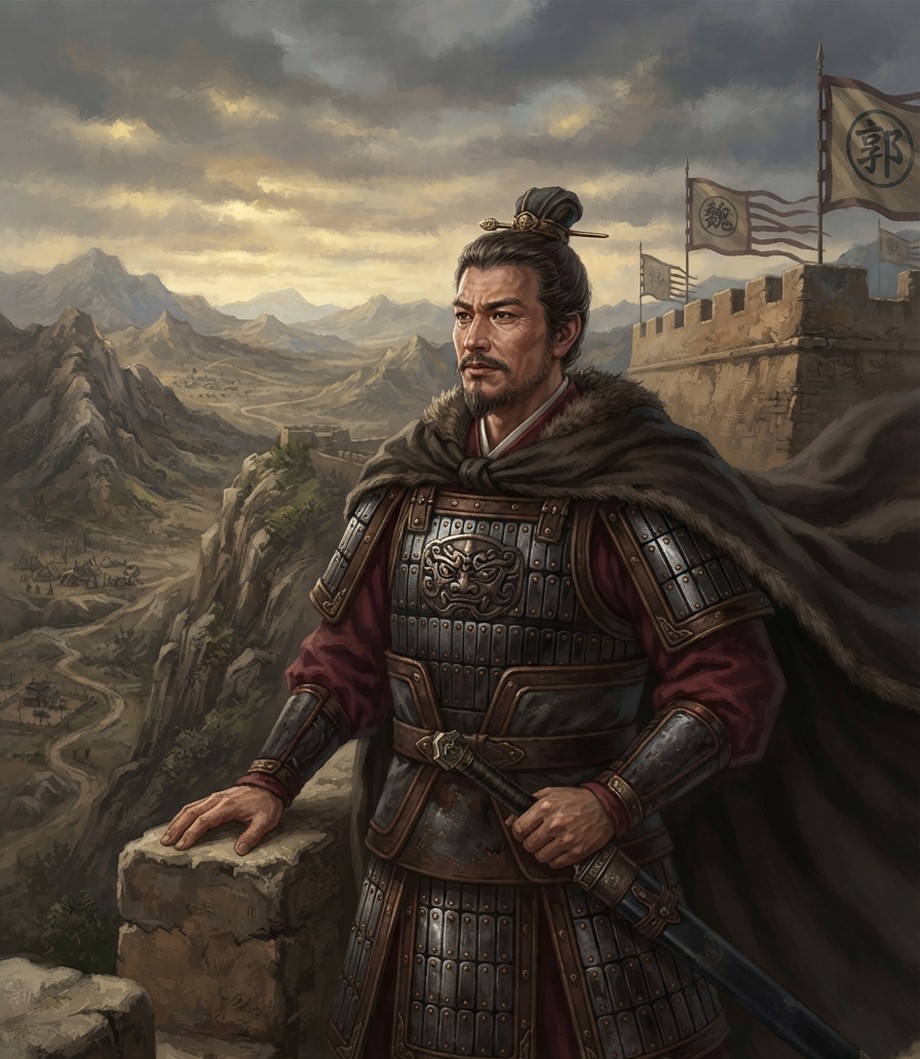
AI-assisted Portrait of Guo Huai
The General Nobody Wrote an Opera About
Guo Huai spent more than two decades holding a border that never made him famous, and that is the whole of his character in a single fact. While Wei's court churned through regents and rebellions, and while Shu Han sent army after army north through the mountains, Guo Huai stayed on the western frontier — first as a subordinate watching Cao Cao's generation die off, then as the man Sima Yi trusted to hold Yong and Liang provinces on his own judgment. He fought Zhuge Liang's Northern Expeditions to a standstill without ever landing the kind of blow histories remember, and when Jiang Wei inherited Shu's ambitions, Guo Huai checked him too — repeatedly, unspectacularly, for years.
What he did instead of winning famous battles was manage a frontier: reading terrain, garrisoning passes before an enemy could use them, and handling the Qiang and other non-Han peoples along the border with a mix of firm authority and genuine diplomacy that kept them from becoming a second front. None of it produces a single legendary anecdote. All of it, compounded over twenty-some years, produces a border that held.
An ISTJ does not need the battle to be remembered. He needs the line to hold — and Guo Huai's line held for a generation.
Psychological Verdict
Guo Huai's career is a case study in Introverted Sensing paired with Extraverted Thinking — the ISTJ engine running at full, joyless efficiency. He accumulated an intimate, granular memory of the western terrain and its peoples, and he treated that accumulated knowledge as the actual asset worth protecting, more valuable than any single victory. Where a more flamboyant commander might have gambled the frontier on a decisive strike to make his name, Guo Huai consistently chose the move that preserved the position rather than the move that made the story — a preference that reads, at a remove of over a thousand years, as almost stubbornly unglamorous.
That same steadiness shows in how he handled the Qiang: not through Fi-flavored personal charisma or Ne-driven improvisation, but through consistent, dependable dealing that let border relationships outlast any single crisis. He was not the general who inspired songs. He was the general other generals, and an entire province, could plan around for twenty years without surprise — which is precisely the quiet, load-bearing competence the ISTJ temperament is built to supply.
Connected Figures
Further Reading
- Records of the Three Kingdoms (Sanguozhi) — Chen ShouGuo Huai's official biography, Book of Wei
- A Biographical Dictionary of Later Han, Three Kingdoms and Jin — Rafe de CrespignyProsopographical entry situating Guo Huai's career within Wei's frontier command
- The Cambridge History of China, Vol. 1: The Ch'in and Han Empires — Denis Twitchett & Michael Loewe (eds.)Background on Han frontier administration and the Qiang peoples
