 Historical Figure MBTI
#367 · 4-2-26 · The French Revolution
Jacques-Pierre Brissot
Leader of the Girondins · The Journalist Who Wanted War · Guillotined with His Faction
1754 — 1793
8 min read
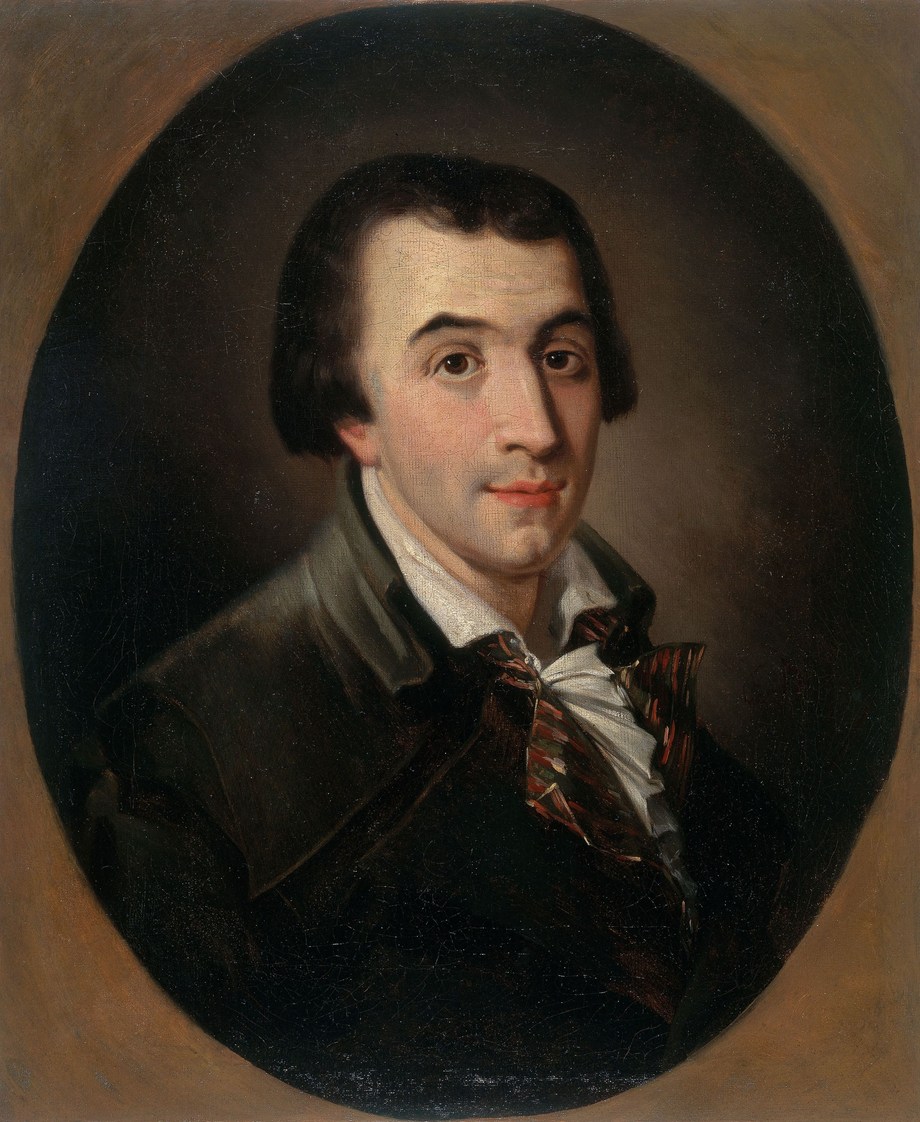
Portrait of Jacques-Pierre Brissot
The Man Who Talked a Continent Into War
He gave his name to a whole party. The faction that dreamed of a Revolution of reason and bourgeois liberty was called the Girondins by later historians, but to the men who hunted them down in 1793 they were simply the Brissotins—followers of a restless, idealistic journalist who had talked them into a war and could not talk them out of the catastrophe that followed. Brissot was born in 1754, the thirteenth child of a cook at Chartres, and he climbed out of that origin the only way a clever commoner could: with a pen. Before the Bastille fell he had crossed the Atlantic, founded the Société des amis des Noirs—the first French abolitionist society—and been imprisoned for his writings. When the Revolution arrived he poured all of this into Le Patriote français and the tribune of the Assembly, where he became the most audible voice of the moderate republic. In the winter of 1791 he used it all to push France toward war against the kings of Europe. It unleashed twenty-three years of bloodshed and the Terror at home—a Terror that swallowed him first.
The psychological signature is unmistakable. Brissot was an ENFP—dominant extraverted intuition firing off causes faster than any could be secured; auxiliary introverted feeling supplying a sincere humanitarian idealism; tertiary extraverted thinking in the tireless party-building and networking; and a fatally weak inferior introverted sensing that never reckoned with the empty arsenals, the disorganized armies, and the disciplined ruthlessness of his enemies. He could imagine the liberation of Europe. He could not count the muskets.
Brissot was the ENFP turned loose on a revolution—a Ne that generated causes faster than a continent could absorb them, wedded to an Fi idealism so sincere it mistook the goodness of the dream for the safety of the gamble, and undone in the end by everything it never bothered to count.
More Causes Than a Lifetime Could Hold
Ne — dominant
Dominant extraverted intuition is a generator, not a finisher. Brissot's whole career reads as a single uninterrupted discharge of this faculty: aspiring philosopher, criminal-law writer, hack pamphleteer, transatlantic traveler, abolitionist organizer, English-style journalist—a man who could not pass an open door without imagining a project on the other side of it. The Revolution merely supplied it with an inexhaustible supply of doors.
The Société des amis des Noirs is Ne at its best. In 1788, when the slave trade was the unexamined foundation of French Atlantic wealth, Brissot simply saw that it could be otherwise and threw himself into arguing against it years ahead of any public appetite for the cause. That is Ne's gift: the courage to act on a future nobody else can yet see. But Ne's gift is also its curse. War, to Brissot in 1792, was the grandest possibility of all—the idea that contained every other idea. He spoke of it with the rapture of a man describing a vision, not the caution of a man counting costs. That is how a dominant-Ne idealist talks an entire continent into war: not by calculation but by the contagious certainty that the future he can see so vividly must be the future that will arrive.
The Sincere Heart Beneath the Noise
Fi — auxiliary
What kept Brissot from being a mere opportunist was the auxiliary introverted feeling that anchored his proliferating causes to a genuine moral core. In an ENFP, Fi gives the dominant Ne its direction: the possibilities it chases bend, consistently, toward what the person cares about most deeply. With Brissot that was liberty, humanity, and the dignity of the powerless—and he cared about these with a sincerity even his enemies rarely denied.
The abolitionism is the proof. There was no career in it, no constituency demanding it; the slave-trading interests of Nantes and Bordeaux were among the most vengeful in France, and to attack them was to make powerful enemies for the sake of people who could do nothing for him in return. He did it anyway, because his Fi could not look at the trade and call it anything but a crime. Yet Fi has its blind side: the conviction that those who opposed him must be opposing the good itself. A war undertaken for liberty must surely serve liberty; a cause that felt noble could not be a blunder. Brissot went to the scaffold still believing he had been right. He very nearly was, about everything except the one decision that killed him.
Building a Party Out of Enthusiasm
Te — tertiary
Tertiary extraverted thinking gave Brissot just enough organizing capacity to be dangerous. In the tertiary position Te does not amount to cold executive competence; it amounts to bursts of organizing energy in service of Ne's enthusiasms—the ability to turn a vision into a network, a cause into a committee, a feeling into a newspaper. Brissot had this in abundance. He founded societies and journals, knitted together the deputies of the Gironde into something that functioned like a coherent faction, and gave it its voice through Le Patriote français. That a party could be named after him testifies to the reach of this tertiary Te.
But tertiary Te organizes for the cause; it does not interrogate it. Brissot could build the machine that carried his war policy through the Assembly—overwhelming even the dissenting Robespierre, who warned that a war begun in weakness would devour the Revolution. What he could not do was the deeper Te work of asking whether the machine was pointed at a wall. He mistook the ability to mobilize for the ability to govern. The Montagnards who destroyed him were Te running a country: ruthless, concrete, attentive to supply and discipline. Against that, Brissot's party of orators was a debating club. Tertiary Te can start a revolution's war. It cannot run a revolution's state.
The Muskets He Never Counted
Si — inferior
If one wanted a single function to explain why the Revolution killed Brissot, it would be his inferior introverted sensing. Si is the patient attention to how things actually are—the sober inventory of present means. In the inferior position it is precisely what the ENFP cannot trust. Brissot, all Ne and dream, was chronically inattentive to the hard material reality on which his visions depended: the empty arsenals, the officer corps gutted by emigration, the half-trained armies that France would actually send across its frontiers in 1792. The early campaigns were a rout.
This failure extended to political logistics. While Brissot composed luminous arguments for liberty, the Montagnards counted votes in the sections, organized the Commune, cultivated the sansculotte street. He saw none of it coming because attending to that grubby granular detail was exactly the work his mind fled. On the second of June 1793 the Montagnards purged the Girondins; Brissot, fleeing in disguise, was arrested and brought back to Paris. He and twenty-one fellow Girondins were guillotined together on the thirty-first of October—the condemned, by the account that has come down to us, singing the Marseillaise on the carts, the song dying voice by voice as the blade did its work. Madame Roland followed a week later. Inferior Si exacts its price from those who will not see the world as it is.
Why ENFP Over INFP
Why not INFP?
The temptation is real: the sincere idealism, the humanitarian conscience, the moral purity that made him a poor match for brutal politics—these all look like dominant Fi. But the INFP holds its values intensely and reluctantly enters the arena. Brissot did the opposite at every turn: outward, restless, ceaselessly public—founding societies, editing a newspaper, building a faction, dominating the tribune, pushing a continent toward war on the momentum of his enthusiasms. That is dominant Ne with Fi in support, not the reverse.
An INFP leads with conviction and reaches for possibility second; its native motion is to retreat inward and act only when values demand it. Brissot's native motion was to rush outward into the next possibility—the war, the abolitionist society, the liberation of Europe, each seized before the last was secured. His idealism gave his life its direction, but it rode atop the Ne. He was an agitator who happened to be sincere, not a sincere man who happened to agitate.
Connected Figures
Further Reading
- The Girondins — M. J. SydenhamThe foundational scholarly study of Brissot's faction — their composition, ideology, and destruction.
- Citizens: A Chronicle of the French Revolution — Simon SchamaVivid narrative history of the Revolution that situates Brissot and the Girondins in the full sweep of events.
- The French Revolution: A History — Thomas CarlyleThe Victorian classic — Carlyle's dramatic account of the Girondin downfall remains one of the most powerful in the literature.
- Liberty or Death: The French Revolution — Peter McPheeA recent scholarly synthesis that gives full weight to the ideological stakes of the Girondin-Jacobin conflict.
