 Historical Figure MBTI
#368 · 4-2-26 · The French Revolution
Emmanuel-Joseph Sieyès
Theorist of the Revolution · What Is the Third Estate? · The Man Who Survived
1748 — 1836
4 min read
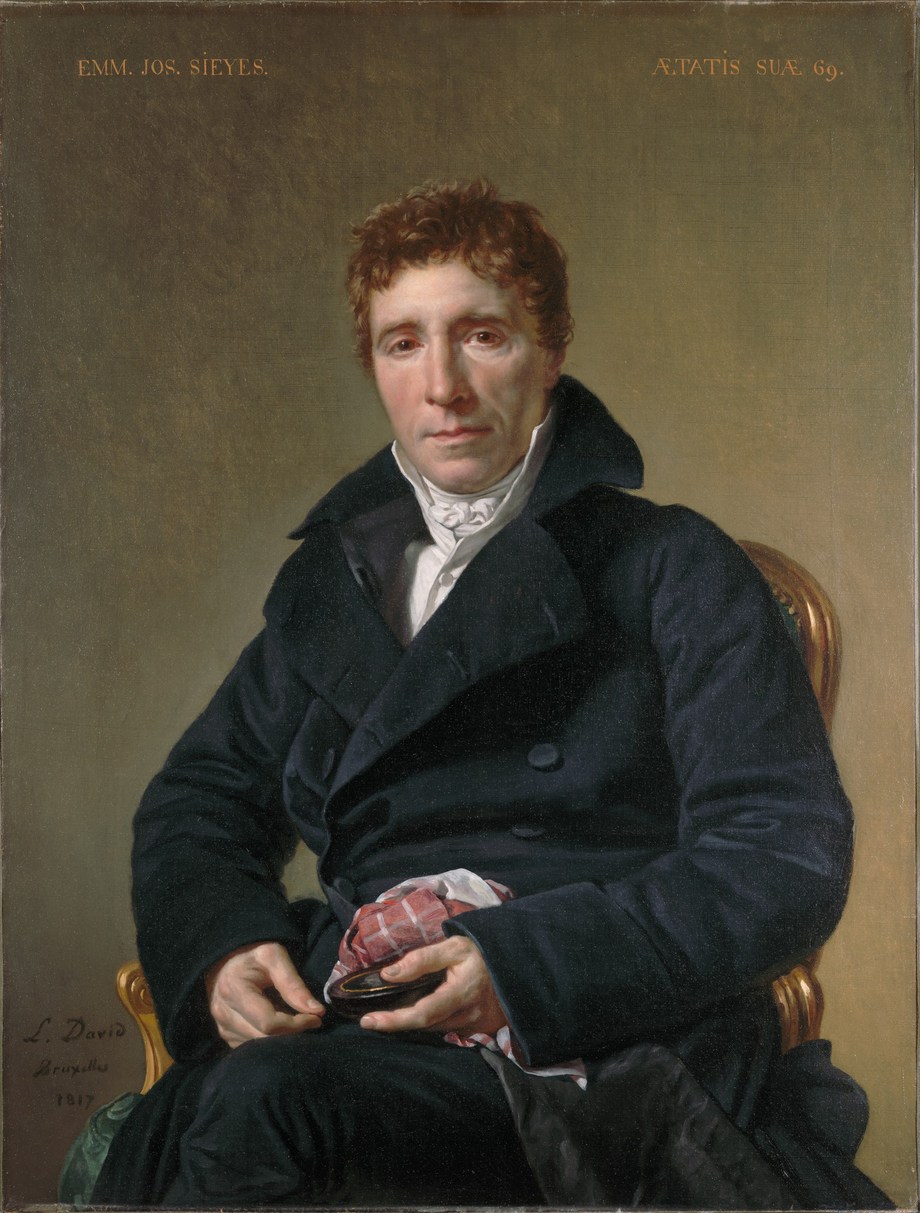
Portrait of Emmanuel-Joseph Sieyès
The Mind Behind the Revolution
Emmanuel-Joseph Sieyès — a clergyman with no discernible religious vocation — was the coldest intellect of the French Revolution. He believed sovereignty resides not in a king or God but in the abstract nation, and that a constitution is a machine to be designed on paper before being set loose on living men. In January 1789 he published Qu'est-ce que le Tiers État? and in three hammer-blows of question and answer gave the Revolution its purpose and battle cry. He sat in a room and thought, and the thought reorganized France.
What followed was the paradox of his career. Sieyès was present at every founding moment — he helped engineer the National Assembly, stood behind the Tennis Court Oath — yet was constitutionally incapable of wielding the power his ideas created. He voted for the death of Louis XVI, then withdrew into silence as the Terror consumed the men who had been louder. Asked what he had done during those years, he gave the most economical answer in political survival: J'ai vécu — “I stayed alive.”
What is the Third Estate? Everything. What has it been until now? Nothing. What does it ask to be? Something.
The Architect of Sovereignty
Ti — dominant
Dominant Ti is the drive to build a model of how something truly works — not how custom says it works, but how it must work from first principles. Sieyès asked not what the king had always been but what a nation is, stripped of inherited fiction. His answer was austere: the nation is the body of people who labor and produce; the privileged orders are a parasitic burden. From that premise the entire argument unfolds with the inevitability of a proof.
The pamphlet's opening is pure Ti. What is the Third Estate? Everything. What has it been until now? Nothing. What does it ask to be? Something. No appeal to passion — only a structure so tightly sprung that it does the emotional work without raising its voice. He coined terms political theory still uses — the distinction between pouvoir constituant and pouvoir constitué was his. He once observed that politics was a science he believed he had completed. No sentence captures dominant Ti more exactly.
The Endless Constitutions
Ne — auxiliary
If Ti gave Sieyès his foundations, auxiliary Ne gave him his fertility. He was a compulsive author of constitutions — schemes of representation, pyramids of indirect election, theories of the jury. His most characteristic invention, the jury constitutionnaire, anticipated the constitutional courts of the next century. The Brumaire constitution of 1799 was meant to be his masterwork, topped by a powerless figurehead he called the Grand Electeur. Napoleon took one look, asked whether Sieyès meant to make him a pig fattened on millions, and threw the contraption out, keeping only what handed real power to himself.
That episode reveals the gift and the limit of Ne in service to dominant Ti. Sieyès could generate possibilities endlessly, each internally elegant. But they lived on paper, and the strong extraverted judging function that might have forced them into contact with brute ambition was precisely what he lacked. His Ne built the labyrinth; men of will simply walked through the walls.
The Man Who Stayed Alive
Si — tertiary
Asked what he had done during the Terror, Sieyès answered J'ai vécu — “I stayed alive.” Dry wit, but also a precise portrait of tertiary Si: in a man whose Ti and Ne pulled toward bold abstraction, Si supplied an instinct to fall silent when the blade began to fall, lower his head, and endure. He sat in the Convention and said almost nothing — a man who voted with the prevailing wind and offered no target. Where Condorcet kept writing until the proscription caught him, Sieyès made himself invisible. He lived to be eighty-eight. A dead theorist drafts no more constitutions.
The Theorist Who Could Not Lead
Fe — inferior
Inferior Fe is the great deficit of the INTP. Fe reads a room, warms an audience, binds men to a leader through shared emotion. Sieyès had none of it. Contemporaries described him as cold, withdrawn, vain about his ideas yet incapable of the magnetism that turns ideas into movements. He could write the words that set a hall on fire but could not stand before the hall and deliver them. Mirabeau, Robespierre, Napoleon — all possessed exactly the outward force Sieyès lacked. He supplied the thought; they supplied the voice; the world remembered them and forgot him.
Why INTP Over ENTP
Why not ENTP?
Sieyès and the ENTP share Ti and Ne, but the ENTP leads with Ne: outward, performative, hungry for a live argument. Sieyès was the inverse — an inward system-builder who hated to speak, who handed his constitutions to other men and watched from the shadows. The ENTP performs the idea; the INTP perfects it in private and lets someone louder carry it. Sieyès never once chose the stage.
The decisive evidence is his arc. An ENTP would have argued in the open — the behavior that got the extraverted firebrands killed. Instead Sieyès wrote the founding pamphlet and stepped back; drafted the machinery of Brumaire and let Napoleon seize the controls; survived the Terror by saying nothing at all. That is a man for whom the system itself is the satisfaction — the inward INTP, never the outward ENTP.
Connected Figures
Further Reading
- What Is the Third Estate? — Emmanuel-Joseph Sieyès (trans. M. Blondel, ed. S. E. Finer)The foundational primary text — eighty pages that gave the Revolution its conceptual backbone.
- Sieyès: The Dividing Line of the Modern World — Paul BastidThe classic French biography tracing his constitutional thought across four decades of upheaval.
- Citizens: A Chronicle of the French Revolution — Simon SchamaVivid narrative history placing Sieyès in the broader drama of 1789 and its aftermath.
- The Idea of France — Pierre Nora (ed.)Essays on French national identity; the concept of the nation Sieyès forged is a recurring touchstone.
- Revolutionary France, 1788–1880 — Martyn LyonsA reliable survey of the period that contextualizes Sieyès's influence on constitutional design through Brumaire and beyond.
