 Historical Figure MBTI
#640 · 5-11-26 · The Julio-Claudians
Julia the Elder
Augustus's Daughter · Wit, Defiance, and Exile to a Rock
39 BCE — 14 CE
7 min read
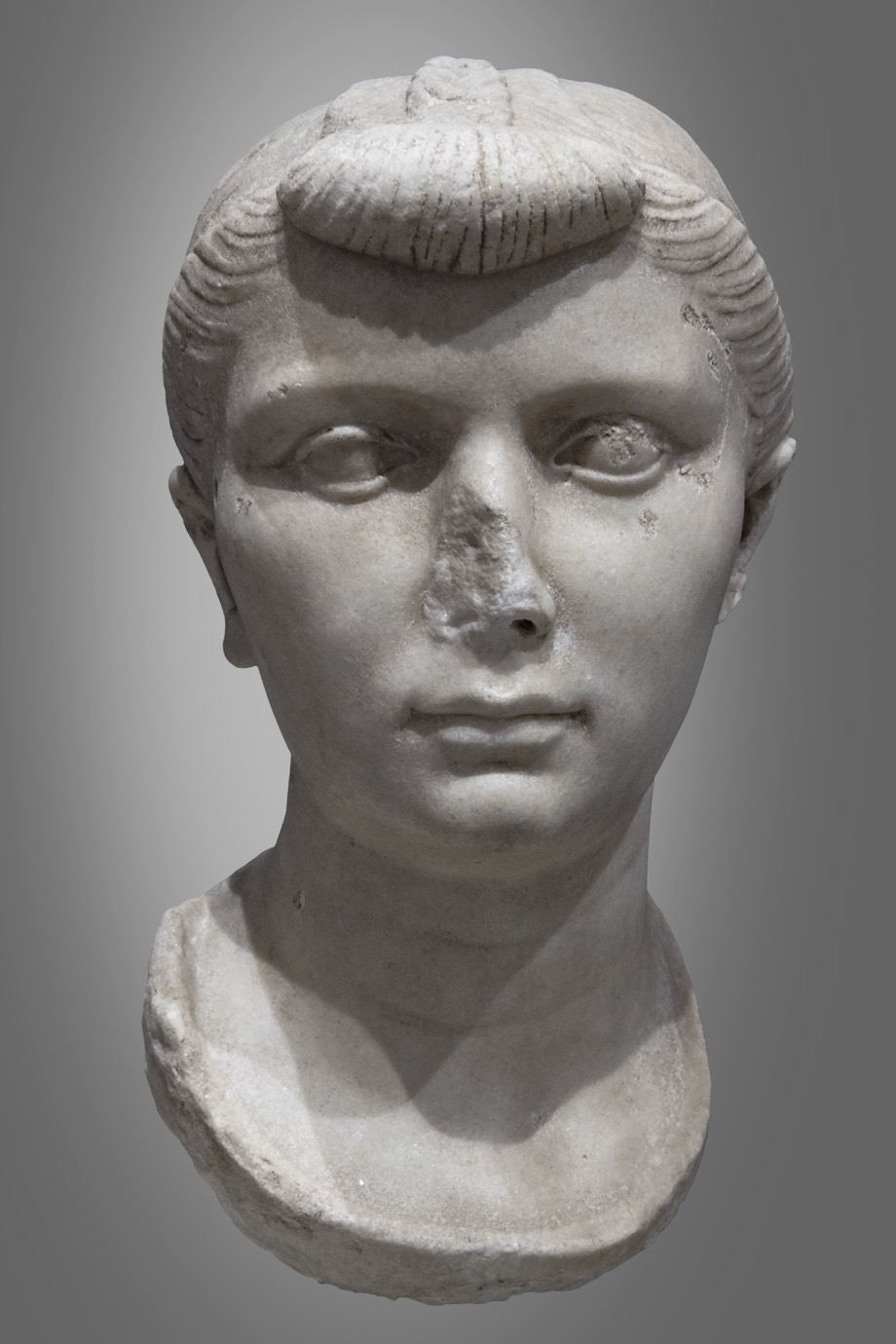
Portrait of Julia the Elder
A Ship Never Sailing Empty
Julia the Elder was born to be a dynastic instrument and spent her life refusing to act like one. Augustus's only biological child, the product of a marriage to Scribonia he dissolved on the day of her birth, she was handed from husband to husband as her father's foreign policy demanded — first to her cousin Marcellus, then, on his early death, to the loyal general Marcus Agrippa, twenty-five years her senior, and finally, after Agrippa died too, to Tiberius, who was forced to divorce the wife he loved, Vipsania Agrippina, to take her instead. Each match was a piece of state architecture. None of them asked what Julia wanted, and by every surviving account, Julia noticed.
What makes her one of the most vivid personalities to survive from the Julio-Claudian court is not the scandal itself but the tone of it. She did not scheme in the shadows or write bitter letters for posterity. She lived loudly, in the open, in the present tense — throwing herself into Rome's social world with a relish that ancient writers, hostile as most of them were, could not quite disguise as merely wicked. Asked, according to Macrobius, how it was that all her children resembled Augustus's line despite her many lovers, she reportedly replied that she "never took on a passenger unless the ship was already full" — a joke that is less a confession than a performance, delivered with the ship's captain's own dry timing.
That performance, and the appetite behind it, is the signature of an ESFP: a personality built for the immediate, the sensory, and the socially alive, governed underneath by a private code of self that no threat — not her father's laws, not her father himself — could talk her out of.
She never took on a passenger unless the ship was already full — the wit of a dominant-Se ESFP cornered and unbothered.
A Scandal Conducted in Daylight
What separated Julia from a merely unhappy political wife was the sheer visibility of her indiscretion. Married to a cold, humorless Tiberius who eventually withdrew to Rhodes rather than remain in her company, she did not retreat into private grievance. She conducted a string of affairs with prominent senators in Rome with what ancient sources describe as remarkably little effort at concealment — dinners, processions, a social calendar lived at full volume, seemingly for its own immediate pleasure rather than as a strategy toward any further end.
That is the marker of dominant Se: an orientation toward the vivid present, toward company and sensation as they are happening, without the deferred calculation an Ni-led schemer would apply. When the affairs finally surfaced as a full public scandal in 2 BCE — one Augustus, having personally written Rome's adultery laws, could not ignore — Julia's exposure reads less like the unraveling of a hidden plot than the inevitable conclusion of a life that had simply never bothered to hide.
Even her punishment could not touch the instinct. Exiled first to the barren island of Pandateria and forbidden wine and the company of men, she was, in effect, sentenced to the negation of everything Se craved — immediate pleasure, company, sensation — which is precisely why Augustus chose it.
The Wit That Would Not Apologize
Beneath the sensory appetite sat something harder: a private, unshakeable sense of who she was, which she refused to perform contrition against even under direct interrogation by her father. The "full ship" line, preserved by Macrobius, is the clearest surviving evidence of it — asked to answer for the paternity of her children, she did not deny, minimize, or beg. She turned the accusation into a joke at her own expense that was also, unmistakably, a joke at the emperor's.
That is auxiliary Fi doing its work: not a public code of behavior, but a private one, held with total conviction regardless of what it cost her. Julia never seems to have doubted her right to live as she pleased, and the ancient record — even filtered through moralizing Roman historians who plainly disapproved of her — cannot quite erase the note of amused self-possession in every anecdote about her that survives.
It is also, in the end, what doomed her. An Fe type manages appearances; Julia, by every account, did not manage anything. She simply continued being herself in public, at a volume her father's own legislation made impossible to ignore, and paid for it with the rest of her life.
Competent, When It Suited Her
Before the scandal broke, Julia was not merely a court ornament. Under her marriage to Agrippa she bore and helped raise five children — including Agrippina the Elder, who would go on to become a formidable political figure in her own right — while maintaining a visible, functioning public role at her husband's side during his long absences on state business. That competence, unglamorous and rarely credited to her by ancient sources fixated on her later conduct, suggests a practical, tertiary Te capable of managing real responsibility when the task in front of her demanded it.
But it never became the organizing center of her personality. Te here is a tool she could pick up, not a compass she followed — she ran a household and produced heirs, then set the role down the moment circumstance, and her own inclination, pointed elsewhere.
The Blind Spot She Never Corrected
What Julia never developed, and what her story is arguably a record of failing to develop, is any long-range sense of where her present pleasures were leading. An inferior Ni shows up not as an absence of intelligence but as a persistent inattention to trajectory — she conducted her affairs at a volume and in a social milieu that made discovery, and disaster, close to inevitable, and there is no sign she ever weighed that risk against the enjoyment of the moment.
It is telling that Augustus's fury, when it came, seems to have caught her without a contingency. She had no fallback, no version of herself prepared for exile. The rock at Pandateria was not a setback she absorbed and adapted around; it was the abrupt, total foreclosure of the only mode she had ever really lived in.
Why ESFP Over ENFP
Why not ENFP?
An ENFP reading would frame the affairs as a restless search for authentic connection or deeper meaning behind the marriages she never chose. The evidence doesn't support it. What survives of Julia is present-tense and sensory — company, wit, physical enjoyment, delivered and dropped without any apparent thread of idealism running underneath. There is no sign of an Ne-driven hunt for significance, only an Se-driven appetite for the moment as it comes, defended by an Fi that would not bend to anyone's disapproval.
The distinction matters because it changes what her exile means. An ENFP undone by a search for meaning would be a tragedy of thwarted idealism. An ESFP undone by an inferior Ni that never learned to see consequences coming is a simpler and, in its way, harsher story — a woman who lived entirely in the present because the present was where she was most alive, and who was never given the tools, or the room, to imagine what came after.
Connected Figures
Further Reading
- Saturnalia — MacrobiusPreserves the famous witty anecdotes about Julia, including the 'full ship' line.
- The Twelve Caesars (Life of Augustus) — SuetoniusThe primary account of Julia's exile and its stated causes.
- The Annals — TacitusLater references to Julia's fate and treatment under Tiberius's reign.
- Julia Augusti: The Emperor's Daughter — Elaine FanthamThe dedicated modern biography, reassessing Julia against the ancient sources' hostility.
